Kirjojen hintavertailu – 12 903 733 kirjaa ja 27 kauppaa

Kirjailija

Eli Faber

Kirjat ja teokset yhdessä paikassa: 4 kirjaa, julkaisuja vuosilta 1995–2021, suosituimpiin kuuluu The Child in the Electric Chair. Vertaile teosten hintoja ja tarkista saatavuus suomalaisista kirjakaupoista.

4 kirjaa

Kirjojen julkaisuvuodet: 1995–2021.

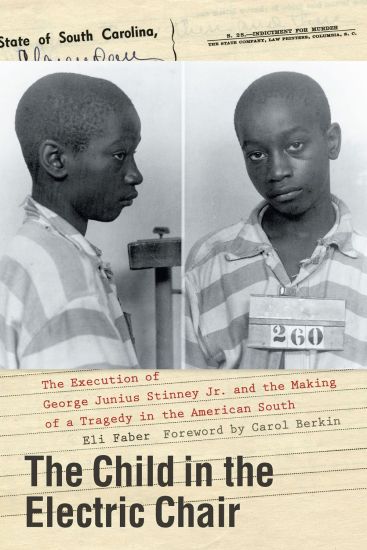
The Child in the Electric Chair

The Child in the Electric Chair

Eli Faber; Carol Berkin

University of South Carolina Press
2021
sidottu
At 7:30 a.m. on June 16, 1944, George Junius Stinney Jr. was escorted by four guards to the death chamber. Wearing socks but no shoes, the 14-year-old Black boy walked with his Bible tucked under his arm. The guards strapped his slight, five-foot-one-inch frame into the electric chair. His small size made it difficult to affix the electrode to his right leg and the face mask, which was clearly too large, fell to the floor when the executioner flipped the switch. That day, George Stinney became, and today remains, the youngest person executed in the United States during the twentieth century. How was it possible, even in Jim Crow South Carolina, for a child to be convicted, sentenced to death, and executed based on circumstantial evidence in a trial that lasted only a few hours? Through extensive archival research and interviews with Stinney's contemporaries-men and women alive today who still carry distinctive memories of the events that rocked the small town of Alcolu and the entire state-Eli Faber pieces together the chain of events that led to this tragic injustice. The first book to fully explore the events leading to Stinney's death, The Child in the Electric Chair offers a compelling narrative with a meticulously researched analysis of the world in which Stinney lived-the era of lynching, segregation, and racist assumptions about Black Americans. Faber explains how a systemically racist system, paired with the personal ambitions of powerful individuals, turned a blind eye to human decency and one of the basic tenets of the American legal system that individuals are innocent until proven guilty. As society continues to grapple with the legacies of racial injustice, the story of George Stinney remains one that can teach us lessons about our collective past and present. By ably placing the Stinney case into a larger context, Faber reveals how this case is not just a travesty of justice locked in the era of the Jim Crow South but rather one that continues to resonate in our own time. A foreword is provided by Carol Berkin, Presidential Professor of History Emerita at Baruch College at the City University of New York and author of several books including Civil War Wives: The Lives and Times of Angelina Grimke Weld, Varina Howell Davis, and Julia Dent Grant.
Jews, Slaves, and the Slave Trade

Jews, Slaves, and the Slave Trade

Eli Faber

New York University Press
2000
pokkari

Halvin toimitettuna 38,20 €

Lays to rest the controversial myth of Jewish involvement in the slave trade In the wake of the civil rights movement, a great divide opened up between African American and Jewish communities. What was historically a harmonious and supportive relationship suffered from a powerful and oft-repeated legend, that Jews controlled and masterminded the slave trade and owned slaves on a large scale, well in excess of their own proportion in the population. In this groundbreaking book, likely to stand as the definitive word on the subject, Eli Faber cuts through this cloud of mystification to recapture an important chapter in both Jewish and African diasporic history. Focusing on the British empire, Faber assesses the extent to which Jews participated in the institution of slavery through investment in slave trading companies, ownership of slave ships, commercial activity as merchants who sold slaves upon their arrival from Africa, and direct ownership of slaves. His unprecedented original research utilizes shipping and tax records, stock-transfer ledgers, censuses, slave registers, and synagogue records. These materials reveal, once and for all, the minimal nature of Jews' involvement in the subjugation of Africans in the Americas. A crucial corrective, Jews, Slaves, and the Slave Trade lays to rest one of the most contested historical controversies of our time.
Jews, Slaves, and the Slave Trade

Jews, Slaves, and the Slave Trade

Eli Faber

New York University Press
1998
sidottu
Lays to rest the controversial myth of Jewish involvement in the slave trade In the wake of the civil rights movement, a great divide opened up between African American and Jewish communities. What was historically a harmonious and supportive relationship suffered from a powerful and oft-repeated legend, that Jews controlled and masterminded the slave trade and owned slaves on a large scale, well in excess of their own proportion in the population. In this groundbreaking book, likely to stand as the definitive word on the subject, Eli Faber cuts through this cloud of mystification to recapture an important chapter in both Jewish and African diasporic history. Focusing on the British empire, Faber assesses the extent to which Jews participated in the institution of slavery through investment in slave trading companies, ownership of slave ships, commercial activity as merchants who sold slaves upon their arrival from Africa, and direct ownership of slaves. His unprecedented original research utilizes shipping and tax records, stock-transfer ledgers, censuses, slave registers, and synagogue records. These materials reveal, once and for all, the minimal nature of Jews' involvement in the subjugation of Africans in the Americas. A crucial corrective, Jews, Slaves, and the Slave Trade lays to rest one of the most contested historical controversies of our time.
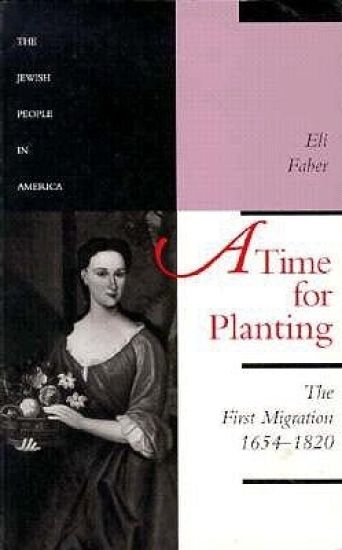
A Time for Planting

A Time for Planting

Eli Faber

Johns Hopkins University Press
1995
pokkari
Volume I: A Time for Planting: The First Migration, 1654-1820 In the autumn of 1654, twenty-three Jews aboard the bark Sainte Catherine landed at the town of New Amsterdam to establish the first permanent Jewish settlement in North America. In A Time for Planting, Eli Faber recounts these earliest days of Jewish life in America, as Jews from Lisbon to Amsterdam to London extended the wanderings of their centuries-old diaspora.