Kirjojen hintavertailu – 12 859 819 kirjaa ja 27 kauppaa
Kirjailija
Elizabeth B. Custer
Kirjat ja teokset yhdessä paikassa: 27 kirjaa, julkaisuja vuosilta 1887–2021, suosituimpiin kuuluu Tenting on the Plains. Vertaile teosten hintoja ja tarkista saatavuus suomalaisista kirjakaupoista.
This book has been considered by academicians and scholars of great significance and value to literature. This forms a part of the knowledge base for future generations. So that the book is never forgotten we have represented this book in a print format as the same form as it was originally first published. Hence any marks or annotations seen are left intentionally to preserve its true nature.
CHAPTER I PAGE Good-by to the Army of the Potomac. 3. CHAPTER II New Orleans After the War. 16. CHAPTER III A Military Execution. 26. CHAPTER IV Marches Through Pine Forests. 38. CHAPTER V Out of the Wilderness. 45. CHAPTER VI A Texas Norther. 55. CHAPTER VII Life in a Texas Town. 66. CHAPTER VIII Letters Home. 75. CHAPTER IX Disturbed Condition of Texas. 84. CHAPTER X General Custer Parts with his Staff at Cairo and Detroit. 94. CHAPTER XI Orders to Report at Fort Riley, Kansas. 105. CHAPTER XII Westward Ho -Fighting Dissipation in the Seventh Cavalry-General Custer's Temptations. 114. CHAPTER XIII A Medley of Officers and Men. 133. CHAPTER XIV The Course of True Love. 146. CHAPTER XV A Prairie Fire. 164. CHAPTER XVI Sacrifices and Self-Denial of Pioneer Duty-Captain Robbins and Colonel Cook attacked, and Fight for Three Hours. 174. CHAPTER XVII A Flood at Fort Hays. 191. CHAPTER XVIII Ordered Back to Fort Harker. 200. CHAPTER XIX The First Fight of the Seventh Cavalry. 208.
Since the Battle of Little Bighorn, George Armstrong Custer (1839-1876) has possessed one of the most unique places in American history. Although he was a capable cavalry officer who served honorably during the Civil War, he remains one of the most instantly identifiable and famous military men in American history due to the fact he was killed during one of the country's most well known and ignominious defeats, the Battle of Little Bighorn. And yet, this one relatively insignificant battle during America's Indian Wars has become one of the country's most mythologized events and continues to fascinate Americans nearly 140 years later. Though he's now best remembered for "Custer's Last Stand", George Armstrong Custer began June 25, 1876 as one of America's better regarded cavalry officers, and a man whose ambitions might one day take him to higher office. In fact, decades before radio and television existed, Custer mastered the art of public relations, dressing impeccably and having newspaper correspondents accompany him on campaign, all in an effort to help cultivate and enhance his legacy. Custer's efforts worked, with one biographer noting that Americans during the 19th century viewed him as "a cavalier without fear and beyond reproach." Much like famous Confederate cavalry leader JEB Stuart, Custer added substance to the style. Despite being in his early 20s when the Civil War started, Custer rose through the ranks so quickly that he famously commanded a brigade of Michigan cavalrymen at Gettysburg, fighting the vaunted JEB Stuart and his horsemen to a standstill on the climactic 3rd day of that battle. Custer's success continued through until the end of the war, with his men playing an integral role during the Appomattox Campaign that forced the surrender of Robert E. Lee's Army of Northern Virginia. Had Custer's career ended there, he would have been both successful and largely forgotten. Instead, the last 10 years of his life were full of political and military intrigue, as he attempted to position himself both in politics and the Army while making himself one of the best known fighters of the Indian Wars. Those actions, along with the Battle of Little Bighorn, made him controversial even in his day, but with his death coming to be widely viewed as a sacrifice for his country, his legend and legacy grew throughout the nation. No matter what critics or supporters thought of him, George Armstrong Custer was unquestionably relevant.
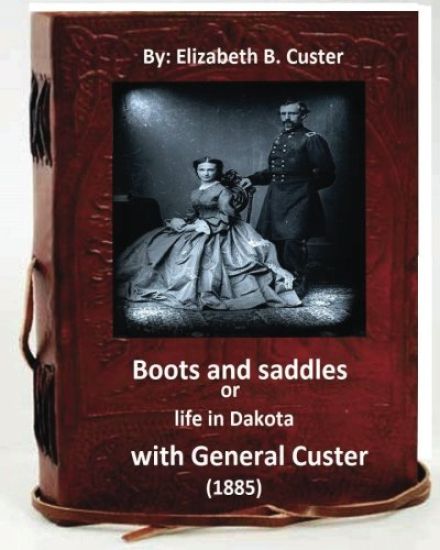
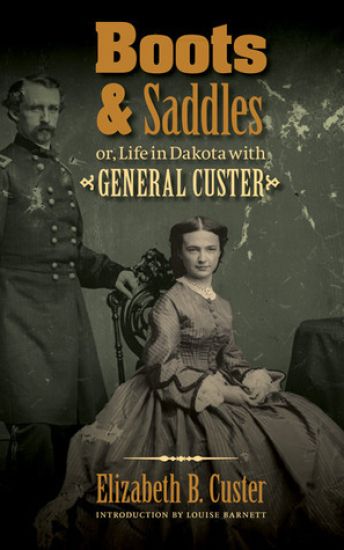
The honeymoon of Elizabeth Bacon and George Armstrong Custer was interrupted in 1864 by his call to duty with the Army of the Potomac. Her entreaties to be allowed to travel along set the pattern of her future life. From that time onward, she did indeed accompany General Custer on all his major assignments except the summer Indian campaigns, "the only woman," she said, "who always rode with the regiment." This is the story of Elizabeth B. Custer (1842–1933), told in her own words. She was not only a housewife on the Plains; she was whatever the occasion demanded: nurse to a group of frostbitten soldiers; any-hour-of-the-day hostess to the regiment, since her husband was not fond of entertaining; the garrison's favorite confidante (and many an interesting story she has to tell); and would-be Indian fighter whenever the women of the regiment had to be left alone. Boots and Saddles also offers a gentle, loving portrait of George Armstrong Custer, husband and man, by the person who knew him best. Elizabeth Custer's absolute devotion to him is revealed in every line of her story, which ends, appropriately enough, with the day on which she received the news of the disaster at Little Big Horn.