Kirjojen hintavertailu – 12 903 737 kirjaa ja 27 kauppaa

Kirjailija

Elizabeth Cooke

Kirjat ja teokset yhdessä paikassa: 48 kirjaa, julkaisuja vuosilta 2000–2025, suosituimpiin kuuluu Violet. Vertaile teosten hintoja ja tarkista saatavuus suomalaisista kirjakaupoista.

48 kirjaa

Kirjojen julkaisuvuodet: 2000–2025.

The Wild Dark Flowers

The Wild Dark Flowers

Elizabeth Cooke

Penguin Putnam Inc
2014
pokkari
"I found myself addicted to Rutherford Park, much as I was to Downton Abbey" (Margaret Wurtele on Rutherford Park). Now comes the new novel of Rutherford Park by the acclaimed Elizabeth Cooke... When May came that year in Rutherford, it was more beautiful than anyone could ever remember. More beautiful, and more terrible... From inside their sprawling estate of Rutherford Park, the Cavendish family had a privileged perspective of the world. On the first morning in May, 1915, with a splendid view that reached across the gardens to the Vale of York, nothing seemed lovelier or less threatening. And yet... At the risk of undoing the Cavendish name with scandal, William and Octavia Cavendish have been living a lie, maintaining a marriage out of duty rather than passion. But when their son Harry joins the Royal Flying Corps in France, the Cavendish family are forced to face the unavoidable truths about themselves, the society in which they thrive, and the secrets they can no longer bear. In the wake of a terrible war, the emotional shifts between a husband and a wife, a wife and her lover, and a mother and her children, will shake the very foundation of the Cavendish family, and change the uniquely vulnerable lives of all who reside at Rutherford Park.
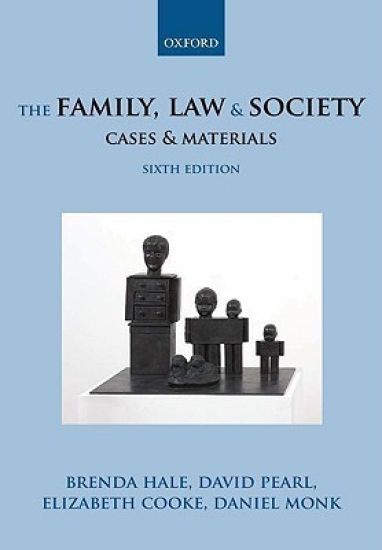
The Family, Law & Society: Cases & Materials

The Family, Law & Society: Cases & Materials

Brenda Hale; David Pearl; Elizabeth Cooke; Daniel Monk

Oxford University Press
2008
nidottu
The Family Law & Society; Cases & Materials is an invaluable resource for students. Produced by an esteemed author team it provides a wealth of carefully selected materials offering an overview of the social, economic, and political trends which have come to shape contemporary family life. The materials are linked by the authors through detailed commentary, opening up the complex legal issues for discussion and offering academic and judicial viewpoints. This new edition has been developed extensively to more effectively meet the needs of the undergraduate student, and as such the authors have created a casebook which combines the expertise of previous editions with a strong awareness of today's family law student.
Peirce's Pragmatic Theory of Inquiry

Peirce's Pragmatic Theory of Inquiry

Elizabeth Cooke

Continuum International Publishing Group Ltd.
2006
sidottu
The philosophy of Charles Sanders Peirce (1839-1914) is very important at every stage of the history of modern American thought. It informs William James's evolutionary metaphysics, John Dewey's theory of logic, W. V. O. Quine's naturalism, and Richard Rorty's notion of the Linguistic Turn. Similarly, many Continental philosophers, like Jurgen Habermas, Karl-Otto Apel, Jacques Derrida, and Umberto Eco, have developed Peirce's semiotic logic as central to their own philosophical views. Yet until now there has been a yawning gap in the literature on what is arguably the most essential idea in the entire Peircean corpus, namely his "fallibilism." The basic idea of fallibilism is that all knowledge claims, including those metaphysical, methodological, introspective, and even mathematical claims - all of these remain uncertain, provisional, merely fallible conjectures. As Elizabeth Cooke explains in Peirce's Pragmatic Theory of Inquiry, one long-standing concern with the idea of fallibilism is that it might all too easily slide into "skepticism." And this would certainly undermine the overall project of making Peirce's fallibilism the linchpin for any realistic pragmatism. So, it is essential to show Peirce's philosophy does not require any claims to certitude, in order to keep his fallibilism from falling into skepticism or contextualism. Cooke's solution to this problem is to interpret Peirce as having reconceived knowledge - traditionally defined as "foundational" and even "static" - as a dynamic process of inquiry, one which evolves within a larger ontological process of evolution. Her book will be of great interest not only to Peirce and Pragmatism specialists but also to contemporary epistemologists more generally.
The New Law of Land Registration

The New Law of Land Registration

Elizabeth Cooke

Hart Publishing
2003
nidottu
This book is an examination of the law of land registration in England and Wales, in the light of the Land Registration Act 2002, and in particular at the way land registration is influenced by, and in turn influences, the evolution of land law as a whole. It examines the legal problems that have arisen in connection with land registration and considers the effect of the 2002 statute, drawing extensively upon the law in other jurisdictions and considering possibilities for future development. This is a book which will be essential reading for students, their teachers, and practitioners who will have to grapple with the intricacies of the new Act when it comes into force.
The Modern Law of Estoppel

The Modern Law of Estoppel

Elizabeth Cooke

Oxford University Press
2000
sidottu
The law of estoppel by representation concerns those critical circumstances when the law will not allow a person to go back on what he has previously said. We might call it the law of consistency. It has developed, from very simple origins, into a complex of ideas, which have proved to be of great practical importance in areas as diverse as land law, contract, and family law. Development continues, as does the interaction with other areas; changes in recent years in the law's conception of contract, and in its approach to problems of family property, as well as the growth of the law of restitution, have all had their impact on estoppel. The Modern Law of Estoppel seeks to explore, explain, and criticize the law of estoppel; to present a logical structure for it; and in particular to analyse the concept of `unconscionability', which is now seen as a basis for the law.