Kirjojen hintavertailu – 12 903 725 kirjaa ja 27 kauppaa

Kirjailija

Ella Shohat

Kirjat ja teokset yhdessä paikassa: 12 kirjaa, julkaisuja vuosilta 2002–2017, suosituimpiin kuuluu Unthinking Eurocentrism. Vertaile teosten hintoja ja tarkista saatavuus suomalaisista kirjakaupoista.

12 kirjaa

Kirjojen julkaisuvuodet: 2002–2017.

Unthinking Eurocentrism

Unthinking Eurocentrism

Ella Shohat; Robert Stam

Routledge
2014
sidottu
Unthinking Eurocentrism, a seminal and award-winning work in postcolonial studies first published in 1994, explored Eurocentrism as an interlocking network of buried premises, embedded narratives, and submerged tropes that constituted a broadly shared epistemology. Within a transdisciplinary study, the authors argued that the debates about Eurocentrism and post/coloniality must be considered within a broad historical sweep that goes at least as far back as the various 1492s – the Inquisition, the Expulsion of Jews and Muslims, the Conquest of the Americas, and the Transatlantic slave trade – a process which culminates in the post-War attempts to radically decolonize global culture. Ranging over multiple geographies, the book deprovincialized media/cultural studies through a "polycentric" approach, while analysing in depth such issues as postcolonial hybridity, antinomies of Enlightenment, the tropes of empire, gender and rescue fantasies, the racial politics of casting, and the limitations of "positive image" analysis. The substantial new afterword in this 20th anniversary new edition brings these issues into the present by charting recent transformations of the intellectual debates, as terms such as the "transnational," the "commons," "indigeneity," and the "Red Atlantic" have come to the fore. The afterword also explores some cinematic trends such as "indigenous media" and "postcolonial adaptations" that have gained strength over the past two decades, along with others, such as Nollywood, that have emerged with startling force. Winner of the Katherine Kovacs Singer Best Film Book Award, the book has been translated in full or in its entirety into diverse languages from Spanish to Farsi. This expanded edition of a ground-breaking text proposes analytical grids relevant to a wide variety of fields including postcolonial studies, literary studies, anthropology, media studies, cultural studies, and critical race studies.
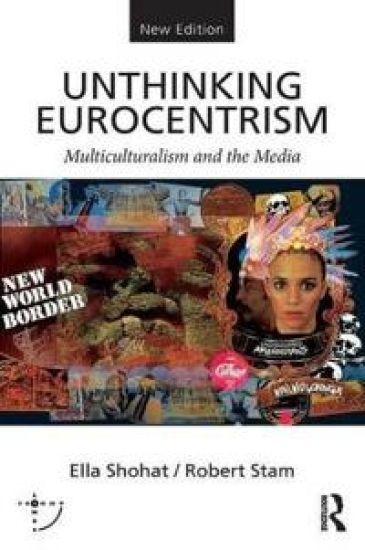
Unthinking Eurocentrism

Unthinking Eurocentrism

Ella Shohat; Robert Stam

Routledge
2014
nidottu
Unthinking Eurocentrism, a seminal and award-winning work in postcolonial studies first published in 1994, explored Eurocentrism as an interlocking network of buried premises, embedded narratives, and submerged tropes that constituted a broadly shared epistemology. Within a transdisciplinary study, the authors argued that the debates about Eurocentrism and post/coloniality must be considered within a broad historical sweep that goes at least as far back as the various 1492s – the Inquisition, the Expulsion of Jews and Muslims, the Conquest of the Americas, and the Transatlantic slave trade – a process which culminates in the post-War attempts to radically decolonize global culture. Ranging over multiple geographies, the book deprovincialized media/cultural studies through a "polycentric" approach, while analysing in depth such issues as postcolonial hybridity, antinomies of Enlightenment, the tropes of empire, gender and rescue fantasies, the racial politics of casting, and the limitations of "positive image" analysis. The substantial new afterword in this 20th anniversary new edition brings these issues into the present by charting recent transformations of the intellectual debates, as terms such as the "transnational," the "commons," "indigeneity," and the "Red Atlantic" have come to the fore. The afterword also explores some cinematic trends such as "indigenous media" and "postcolonial adaptations" that have gained strength over the past two decades, along with others, such as Nollywood, that have emerged with startling force. Winner of the Katherine Kovacs Singer Best Film Book Award, the book has been translated in full or in its entirety into diverse languages from Spanish to Farsi. This expanded edition of a ground-breaking text proposes analytical grids relevant to a wide variety of fields including postcolonial studies, literary studies, anthropology, media studies, cultural studies, and critical race studies.
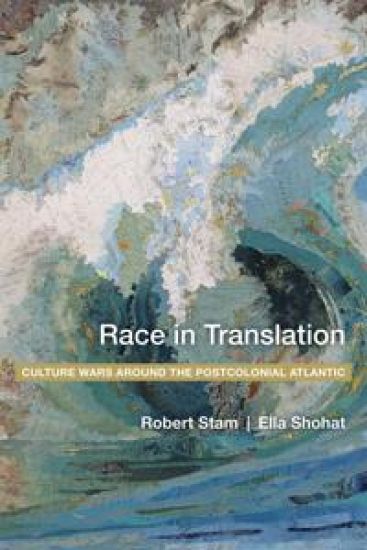
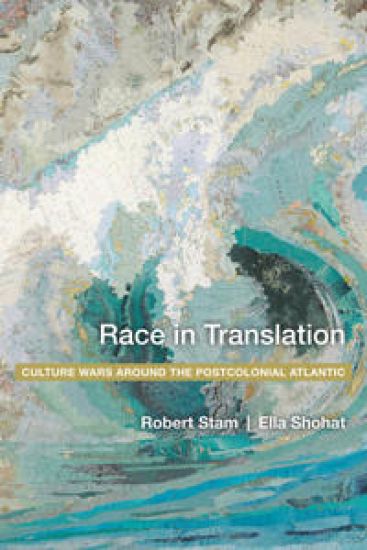
Race in Translation

Race in Translation

Ella Shohat; Robert Stam

New York University Press
2012
sidottu
While the term "culture wars" often designates the heated arguments in the English-speaking world spiraling around race, the canon, and affirmative action, in fact these discussions have raged in diverse sites and languages. Race in Translation charts the transatlantic traffic of the debates within and between three zones—the U. S., France, and Brazil. Stam and Shohat trace the literal and figurative translation of these multidirectional intellectual debates, seen most recently in the emergence of postcolonial studies in France, and whiteness studies in Brazil. The authors also interrogate an ironic convergence whereby rightist politicians like Sarkozy and Cameron join hands with some leftist intellectuals like Benn Michaels, Žižek, and Bourdieu in condemning "multiculturalism" and "identity politics." At once a report from various "fronts" in the culture wars, a mapping of the germane literatures, and an argument about methods of reading the cross-border movement of ideas, the book constitutes a major contribution to our understanding of the Diasporic and the Transnational.
Flagging Patriotism

Flagging Patriotism

Ella Shohat; Robert Stam

Routledge
2006
sidottu
The question "Why do they hate us?" is one of the most oft-cited puzzles of contemporary American affairs, yet it’s not clear to whom "they" or "us" refers, nor even what "hate" means. In this bold new work, Ella Shohat and Robert Stam take apart the "hate discourse" of right-wing politics, placing it in an international context. How, for example, do other nations love themselves, and how is that love connected to their attitudes toward America? Is love of country "monogamous" or can one love many countries? When can a country’s self-love be a symptom of self-hatred? Drawing upon their extensive experience with South American, European, and Middle Eastern societies, the authors have written a long engagement with a problem that refuses to go away. Flagging Patriotism considers these complex features of "being patriotic," and in so doing insists that the idea of patriotism, instead of being rejected or embraced, be accorded the complex identity it possesses.
On the Arab-Jew, Palestine, and Other Displacements
*Winner of the MEMO Palestine Book Awards 2017* Spanning several decades, Ella Shohat's work has introduced conceptual frameworks that fundamentally challenged conventional understandings of Palestine, Zionism and the Middle East, focusing on the pivotal figure of the Arab-Jew. This book gathers together her most influential political essays, interviews, speeches, testimonies and memoirs, as well as previously unpublished material. Defying the binarist and Eurocentric Arab-versus-Jew rendering of the Israeli/Palestinian conflict, Shohat's work has dared to engage with the deeper historical and cultural questions swirling around colonialism, Orientalism and nationalism. Shohat's paradigm-shifting work unpacks such fraught issues as the anomalies of the national/colonial in Zionist discourse; the narrating of Jewish pasts in Muslim spaces; the links and distinctions between the dispossession of the Nakba and the dislocation of Arab-Jews; the traumatic memories triggered by partition and border-crossing; the echoes within Islamophobia of the anti-Semitic figure of 'the Jew'; and the efforts to imagine a possible future inter-communal 'convivencia'. Shohat's transdisciplinary perspective illuminates the cultural politics in and around the Middle East. Juxtaposing texts of various genres written in divergent contexts, the book offers a vivid sense of the author's intellectual journey.
On the Arab-Jew, Palestine, and Other Displacements
*Winner of the MEMO Palestine Book Awards 2017* Spanning several decades, Ella Shohat's work has introduced conceptual frameworks that fundamentally challenged conventional understandings of Palestine, Zionism and the Middle East, focusing on the pivotal figure of the Arab-Jew. This book gathers together her most influential political essays, interviews, speeches, testimonies and memoirs, as well as previously unpublished material. Defying the binarist and Eurocentric Arab-versus-Jew rendering of the Israeli/Palestinian conflict, Shohat's work has dared to engage with the deeper historical and cultural questions swirling around colonialism, Orientalism and nationalism. Shohat's paradigm-shifting work unpacks such fraught issues as the anomalies of the national/colonial in Zionist discourse; the narrating of Jewish pasts in Muslim spaces; the links and distinctions between the dispossession of the Nakba and the dislocation of Arab-Jews; the traumatic memories triggered by partition and border-crossing; the echoes within Islamophobia of the anti-Semitic figure of 'the Jew'; and the efforts to imagine a possible future inter-communal 'convivencia'. Shohat's transdisciplinary perspective illuminates the cultural politics in and around the Middle East. Juxtaposing texts of various genres written in divergent contexts, the book offers a vivid sense of the author's intellectual journey.
Race in Translation

Race in Translation

Ella Shohat; Robert Stam

New York University Press
2012
pokkari
While the term "culture wars" often designates the heated arguments in the English-speaking world spiraling around race, the canon, and affirmative action, in fact these discussions have raged in diverse sites and languages. Race in Translation charts the transatlantic traffic of the debates within and between three zones—the U. S., France, and Brazil. Stam and Shohat trace the literal and figurative translation of these multidirectional intellectual debates, seen most recently in the emergence of postcolonial studies in France, and whiteness studies in Brazil. The authors also interrogate an ironic convergence whereby rightist politicians like Sarkozy and Cameron join hands with some leftist intellectuals like Benn Michaels, Žižek, and Bourdieu in condemning "multiculturalism" and "identity politics." At once a report from various "fronts" in the culture wars, a mapping of the germane literatures, and an argument about methods of reading the cross-border movement of ideas, the book constitutes a major contribution to our understanding of the Diasporic and the Transnational.
Flagging Patriotism

Flagging Patriotism

Ella Shohat; Robert Stam

Routledge
2006
nidottu
The question "Why do they hate us?" is one of the most oft-cited puzzles of contemporary American affairs, yet it’s not clear to whom "they" or "us" refers, nor even what "hate" means. In this bold new work, Ella Shohat and Robert Stam take apart the "hate discourse" of right-wing politics, placing it in an international context. How, for example, do other nations love themselves, and how is that love connected to their attitudes toward America? Is love of country "monogamous" or can one love many countries? When can a country’s self-love be a symptom of self-hatred? Drawing upon their extensive experience with South American, European, and Middle Eastern societies, the authors have written a long engagement with a problem that refuses to go away. Flagging Patriotism considers these complex features of "being patriotic," and in so doing insists that the idea of patriotism, instead of being rejected or embraced, be accorded the complex identity it possesses.
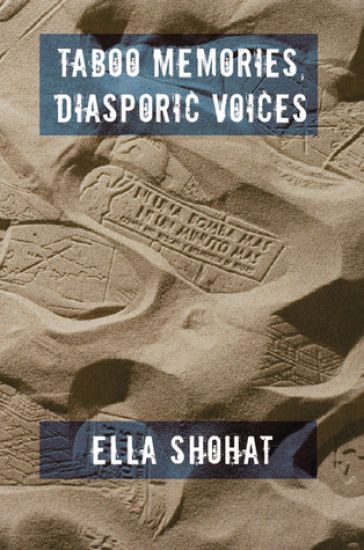
Taboo Memories, Diasporic Voices

Taboo Memories, Diasporic Voices

Ella Shohat

Duke University Press
2006
pokkari
Taboo Memories, Diasporic Voices brings together for the first time a selection of trailblazing essays by Ella Shohat, an internationally renowned theorist of postcolonial and cultural studies of Iraqi-Jewish background. Written over the past two decades, these twelve essays-some classic, some less known, some new-trace a powerful intellectual trajectory as Shohat rigorously teases out the consequences of a deep critique of Eurocentric epistemology, whether to rethink feminism through race, nationalism through ethnicity, or colonialism through sexuality. Shohat’s critical method boldly transcends disciplinary and geographical boundaries. She explores such issues as the relations between ethnic studies and area studies, the paradoxical repercussions for audio-visual media of the “graven images” taboo, the allegorization of race through the refiguring of Cleopatra, the allure of imperial popular culture, and the gender politics of medical technologies. She also examines the resistant poetics of exile and displacement; the staging of historical memory through the commemorations of the two 1492s, the anomalies of the “national” in Zionist discourse, the implications of the hyphen in the concept “Arab-Jew,” and the translation of the debates on orientalism and postcolonialism across geographies. Taboo Memories, Diasporic Voices not only illuminates many of the concerns that have animated the study of cultural politics over the past two decades; it also points toward new scholarly possibilities.
Taboo Memories, Diasporic Voices

Taboo Memories, Diasporic Voices

Ella Shohat

Duke University Press
2006
sidottu
Taboo Memories, Diasporic Voices brings together for the first time a selection of trailblazing essays by Ella Shohat, an internationally renowned theorist of postcolonial and cultural studies of Iraqi-Jewish background. Written over the past two decades, these twelve essays-some classic, some less known, some new-trace a powerful intellectual trajectory as Shohat rigorously teases out the consequences of a deep critique of Eurocentric epistemology, whether to rethink feminism through race, nationalism through ethnicity, or colonialism through sexuality. Shohat’s critical method boldly transcends disciplinary and geographical boundaries. She explores such issues as the relations between ethnic studies and area studies, the paradoxical repercussions for audio-visual media of the “graven images” taboo, the allegorization of race through the refiguring of Cleopatra, the allure of imperial popular culture, and the gender politics of medical technologies. She also examines the resistant poetics of exile and displacement; the staging of historical memory through the commemorations of the two 1492s, the anomalies of the “national” in Zionist discourse, the implications of the hyphen in the concept “Arab-Jew,” and the translation of the debates on orientalism and postcolonialism across geographies. Taboo Memories, Diasporic Voices not only illuminates many of the concerns that have animated the study of cultural politics over the past two decades; it also points toward new scholarly possibilities.
Corruption in Corporate Culture

Corruption in Corporate Culture

Randy Martin; Ella Shohat

Duke University Press
2003
pokkari
Corruption in Corporate Culture argues that there has been a serious breakdown in the systems designed to ensure fair dealing in the self-governing and self-policing worlds of U. S. business and finance. Contending that a war of containment has been launched to conceal both the repercussions of corporate corruption and government complicity in it, this special issue of Social Text evaluates these problems on a systemic level, as well as focusing on immediate cases. Addressing several recent high-profile scandals, contributors examine both the short- and the long-term ramifications of corporate corruption: the means by which Martha Stewart has been used as an icon and a scapegoat in the ImClone case while broader critical issues have failed to receive the attention they demand; the divisive ways in which the antifeminist Independent Women’s Forum-along with other neocon organizations and pundits-has moved the debate regarding the deregulation of the financial services sector far to the right of the far right; the collapse of Enron and what it means for corporate governance; the global implications of U. S. corporate corruption; the confusion over public and private business transactions in Argentina; the moral panic ensuing from the random violence caused by the Washington, D. C. area snipers precisely as the U. S. was launching a war on Iraq because of its supposed weapons of mass destruction; and the emergence of a new business model and icon, the hiphop mogul. Contributors. Peter Bratsis, David M. Brennan, Jane Marcus-Delgado, Randy Martin, Nancy Shaw, Ella Shohat, Christopher Holmes Smith, Barbara Spindel, Susan Willis
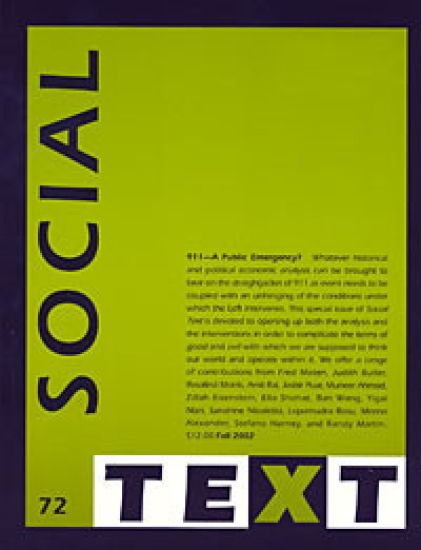
911 A Public Emergency?

911 A Public Emergency?

Brent Hayes Edwards; Stefano Harney; Randy Martin; Timothy Mitchell; Ella Shohat; Fred Moten

Duke University Press
2002
pokkari
Since September 11, public discourse has often been framed in terms of absolutes: an age of innocence gives way to a present under siege, while the United States and its allies face off against the Axis of Evil. This special issue of Social Text aims to move beyond these binaries toward thoughtful analysis. The editors argue that the challenge for the Left is to develop an antiterrorism stance that acknowledges the legacy of U. S. trade and foreign policy as well as the diversity of the Muslim faith and the dangers presented by fundamentalism of all kinds. Examining the strengths and shortcomings of area, race, and gender studies in the search for understanding, this issue considers cross-cultural feminism as a means of combating terrorism; racial profiling of Muslims in the context of other racist logics; and the homogenization of dissent. The issue includes poetry, photographic work, and an article by Judith Butler on the discursive space surrounding the attacks of September 11. This impressive range of contributions questions the meaning and implications of the events of September 11 and their aftermath. Contributors. Muneer Ahmad, Meena Alexander, Lopamudra Basu, Judith Butler, Zillah Eisenstein, Stefano Harney, Randy Martin, Rosalind C. Morris, Fred Moten, Sandrine Nicoletta, Yigal Nizri, Jasbir K. Puar, Amit S. Rai, Ella Shohat, Ban Wang