

Kirjailija
Ellen Smith
Kirjat ja teokset yhdessä paikassa: 7 kirjaa, julkaisuja vuosilta 2010–2026, suosituimpiin kuuluu All Kinds of Time. Vertaile teosten hintoja ja tarkista saatavuus suomalaisista kirjakaupoista.
7 kirjaa
Kirjojen julkaisuvuodet: 2010–2026.

Nick the Chick and Chuck the Duck, are good friends. When one gets into trouble, the other enlists the help of their farm friends to help save the day. Once the other goes missing, the friends rally to find and help him. Another animal, so different from the others, is discovered and survival instincts kick in. A story of friendship, helping one another and inclusivity.


Will and Mara Sterling are already living their dream. After surviving a campus shooting, they both went on to finish college, fall in love, and start a new life together as husband and wife. That's not to say things have been easy: Will suffers from post-traumatic stress disorder and Mara has debilitating chronic pain from her gunshot wound. Despite it all, they feel lucky to be alive and even luckier to be in love. Then a new initiative from the Justice Department offers Will and Mara the chance of a lifetime. The shooter has been rehabilitated and his crime qualifies for a timeline rectification. With Will and Mara's consent, they can all travel through time back to the original scene of the crime, giving the gunman a chance to put things right. It sounds like a dream come true, but both Will and Mara have their doubts. Timeline rectification--called "time wrecking" by its critics--is at the center of a politically charged debate. Will and Mara aren't entirely sure where they fall on this issue and the clock is ticking for them to decide. Is it moral to change time for the rest of the world, just to undo one crime? Is it moral to deny the gunman a chance to correct his past crimes? And what if this one ripple means that they never meet . . . or fall in love? Set in 2011, Every Last Minute is the first book in the Time Wrecker Trilogy.


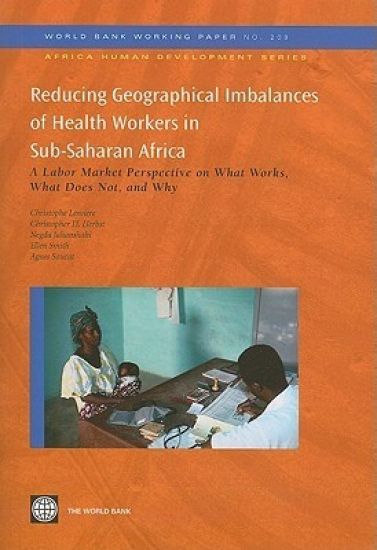
Reducing Geographical Imbalances of the Distribution of Health Workers in Sub-Saharan Africa
Christophe Lemiere; Christopher Herbst; Negda Jahanshahi; Ellen Smith; Agnes Soucat
World Bank Publications
2010
nidottu
The human resources crisis in the health sector has been gathering attention on the global stage. To date, however, most of this attention has focused on shortages of health human resources (HRH) at the national level. At least as important are problems at the sub-national level. Massive geographic and skill mix imbalances are reflected in the perilous undersupply of HRH in most rural areas. Virtually all Sub-Saharan African countries suffer from significant geographic imbalances. Very little substantive information or documentation exists on the problem. Even less is known about the lessons from policies aimed at addressing urban-rural human resource imbalances, let alone experiences of Sub-Saharan Africa countries, with such policies. There also appears to be a disconnect between the objectives and efforts of policymakers on the one hand and the functioning of national health labor markets and labor market behavior on the other hand. This disconnect hinders policy effectiveness and the efficient utilization of resources intended to narrow urban-rural inequities. In Sub-Saharan Africa government policies, often limited to the management of public sector vacancies, appear to be elaborated, prescribed, and implemented independently of labor market considerations. Partly as a result, they are unable to effectively address urban-rural imbalances, which are an outcome of labor market dynamics. This report discusses and analyzes labor market dynamics and outcomes (including unemployment, worker shortages, and urban-rural imbalances of categories of health workers) from a labor economics perspective. It then use insights from this perspective as a basis for elaborating policy options that incorporate the underlying labor market forces. The goal of the study is to address undesirable outcomes (including urban-rural HRH imbalances) more effectively. The book is thus suitable for researchers, policy analysts and policy makers with an interest in understanding and improving the allocation of human resources for health in the developing world.