Kirjojen hintavertailu – 12 903 725 kirjaa ja 27 kauppaa
Kirjailija
Elliott H. Lieb
Kirjat ja teokset yhdessä paikassa: 8 kirjaa, julkaisuja vuosilta 2001–2012, suosituimpiin kuuluu Inequalities. Vertaile teosten hintoja ja tarkista saatavuus suomalaisista kirjakaupoista.
Inequalities play a fundamental role in Functional Analysis and it is widely recognized that finding them, especially sharp estimates, is an art. E. H. Lieb has discovered a host of inequalities that are enormously useful in mathematics as well as in physics. His results are collected in this book which should become a standard source for further research. Together with the mathematical proofs the author also presents numerous applications to the calculus of variations and to many problems of quantum physics, in particular to atomic physics.
This is the third Selecta of publications of Elliott Lieb, the first two being Stabil ity of Matter: From Atoms to Stars, edited by Walter Thirring, and Inequalities, edited by Michael Loss and Mary Beth Ruskai. A companion fourth Selecta on Statistical Mechanics is also edited by us. Elliott Lieb has been a pioneer of the discipline of mathematical physics as it is nowadays understood and continues to lead several of its most active directions today. For the first part of this selecta we have made a selection of Lieb's works on Condensed Matter Physics. The impact of Lieb's work in mathematical con densed matter physics is unrivaled. It is fair to say that if one were to name a founding father of the field, Elliott Lieb would be the only candidate to claim this singular position. While in related fields, such as Statistical Mechanics and Atomic Physics, many key problems are readily formulated in unambiguous mathematical form, this is less so in Condensed Matter Physics, where some say that rigor is "probably impossible and certainly unnecessary". By carefully select ing the most important questions and formulating them as well-defined mathemat ical problems, and then solving a good number of them, Lieb has demonstrated the quoted opinion to be erroneous on both counts. What is true, however, is that many of these problems turn out to be very hard. It is not unusual that they take a decade (even several decades) to solve.
Research into the stability of matter has been one of the most successful chapters in mathematical physics, and is a prime example of how modern mathematics can be applied to problems in physics. A unique account of the subject, this book provides a complete, self-contained description of research on the stability of matter problem. It introduces the necessary quantum mechanics to mathematicians, and aspects of functional analysis to physicists. The topics covered include electrodynamics of classical and quantized fields, Lieb-Thirring and other inequalities in spectral theory, inequalities in electrostatics, stability of large Coulomb systems, gravitational stability of stars, basics of equilibrium statistical mechanics, and the existence of the thermodynamic limit. The book is an up-to-date account for researchers, and its pedagogical style makes it suitable for advanced undergraduate and graduate courses in mathematical physics.
The mathematical study of the Bose gas goes back to the ?rst quarter of the twentieth century, with the invention of quantum mechanics. The name refers to the Indian physicist S. N. Bose who realized in 1924 that the statistics governing photons(essentiallyinventedbyMaxPlanckin1900)isdetermined(usingmodern terminology) by restricting the physical Hilbert space to be the symmetric tensor product of single photon states. Shortly afterwards, Einstein applied this idea to massive particles, such as a gas of atoms, and discovered the phenomenon that we now call Bose-Einstein condensation. At that time this was viewed as a mathematical curiosity with little experimental interest, however. The peculiar properties of liquid Helium (?rst lique?ed by Kammerlingh Onnes in 1908) were eventually viewed as an experimental realization of Bose- Einstein statistics applied to Helium atoms. The unresolved mathematical pr- lem was that the atoms in liquid Helium are far from the kind of non-interacting particles envisaged in Einstein’s theory, and the question that needed to be - solved was whether Bose-Einstein condensation really takes place in a strongly interacting system — or even in a weakly interacting system. That question is still with us, three quarters of a century later! The ?rst systematic and semi-rigorous mathematical treatment of the pr- lem was due to Bogoliubov in 1947, but that theory, while intuitively appealing and undoubtedly correct in many aspects, has major gaps and some ?aws. The 1950’s and 1960’s brought a renewed ?urry of interest in the question, but while theoreticalintuitionbene?tedhugelyfromthisactivitythemathematicalstructure did not signi?cantly improve.
This fourth edition of selecta of my work on the stability of matter contains recent work on two topics that continue to fascinate me: Quantum electrodynamics (QED) and the Bose gas. Three papers have been added to Part VII on QED. As I mentioned in the preface to the third edition, there must be a way to formulate a non-perturbative QED, presumably with an ultraviolet cutoff, that correctly describes low energy physics, i.e., ordinary matter and its interaction with the electromagnetic field. The new paper VII.5, which “quantizes” the results in V.9, shows that the elementary ‘no-pair’ version of relativistic QED (using the Dirac operator) is unstable when many-body effects are taken into account. Stability can be restored, however, if the Dirac operator with the field, instead of the bare Dirac operator, is used to define an electron. Thus, the notion of a “bare” electron without its self-field is physically questionable.
This is the third Selecta of publications of Elliott Lieb, the first two being Stabil ity of Matter: From Atoms to Stars, edited by Walter Thirring, and Inequalities, edited by Michael Loss and Mary Beth Ruskai. A companion fourth Selecta on Statistical Mechanics is also edited by us. Elliott Lieb has been a pioneer of the discipline of mathematical physics as it is nowadays understood and continues to lead several of its most active directions today. For the first part of this selecta we have made a selection of Lieb's works on Condensed Matter Physics. The impact of Lieb's work in mathematical con densed matter physics is unrivaled. It is fair to say that if one were to name a founding father of the field, Elliott Lieb would be the only candidate to claim this singular position. While in related fields, such as Statistical Mechanics and Atomic Physics, many key problems are readily formulated in unambiguous mathematical form, this is less so in Condensed Matter Physics, where some say that rigor is "probably impossible and certainly unnecessary". By carefully select ing the most important questions and formulating them as well-defined mathemat ical problems, and then solving a good number of them, Lieb has demonstrated the quoted opinion to be erroneous on both counts. What is true, however, is that many of these problems turn out to be very hard. It is not unusual that they take a decade (even several decades) to solve.
Inequalities play a fundamental role in Functional Analysis and it is widely recognized that finding them, especially sharp estimates, is an art. E. H. Lieb has discovered a host of inequalities that are enormously useful in mathematics as well as in physics. His results are collected in this book which should become a standard source for further research. Together with the mathematical proofs the author also presents numerous applications to the calculus of variations and to many problems of quantum physics, in particular to atomic physics.
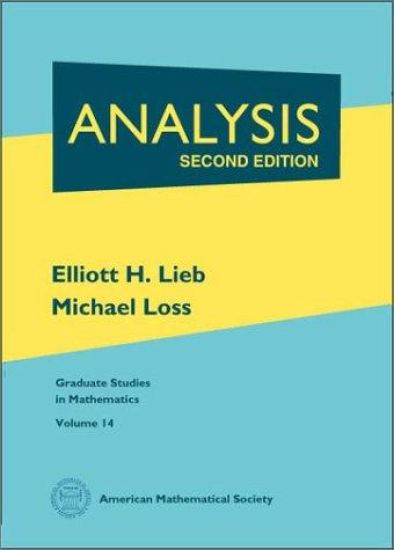
Presents the concepts and tools to solve problems of analysis, and shows how to apply these concepts to research in a variety of areas. This work covers the min-max principle, semi-classical approximation, coherent states and Lieb-Thirring inequalities. It also covers Sobolev Inequalities, including the Nash and Log Sobolev inequalities.