
Kirjojen hintavertailu – 12 903 725 kirjaa ja 27 kauppaa

Kirjailija

Emile I. Haddad

Kirjat ja teokset yhdessä paikassa: 2 kirjaa, julkaisuja vuosilta 2006–2019, suosituimpiin kuuluu Fibre Bragg Gratings in Harsh and Space Environments. Vertaile teosten hintoja ja tarkista saatavuus suomalaisista kirjakaupoista.

2 kirjaa

Kirjojen julkaisuvuodet: 2006–2019.

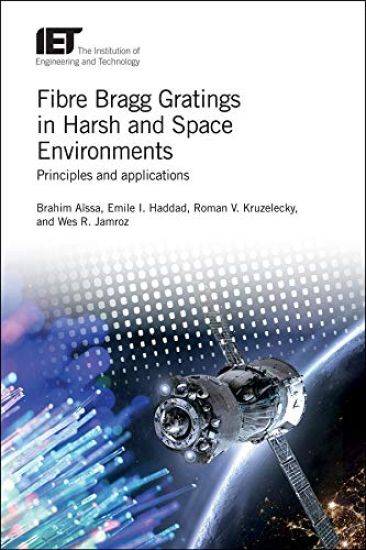
Fibre Bragg Gratings in Harsh and Space Environments

Fibre Bragg Gratings in Harsh and Space Environments

Brahim Aïssa; Emile I. Haddad; Roman V. Kruzelecky; Wes R. Jamroz

Institution of Engineering and Technology
2019
sidottu
A fibre Bragg grating (FBG) is a type of distributed Bragg reflector constructed in a short segment of optical fibre that reflects particular wavelengths of light and transmits all the others. As such, FBGs can be used as inline optical filters to block certain wavelengths, or as wavelength-specific reflectors. Applications include optical fibre communications, sensors and fibre lasers. This book addresses the critical challenge of developing Fibre Bragg Gratings (FBGs) for applications as sensors in harsh and space environment. Coverage ranges from the basic principles through design, fabrication, and testing to their industrial implementation. A thorough review includes the in-depth examination of the FBGs properties and the most important developments in devices and applications. A particular emphasis is given to the applications of fibre optic sensors in the space environment, which is characterized mainly by vacuum, high thermal gradients, mechanical vibrations and various types of cosmic radiation. The book concludes with a summary and overview of challenges faced by FBG technology. The book is supplemented by an extensive survey of published papers, books and conference reports. As an added benefit, the book is structured in such a way as to provide useful and in-depth training and skills development to graduate/undergraduate students, specialised engineers, and academic/industrial experts.
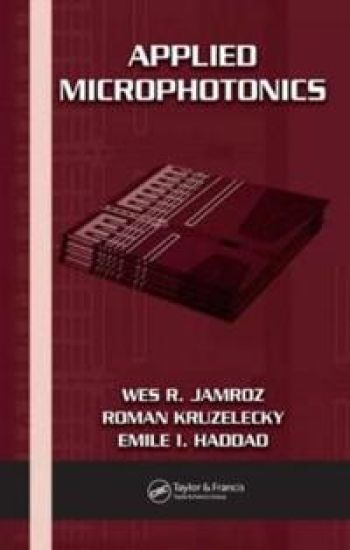
Applied Microphotonics

Applied Microphotonics

Wes R. Jamroz; Roman Kruzelecky; Emile I. Haddad

CRC Press Inc
2006
sidottu
As the limits of electrical performance come within sight, photons are poised to take over for the electron. But the search continues for the materials, topologies, and fabrication technologies capable of producing photonic devices at a reasonable speed and cost. Taking a fundamentallook at the development of photonic technology from the macro- to the microscale, Applied Microphotonics introduces the major principles and technologies underlying the field. Following an overview of historical and commercial driving forces, the authors briefly review the underlying physics, emphasizing the practical and design implications for photonic systems. This general discussion lays the foundation for the remainder of the book, where the authors first introduce the photonic node and then discuss each subsystem in detail, including transmitters, couplers and switches, multiplexers and demultiplexers, receivers, amplifiers, and compensators. The following chapters explore new technologies such as photonic band gap structures, materials and fabrication processes, integration methodologies, and advanced devices such as photonic computers. The book concludes with a brief introduction to quantum photonics and a forward look at potential directions of photonics. Applied Microphotonics encapsulates the recent push toward all-optical networks and devices with an applications-oriented perspective. It is ideal for newcomers to the field as well as anyone curious to know how photonic technology can benefit their own field.