

Kirjailija
Emile Meyerson
Kirjat ja teokset yhdessä paikassa: 15 kirjaa, julkaisuja vuosilta 1951–2026, suosituimpiin kuuluu Identity & Reality. Vertaile teosten hintoja ja tarkista saatavuus suomalaisista kirjakaupoista.
Nimi esiintyy myös muodoissa: Émile Meyerson
15 kirjaa
Kirjojen julkaisuvuodet: 1951–2026.


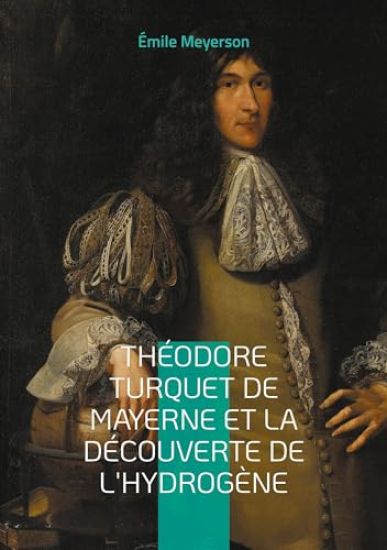
Théodore Turquet de Mayerne et la découverte de l'hydrogène: La révélation d'une découverte oubliée - l'hydrogène et son inventeur au coeur de la chim
Émile Meyerson
BoD - Books on Demand
2025
nidottu

This is Volume IV of six in a series on Epistemology. Originally published in 1930, this is the third edition and translated from French in the domain of the philosophy of science.
Emile Meyerson's writings on the philosophy of science are a rich source of ideas and information concerning many philosophical and historical aspects of the development of modem science. Meyerson's works are not widely read or cited today by philosophers or even philosophers of science, in part because they have long been out of print and are often not available even in research libraries. There are additional chevaux de !rise for all but the hardiest scholars: Meyerson's books are written in French (and do not all exist in English versions) and deal with the subject matter of science - ideas or concepts, laws or principles, theories - and epis temological questions rather than today's more fashionable topics of the social matrix and external influences on science with the concomitant neglect of the intellectual content of science. Born in Lublin, Poland, in 1859, Meyerson received most of his education in Germany, where he studied from the age of 12 to 23, preparing himself for a career in chemistry. ! He moved to Paris in 1882, where he began a career as an industrial chemist. Changing his profession, he then worked for a time as the foreign news editor of the HAVAS News Agency in Paris. In 1898 he joined the agency established by Edmond Rothschild that had as its purpose the settling of Jews in Palestine and became the Director of the Jewish Colonization Association for Europe and Asia Minor. These activities represent Meyerson's formal career.
When the author of Identity and Reality accepted Langevin's suggestion that Meyerson "identify the thought processes" of Einstein's relativity theory, he turned from his assured perspective as historian of the sciences to the risky bias of contemporary philosophical critic. But Emile Meyerson, the epis temologist as historian, could not find a more rigorous test of his conclusions from historical learning than the interpretation of Einstein's work, unless perhaps he were to turn from the classical revolution of Einstein's relativity to the non-classical quantum theory. Meyerson captures our sympathy in all his writings: " . . . the role of the epistemologist is . . . in following the development of science" (250); the study of the evolution of reason leads us to see that "man does not experience himself reasoning . . . which is carried on unconsciously," and as the summation of his empirical studies of the works and practices of scientists, "reason . . . behaves in an altogether predict able way: . . . first by making the consequent equivalent to the antecedent, and then by actually denying all diversity in space" (202). If logic - and to Meyerson the epistemologist is logician - is to understand reason, then "logic proceeds a posteriori. " And so we are faced with an empirically based Par menides, and, as we shall see, with an ineliminable 'irrational' within science. Meyerson's story, written in 1924, is still exciting, 60 years later.
A Critical Analysis of the Philosophy of Emile Meyerson
George Boas; Emile Meyerson
Literary Licensing, LLC
2011
nidottu
A Critical Analysis of the Philosophy of Emile Meyerson
George Boas; Emile Meyerson; Emil Meyerson
Literary Licensing, LLC
2011
sidottu
""A Critical Analysis of the Philosophy of Emile Meyerson"" by George Boas is a comprehensive examination of the philosophical ideas and theories of Emile Meyerson, a French philosopher who lived in the late 19th and early 20th centuries. Boas offers a detailed analysis of Meyerson's work, focusing on his views on epistemology, ontology, and the nature of reality. The book is divided into several chapters, each of which explores a different aspect of Meyerson's philosophy. Boas examines Meyerson's ideas about the relationship between language and thought, the role of perception in knowledge acquisition, and the nature of scientific inquiry. He also considers Meyerson's views on the nature of time and space, as well as his contributions to the philosophy of mathematics. Throughout the book, Boas provides insightful critiques of Meyerson's ideas, highlighting both their strengths and weaknesses. This book is an important resource for anyone interested in the history of philosophy, epistemology, and the philosophy of science.""This scarce antiquarian book is a facsimile reprint of the old original and may contain some imperfections such as library marks and notations. Because we believe this work is culturally important, we have made it available as part of our commitment for protecting, preserving, and promoting the world's literature in affordable, high quality, modern editions, that are true to their original work.

This is Volume IV of six in a series on Epistemology. Originally published in 1930, this is the third edition and translated from French in the domain of the philosophy of science.
Emile Meyerson's writings on the philosophy of science are a rich source of ideas and information concerning many philosophical and historical aspects of the development of modem science. Meyerson's works are not widely read or cited today by philosophers or even philosophers of science, in part because they have long been out of print and are often not available even in research libraries. There are additional chevaux de !rise for all but the hardiest scholars: Meyerson's books are written in French (and do not all exist in English versions) and deal with the subject matter of science - ideas or concepts, laws or principles, theories - and epis temological questions rather than today's more fashionable topics of the social matrix and external influences on science with the concomitant neglect of the intellectual content of science. Born in Lublin, Poland, in 1859, Meyerson received most of his education in Germany, where he studied from the age of 12 to 23, preparing himself for a career in chemistry. ! He moved to Paris in 1882, where he began a career as an industrial chemist. Changing his profession, he then worked for a time as the foreign news editor of the HAVAS News Agency in Paris. In 1898 he joined the agency established by Edmond Rothschild that had as its purpose the settling of Jews in Palestine and became the Director of the Jewish Colonization Association for Europe and Asia Minor. These activities represent Meyerson's formal career.
Paru pour la premiere fois en 1908, l'essai d'Emile Meyerson Identite et realite demeure aujourd'hui un classique de la philosophie des sciences, dont A. Koyre a salue l'importance. Un premier aspect important de cet ouvrage concerne la conception et le statut meme de la science (physique, biologie, etc.). Meyerson developpe une critique profonde de la conception positiviste de la science formulee par Auguste Comte, en montrant l'impossibilite de penser des rapports phenomenaux sans leur presupposer des supports: la legalite ne peut pas se resoudre dans la causalite . C'est la raison pour laquelle l'auteur s'efforce de definir un substantialisme renouvele, apte a echapper aux critiques positivistes. L'autre these essentielle de cet essai se rapporte bien entendu au celebre concept de causalite scientifique: le concept de legalite mis en jeu dans la conception positiviste de la science ne suffit pas, car la science cherche egalement a expliquer les phenomenes; et c'est precisement cette explication, qui consiste dans l'identification de l'antecedent au conequent, que l'auteur appelle la causalite scientifique, et qu'il distingue et oppose a la causalite theologique aussi bien qu'a la causalite efficiente.