Kirjojen hintavertailu – 12 859 819 kirjaa ja 27 kauppaa

Kirjailija

Emma Rich

Kirjat ja teokset yhdessä paikassa: 6 kirjaa, julkaisuja vuosilta 2008–2022, suosituimpiin kuuluu Rethinking Obesity. Vertaile teosten hintoja ja tarkista saatavuus suomalaisista kirjakaupoista.

6 kirjaa

Kirjojen julkaisuvuodet: 2008–2022.

Rethinking Obesity

Rethinking Obesity

Lee F. Monaghan; Emma Rich; Andrea E. Bombak

TAYLOR FRANCIS LTD
2022
nidottu
Theoretically informed and empirically grounded, Rethinking Obesity invites readers to reconsider the medical and public health framing of population weight (gain) as a massive global problem, epidemic or crisis. Attentive to social values, scientific uncertainty and possible harms, the book furthers critique of the weight-centred health paradigm and world war on obesity. Building upon existing international literature from critical weight studies, fat studies and critical obesity research, the book advances scholarship with reference to body politics and health policy, epidemiology and obesity science, media reporting and weight-related stigma. The authors resist the common moralised narrative that ‘the overweight majority’ are lazy, gluttonous, and personally responsible for their actual or potential ills and the solution ultimately necessitates individual lifestyle change. Critique is also extended to seemingly compassionate public health interventions that putatively avoid victim-blaming through an appeal to ‘the obesogenic environment’, a consequence of modern living. Empirical case studies are grounded in women’s repeated and often frustrating experiences of dieting and schoolgirls’ encounters with fat pedagogy, which challenges dominant obesity discourse. Recognising that declared public health crises may become layered and cascade through society, this book also includes timely research on the COVID-19 pandemic response amidst concerns about lockdown weight-gain, heightened risk of infection and death among people deemed overweight and obese. Rethinking Obesity interrogates how social injustice is reproduced not only through cruelty but also through seemingly benevolent representations, pedagogies and policies. Alternative approaches and action, ranging from weight-inclusive health paradigms to broader social change, are also considered when seeking to foster collective hope in crisis times. This is valuable reading for students and researchers in medical sociology, social and population health sciences, physical education, critical weight and fat studies, and the social dimensions of the body.
Rethinking Obesity

Rethinking Obesity

Lee F. Monaghan; Emma Rich; Andrea E. Bombak

TAYLOR FRANCIS LTD
2022
sidottu
Theoretically informed and empirically grounded, Rethinking Obesity invites readers to reconsider the medical and public health framing of population weight (gain) as a massive global problem, epidemic or crisis. Attentive to social values, scientific uncertainty and possible harms, the book furthers critique of the weight-centred health paradigm and world war on obesity. Building upon existing international literature from critical weight studies, fat studies and critical obesity research, the book advances scholarship with reference to body politics and health policy, epidemiology and obesity science, media reporting and weight-related stigma. The authors resist the common moralised narrative that ‘the overweight majority’ are lazy, gluttonous, and personally responsible for their actual or potential ills and the solution ultimately necessitates individual lifestyle change. Critique is also extended to seemingly compassionate public health interventions that putatively avoid victim-blaming through an appeal to ‘the obesogenic environment’, a consequence of modern living. Empirical case studies are grounded in women’s repeated and often frustrating experiences of dieting and schoolgirls’ encounters with fat pedagogy, which challenges dominant obesity discourse. Recognising that declared public health crises may become layered and cascade through society, this book also includes timely research on the COVID-19 pandemic response amidst concerns about lockdown weight-gain, heightened risk of infection and death among people deemed overweight and obese. Rethinking Obesity interrogates how social injustice is reproduced not only through cruelty but also through seemingly benevolent representations, pedagogies and policies. Alternative approaches and action, ranging from weight-inclusive health paradigms to broader social change, are also considered when seeking to foster collective hope in crisis times. This is valuable reading for students and researchers in medical sociology, social and population health sciences, physical education, critical weight and fat studies, and the social dimensions of the body.

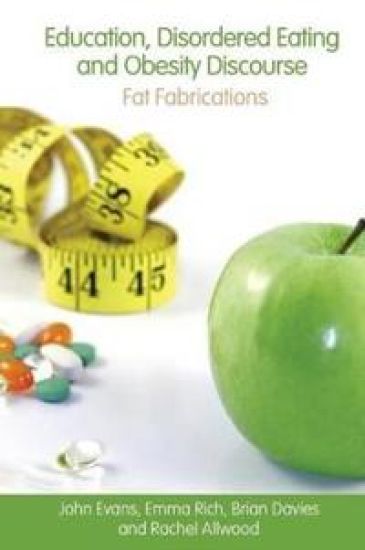
Education, Disordered Eating and Obesity Discourse

Education, Disordered Eating and Obesity Discourse

John Evans; Emma Rich; Brian Davies; Rachel Allwood

Routledge
2008
sidottu
Eating less, exercising more and losing weight seem the obvious solution for the oncoming 'obesity epidemic'. Rarely, however, is thought given to how these messages are interpreted and whether they are in fact inherently healthy. Education, Disordered Eating and Obesity Discourse investigates how 'body centred talk' about weight, fat, food and exercise is recycled in schools, enters educational processes, and impacts on the identities and health of young people. Drawing on the experiences of young women who have developed eating disorders and research on international school curricula and the media, the authors challenge the veracity, substance and merits of contemporary 'obesity discourse'. By concentrating on previously unexplored aspects of the debate around weight and health, it is revealed how well-meaning advice can propel some children toward behaviour that seriously damages their health. This book is not only about 'eating disorders' and the people affected, but the effects of obesity discourse on everyone’s health as it enters public policy, educational practice and the cultural fabric of our lives. It will interest students, teachers, doctors, health professionals and researchers concerned with obesity and weight issues.
Education, Disordered Eating and Obesity Discourse

Education, Disordered Eating and Obesity Discourse

John Evans; Emma Rich; Brian Davies; Rachel Allwood

Routledge
2008
nidottu
Eating less, exercising more and losing weight seem the obvious solution for the oncoming 'obesity epidemic'. Rarely, however, is thought given to how these messages are interpreted and whether they are in fact inherently healthy. Education, Disordered Eating and Obesity Discourse investigates how 'body centred talk' about weight, fat, food and exercise is recycled in schools, enters educational processes, and impacts on the identities and health of young people. Drawing on the experiences of young women who have developed eating disorders and research on international school curricula and the media, the authors challenge the veracity, substance and merits of contemporary 'obesity discourse'. By concentrating on previously unexplored aspects of the debate around weight and health, it is revealed how well-meaning advice can propel some children toward behaviour that seriously damages their health. This book is not only about 'eating disorders' and the people affected, but the effects of obesity discourse on everyone’s health as it enters public policy, educational practice and the cultural fabric of our lives. It will interest students, teachers, doctors, health professionals and researchers concerned with obesity and weight issues.
The Medicalization of Cyberspace

The Medicalization of Cyberspace

Andy Miah; Emma Rich

Routledge
2008
sidottu
The entire infrastructure and culture of medicine is being transformed by digital technology, the Internet and mobile devices. Cyberspace is now regularly used to provide medical advice and medication, with great numbers of sufferers immersing themselves within virtual communities. What are the implications of this medicalization of cyberspace for how people make sense of health and identity? The Medicalization of Cyberspace is the first book to explore the relationship between digital culture and medical sociology. It examines how technology is redefining expectations of and relationships with medical culture, addressing the following questions: How will the rise of digital communities affect traditional notions of medical expertise? What will the medicalization of cyberspace mean in a new era of posthuman enhancements? How should we regard hype and exaggeration about science in the media and how can this encourage public engagement with bioethics? This book looks at the complex interactions between health, medicalization, cyberculture, the body and identity. It addresses topical issues, such as medical governance, reproductive rights, eating disorders, Web 2.0, and perspectives on posthumanism. It is essential reading for healthcare professionals and social, philosophical and cultural theorists of health.
The Medicalization of Cyberspace

The Medicalization of Cyberspace

Andy Miah; Emma Rich

Routledge
2008
nidottu
The entire infrastructure and culture of medicine is being transformed by digital technology, the Internet and mobile devices. Cyberspace is now regularly used to provide medical advice and medication, with great numbers of sufferers immersing themselves within virtual communities. What are the implications of this medicalization of cyberspace for how people make sense of health and identity? The Medicalization of Cyberspace is the first book to explore the relationship between digital culture and medical sociology. It examines how technology is redefining expectations of and relationships with medical culture, addressing the following questions: How will the rise of digital communities affect traditional notions of medical expertise? What will the medicalization of cyberspace mean in a new era of posthuman enhancements? How should we regard hype and exaggeration about science in the media and how can this encourage public engagement with bioethics? This book looks at the complex interactions between health, medicalization, cyberculture, the body and identity. It addresses topical issues, such as medical governance, reproductive rights, eating disorders, Web 2.0, and perspectives on posthumanism. It is essential reading for healthcare professionals and social, philosophical and cultural theorists of health.