Kirjojen hintavertailu – 12 903 725 kirjaa ja 27 kauppaa
Kirjailija
Emmanuel Levinas
Kirjat ja teokset yhdessä paikassa: 31 kirjaa, julkaisuja vuosilta 1993–2024, suosituimpiin kuuluu Unforeseen History. Vertaile teosten hintoja ja tarkista saatavuus suomalaisista kirjakaupoista.
First published in 1935, On Escape represents Emmanuel Levinas's first attempt to break with the ontological obsession of the Western tradition. In it, Levinas not only affirms the necessity of an escape from being, but also gives a meaning and a direction to it. Beginning with an analysis of need not as lack or some external limit to a self-sufficient being, but as a positive relation to our being, Levinas moves through a series of brilliant phenomenological analyses of such phenomena as pleasure, shame, and nausea in order to show a fundamental insufficiency in the human condition. In his critical introduction and annotation, Jacques Rolland places On Escape in its historical and intellectual context, and also within the context of Levinas's entire oeuvre, explaining Levinas's complicated relation to Heidegger, and underscoring the way Levinas's analysis of "being riveted," of the need for escape, is a meditation on the body.
In diesem Buch wird ein neues Verstandnis von Wissen auf der Grundlage der Kommunikationsprozesse eines Individuums mit seiner Umwelt entworfen. Gestutzt auf neueste neurobiologische Forschungen unterscheidet der Autor ein Wissen uber die Umwelt aus den Wahrnehmungen, aus den Emotionen und aus den Reflexionen, wobei den Emotionen die unverzichtbare Aufgabe der Bewertung der Wahrnehmungen zufallt. Dieser Zugang ermoglicht es, objektiviertes Wissen uber die Welt, wie es die Naturwissenschaften hervorbringen, systematisch zu verknupfen mit den subjektiven Aspekten des Individuums, wie sie in den Geisteswissenschaften zum Ausdruck kommen. Aus dieser unaufloslichen Verbindung lasst sich ein Alleinvertretungsanspruch der Naturwissenschaft nicht aufrechterhalten, weil zu einem Wissen uber die Welt die emotionalen Bewertungen hinzugehoren. Da letztere Verhaltensanderungen und Handlungen veranlassen, erschliesst der Autor aus dieser systematischen Verbindung einen Weg zu einer Ethik der Naturwissenschaften.
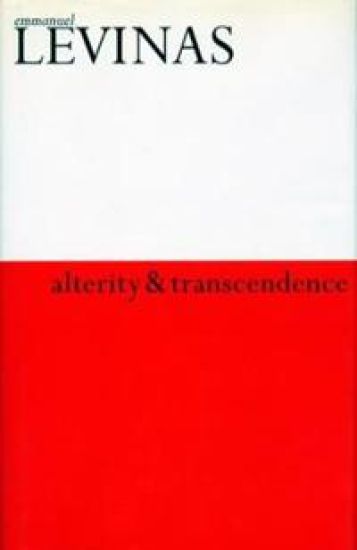
Internationally renowned as one of the great French philosophers of the twentieth century, the late Emmanuel Levinas remains a pivotal figure across the humanistic disciplines for his insistence-against the grain of Western philosophical tradition-on the primacy of ethics in philosophical investigation. This first English translation of a series of twelve essays known as Alterity and Transcendence offers a unique glimpse of Levinas defining his own place in the history of philosophy. Published by a mature thinker between 1967 and 1989, these works exhibit a refreshingly accessible perspective that seasoned admirers and newcomers will appreciate. In today's world, where religious conceptions of exalted higher powers are constantly called into question by theoretical investigation and by the powerful influence of science and technology on our understanding of the universe, has the notion of transcendence been stripped of its significance? In Levinas's incisive model, transcendence is indeed alive-not in any notion of our relationship to a mysterious, sacred realm but in the idea of our worldly, subjective relationships to others. Without presupposing an intimate knowledge of the history of philosophy, Levinas explores the ways in which Plotinus, Descartes, Husserl, and Heidegger have encountered the question of transcendence. In discourses on the concepts of totality and infinity, he locates his own thinking in the context of pre-Socratic philosophers, Aristotle, Leibniz, Spinoza, Kant, and Descartes. Always centering his discussions on the idea of interpersonal relations as the basis of transcendence, Levinas reflects on the rights of individuals (and how they are inextricably linked to those of others), the concept of peace, and the dialogic nature of philosophy. Finally, in interviews conducted by Christian Chabanis and Angelo Bianchi, Levinas responds to key questions not directly addressed in his writings. Throughout, Alterity and Transcendence reveals a commitment to ethics as first philosophy-obliging modern thinkers to investigate not merely the true but the good.
This book consists of transcripts from two lecture courses Levinas delivered in 1975-76, his last year at the Sorbonne. They cover some of the most pervasive themes of his thought and were written at a time when he had just published his most important—and difficult—book, Otherwise than Being, or Beyond Essence. Both courses pursue issues related to the question at the heart of Levinas's thought: ethical relation. The Foreword and Afterword place the lectures in the context of his work as a whole, rounding out this unique picture of Levinas the thinker and the teacher. The lectures are essential to a full understanding of Levinas for three reasons. First, he seeks to explain his thought to an audience of students, with a clarity and an intensity altogether different from his written work. Second, the themes of God, death, and time are not only crucial for Levinas, but they lead him to confront their treatment by the main philosphers of the great continental tradition. Thus his discussions of accounts of death by Heidegger, Hegel, and Bloch place Levinas's thought in a broader context. Third, the basic concepts Levinas employs are those of Otherwise than Being rather than the earlier Totality and Infinity: patience, obsession, substitution, witness, traumatism. There is a growing recognition that the ultimate standing of Levinas as a philosopher may well depend on his assessment of those terms. These lectures offer an excellent introduction to them that shows how they contribute to a wide range of traditional philosophical issues.
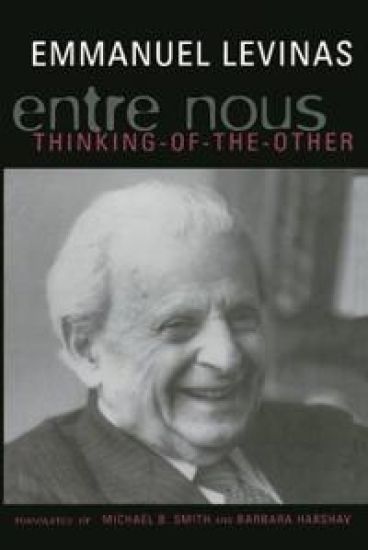
Emmanuel Levinas is one of the most important figures of twentieth-century philosophy. Exerting a profound influence upon such thinkers as Derrida, Lyotard, Blanchot, and Irigaray, Levinas's work bridges several major gaps in the evolution of continental philosophy-between modern and postmodern, phenomenology and poststructuralism, ethics and ontology. He is credited with having spurred a revitalized interest in ethics-based philosophy throughout Europe and America. Entre Nous (Between Us) is the culmination of Levinas's philosophy. Published in France a few years before his death, it gathers his most important work and reveals the development of his thought over nearly forty years of committed inquiry. Along with several trenchant interviews published here, these essays engage with issues of suffering, love, religion, culture, justice, human rights, and legal theory. Taken together, they constitute a key to Levinas's ideas on the ethical dimensions of otherness. Working from the phenomenological method of Edmund Husserl and Martin Heidegger, Levinas pushed beyond the limits of their framework to argue that it is ethics, not ontology, that orients philosophy, and that responsibility precedes reasoning. Ethics for Levinas means responsibility in relation to difference. Throughout his work, Levinas returns to the metaphor of the face of the other to discuss how and where responsibility enters our lives and makes philosophy necessary. For Levinas, ethics begins with our face to face interaction with another person-seeing that person not as a reflection of one's self, nor as a threat, but as different and greater than self. Levinas moves the reader to recognize the implications of this interaction: our abiding responsibility for the other, and our concern with the other's suffering and death. Situated at the crossroads of several philosophical schools and approaches, Levinas's work illuminates a host of critical issues and has found resonances among students and scholars of literature, law, religion, and politics. Entre Nous is at once the apotheosis of his work and an accessible introduction to it. In the end, Levinas's urgent meditations upon the face of the other suggest a new foundation upon which to grasp the nature of good and evil in the tangled skein of our lives.
The "Nations" are the "seventy nations": a metaphor which, in the Talmudic idiom, designates the whole of humanity surrounding Israel. In this major collection of essays, Levinas considers Judaism's uncertain relationship to European culture since the Enlightenment, problems of distance and integration. It also includes essays on Franz Rosenzweig and Moses Mendelssohn, and a discussion of central importance to Jewish philosophy in the context of general philosophy. This work brings to the fore the vital encounter between philosophy and Judaism, a hallmark of Levinas's thought.
Levinas' Kritik an der abendlandischen Ontologie besteht darin, dass sie weder die Frage nach dem Anderen noch die ethische Frage nachdrucklich genug gestellt hat. Er betont, dass seine Beziehung zur Unendlichkeit des Anderen letztendlich der Erorterung unzuganglich bleibt. Gleichwohl halt er es fur die Aufgabe der Philosophie, dieser Beziehung Sprache zu verleihen. Levinas nimmt die Krise des neuzeitlichen Humanismus so ernst, dass im Kampf um die Sinnhaftigkeit einer bis an die Grenze gehenden Sprachlosigkeit die Berufung zu einer vorgangig anders bestimmten Conditio humana vernehmbar wird. Ihr Ort ist die Sinnlichkeit und Verletzlichkeit des Menschen, ihre Bestimmung eine "unubernehmbare Passivitat", fur die man sich sowenig vertreten lassen kann wie fur das eigene Sterben.
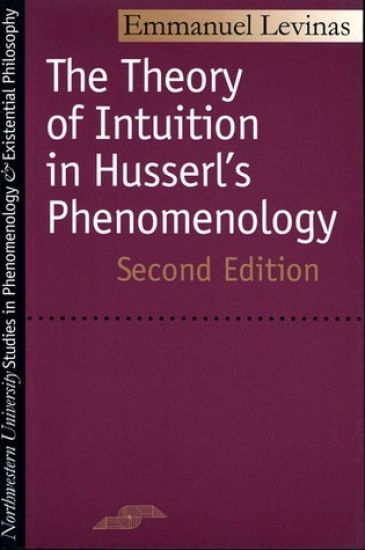
As an exponent of the phenomenological tradition, Levinas ranks with Heidegger and Sartre; as a disciple of Husserl, he was one of the most independent and original interpreters of phenomenology. This volume collects most of Levina's articles on Husselian phenomenology as well as providing insight into the complexities and difficulties of Levina's thought for the expert.
This is a study that discusses the aspects and function of intuition in Husserl's thought and its meaning for philosophical self-reflection. It focuses on the role of intuition in Husserl, demonstrating how his theory of intuition follows directly from his new conception of being. He then identifies intuition as the original phenomenon that leads to the concept of truth itself. The introduction has updated the critical apparatus, and places this work in the context of contemporary phenomenology.
One of the most influential philosophers of our day has selected 16 previously uncollected pieces that are unified by Levinas's project of revising the phenomenological description of the world in light of our experience of other persons.
One of the most influential philosophers of our day has selected 16 previously uncollected pieces that are unified by Levinas's project of revising the phenomenological description of the world in light of our experience of other persons.