Kirjojen hintavertailu – 12 859 828 kirjaa ja 27 kauppaa

Kirjailija

Erchin Serpedin

Kirjat ja teokset yhdessä paikassa: 5 kirjaa, julkaisuja vuosilta 2008–2021, suosituimpiin kuuluu Efficient Integration of 5G and Beyond Heterogeneous Networks. Vertaile teosten hintoja ja tarkista saatavuus suomalaisista kirjakaupoista.

5 kirjaa

Kirjojen julkaisuvuodet: 2008–2021.

Efficient Integration of 5G and Beyond Heterogeneous Networks

Efficient Integration of 5G and Beyond Heterogeneous Networks

Zi-Yang Wu; Muhammad Ismail; Justin Kong; Erchin Serpedin; Jiao Wang

SPRINGER VERLAG, SINGAPORE
2021
nidottu
This book discusses the smooth integration of optical and RF networks in 5G and beyond (5G+) heterogeneous networks (HetNets), covering both planning and operational aspects. The integration of high-frequency air interfaces into 5G+ wireless networks can relieve the congested radio frequency (RF) bands. Visible light communication (VLC) is now emerging as a promising candidate for future generations of HetNets. Heterogeneous RF-optical networks combine the high throughput of visible light and the high reliability of RF. However, when implementing these HetNets in mobile scenarios, several challenges arise from both planning and operational perspectives. Since the mmWave, terahertz, and visible light bands share similar wave propagation characteristics, the concepts presented here can be broadly applied in all such bands. To facilitate the planning of RF-optical HetNets, the authors present an algorithm that specifies the joint optimal densities of the base stations by drawing on stochastic geometry in order to satisfy the users’ quality-of-service (QoS) demands with minimum network power consumption. From an operational perspective, the book explores vertical handovers and multi-homing using a cooperative framework. For vertical handovers, it employs a data-driven approach based on deep neural networks to predict abrupt optical outages; and, on the basis of this prediction, proposes a reinforcement learning strategy that ensures minimal network latency during handovers. In terms of multi-homing support, the authors examine the aggregation of the resources from both optical and RF networks, adopting a two-timescale multi-agent reinforcement learning strategy for optimal power allocation. Presenting comprehensive planning and operational strategies, the book allows readers to gain an in-depth grasp of how to integrate future coexisting networks at high-frequency bands in a cooperative manner, yielding reliable and high-speed 5G+ HetNets.
Efficient Integration of 5G and Beyond Heterogeneous Networks

Efficient Integration of 5G and Beyond Heterogeneous Networks

Zi-Yang Wu; Muhammad Ismail; Justin Kong; Erchin Serpedin; Jiao Wang

Springer Verlag, Singapore
2020
sidottu
This book discusses the smooth integration of optical and RF networks in 5G and beyond (5G+) heterogeneous networks (HetNets), covering both planning and operational aspects. The integration of high-frequency air interfaces into 5G+ wireless networks can relieve the congested radio frequency (RF) bands. Visible light communication (VLC) is now emerging as a promising candidate for future generations of HetNets. Heterogeneous RF-optical networks combine the high throughput of visible light and the high reliability of RF. However, when implementing these HetNets in mobile scenarios, several challenges arise from both planning and operational perspectives. Since the mmWave, terahertz, and visible light bands share similar wave propagation characteristics, the concepts presented here can be broadly applied in all such bands. To facilitate the planning of RF-optical HetNets, the authors present an algorithm that specifies the joint optimal densities of the base stations by drawing on stochastic geometry in order to satisfy the users’ quality-of-service (QoS) demands with minimum network power consumption. From an operational perspective, the book explores vertical handovers and multi-homing using a cooperative framework. For vertical handovers, it employs a data-driven approach based on deep neural networks to predict abrupt optical outages; and, on the basis of this prediction, proposes a reinforcement learning strategy that ensures minimal network latency during handovers. In terms of multi-homing support, the authors examine the aggregation of the resources from both optical and RF networks, adopting a two-timescale multi-agent reinforcement learning strategy for optimal power allocation. Presenting comprehensive planning and operational strategies, the book allows readers to gain an in-depth grasp of how to integrate future coexisting networks at high-frequency bands in a cooperative manner, yielding reliable and high-speed 5G+ HetNets.
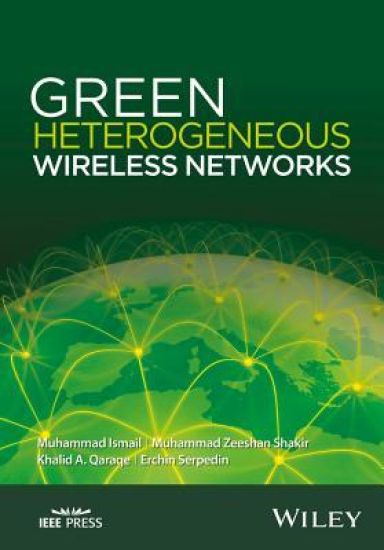
Green Heterogeneous Wireless Networks

Green Heterogeneous Wireless Networks

Muhammad Ismail; Muhammad Zeeshan Shakir; Khalid A. Qaraqe; Erchin Serpedin

Wiley-Blackwell
2016
sidottu
This book focuses on the emerging research topic "green (energy efficient) wireless networks" which has drawn huge attention recently from both academia and industry. This topic is highly motivated due to important environmental, financial, and quality-of-experience (QoE) considerations. Specifically, the high energy consumption of the wireless networks manifests in approximately 2% of all CO2 emissions worldwide. This book presents the authors’ visions and solutions for deployment of energy efficient (green) heterogeneous wireless communication networks. The book consists of three major parts. The first part provides an introduction to the "green networks" concept, the second part targets the green multi-homing resource allocation problem, and the third chapter presents a novel deployment of device-to-device (D2D) communications and its successful integration in Heterogeneous Networks (HetNets). The book is novel in that it specifically targets green networking in a heterogeneous wireless medium, which represents the current and future wireless communication medium faced by the existing and next generation communication networks. The book focuses on multi-homing resource allocation, exploiting network cooperation, and integrating different and new network technologies (radio frequency and VLC), expanding the network coverage and integrating new device centric communication paradigms such as D2D Communications. Whilst the book discusses a significant research topic supported with advanced mathematical analysis, the resulting algorithms and solutions are explained and summarized in a way that is easy to follow and grasp. This book is suitable for networking and telecommunications engineers, researchers in industry and academia, as well as students and instructors.
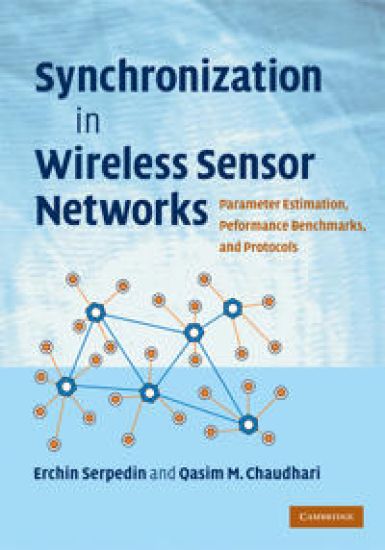
Synchronization in Wireless Sensor Networks

Synchronization in Wireless Sensor Networks

Erchin Serpedin; Qasim M. Chaudhari

Cambridge University Press
2009
sidottu
Wireless sensor networks are set to play a key role in a wide range of civilian and military applications, with tiny sensors connected through wireless links performing various sensing, computing, communication, and control tasks in highly distributed systems. This book presents a critical element in the deployment of wireless sensor networks: the process of synchronization. It summarizes the most important clock synchronization protocols proposed for wireless sensor networks with special emphasis placed on deriving efficient clock offset estimation schemes and performance benchmarks. Graduate students of electrical and computer engineering and computer science will find this a valuable resource, as will engineers who are interested in designing efficient clock synchronization algorithms and improving the performance of existing synchronization protocols.