Kirjojen hintavertailu – 12 903 725 kirjaa ja 27 kauppaa
Kirjailija
Erdener Kaynak
Kirjat ja teokset yhdessä paikassa: 86 kirjaa, julkaisuja vuosilta 1985–2021, suosituimpiin kuuluu Market Evolution in Developing Countries. Vertaile teosten hintoja ja tarkista saatavuus suomalaisista kirjakaupoista.
Going global can be risky business if you don't divest yourself of your ethnocentric thinking. You have to take into consideration your new market's language, work schedules, tastes, lifestyle choices, and cultural associations, and this is the book to help you do that! Handbook of Cross-Cultural Marketing shows you how to sensitize your marketing approaches to the cultural norms and taboos of other societies, as well as the importance of demonstrating an interest in and appreciation of different cultures. Designed to assist both American and foreign companies, Handbook of Cross-Cultural Marketing shows you how to increase your chance at success in international markets. It identifies and explains ten important aspects of culture that are essential to cross-cultural marketing to help you understand how underlying cultural beliefs govern the way marketing functions in different societies. It also gives you specific steps for developing cultural adaptation strategies in international marketing. To further your understanding of global marketing and fundamental marketing concepts, this comprehensive book discusses:real life examples of company successes and failures abroad attitudes toward middlemen in underdeveloped countries the advantages of foreign trade shows locating and using representatives, agents, and/or distributors in foreign countries the reception of different American products in different countries potential cultural pitfalls of primary data collecting techniques the role of time in various cultures setting standards for product performanceA useful text for students and practitioners alike, Handbook of Cross-Cultural Marketing gives you hands-on strategies and advice for delving into different markets, using techniques that are respectful of individual cultures, and avoiding unnecessary mistakes that can occur if you don't take the initiative to get to know the culture of your new marketplace. Your outlook and beliefs are not the global norm, so read this book to find out how you can be successful with customers who are different from you in terms of motivation, values, beliefs, and outlook.

If you feel you have a disjointed, or unbalanced, view of the global system of demand and supply, you are probably correct. Most studies leave out a very important part of the system--the marketing channel. That is why Laurens van der Laan developed and wrote this book, The Trans-Oceanic Marketing Channel. To help you understand what happens to export crops, such as cocoa, coffee, cotton, groundnuts, tea, and tobacco, between their country of origin and consumer markets, this book analyzes the roles of different actors in trans-oceanic trade, inherent differences between world markets, export diversification policies, and the commercial and institutional forces at play. The Trans-Oceanic Marketing Channel will give you a strong background in marketing channel concepts, and because of its focus on the exporter rather than on the government, it will provide you with an excellent model for microanalysis. As you read about the special features of trans-oceanic trade, you will also learn about:trade associations and their role in shaping world markets for trans-oceanic crops the uneasy relationship between exporters and shipping companies the selling conduct of agricultural exporters in Africa the tendency of actors in Africa to accelerate the trans-oceanic product flow the effectiveness of export marketing boards as channel leaders private enterprise, the chief agent of development the theory of “exporter preference”The Trans-Oceanic Marketing Channel invites policymakers, international businessmen, professors, and students to examine the opportunities, problems, and policies that confront the various players in trans-oceanic trade, especially the exporters. As the book discusses the divergent institutional arrangements in the world markets for agricultural products and their differential effect on African exports, you will become keenly aware of how vertical marketing systems differ from conventional marketing channels. No other book brings together the three fundamental sections of export agriculture, the country of production, the channel through which the products flow, and the country of destination, to provide you with a complete understanding of trans-oceanic marketing.
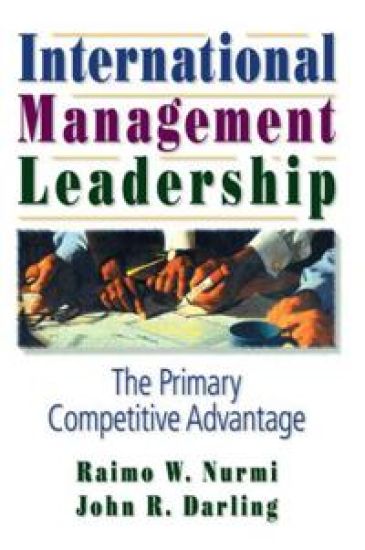
The primary competitive advantage that firms have today is the perspective, outlook, and commitment of their management leaders. International Management Leadership helps you develop the leadership skills that will enable your firm to stay competitive in today's global business environment. From the necessary international perspective, this book provides you with the information you need to understand the competitive factors that distinguish one firm from another and to recognize the determinants of success. Giving you formats and outlines and a fresh perspective of your work, your organization, and yourself, International Management Leadership is much more practical than other management textbooks. You'll learn how to help make your company more effective in the arena of international management leadership as you read about:requirements of and special demands on international managers managerial leadership in the era of knowledge strategic leadership and implementation of strategy management as a fulfillment of purpose leadership of conflict management transformational leadership team leadershipWhether you're an individual involved in a management training program, a management consultant, an executive manager, or a student of international management or business, you'll appreciate this book's take on the competitive factors of leadership in international business today. As a textbook, International Management Leadership provides students with a broad perspective on the practice of managerial leadership and organizational life in the global arena--bringing examples to life and going far beyond what is needed to simply pass a course.
Since the sudden opening of the markets in Central and Eastern Europe (CEE) in 1989, there has been a growing need to investigate the fundamental changes occurring in the countries’marketing environment, the lucrative market opportunities created by the changes, and the inscrutable marketing practice followed by local and international companies. Marketing in Central and Eastern Europe helps you understand the changes taking place in these valuable and challenging markets and introduces you to the emerging opportunities and effective marketing strategies to be employed in the region. Researchers specializing in CEE business; managers of international companies operating in or contemplating entering CEE markets; and students studying CEE business, East-West business, or marketing in transitional economies will better understand the region by examining issues of cross- cultural inquiry, commonality, and market segmentation. Marketing in Central and Eastern Europe also provides you with:a region-relevant market analysis to determine environmental dimensions of emerging markets a preliminary report on market-entry strategies in Poland an assessment of foreign direct investment opportunities in Hungary a study of Western-style marketing applied in transitional economies an analysis of marketization and Westernization used as classifying dimensions information on increasing the validity of post-command economy research and applicationAlthough the book’s chapters cover a variety of topics and use different research approaches and methodologies, they have a common theme--there is a great interest in, and an equally great need to scientifically investigate, rapidly emerging market opportunities, marketing-environment issues, and marketing-strategy problems with respect to transitional economies of Central and Eastern Europe.
If you find traditional lectures and course material ineffective for teaching students how to develop a sensitivity to cultural differences and apply “home grown” technologies to foreign situations, Business Simulations, Games and Experiential Learning in International Business Education is the guide to help you remedy this predicament! Helpful and easy-to-use, this text teaches you how to use computer-based games and experiential learning exercises to teach international business. You’ll learn how to place students in realistic situations where they can experiment with new behaviors and receive immediate, constructive feedback and then take what they have learned beyond the classroom. Business Simulations, Games and Experiential Learning in International Business Education helps you introduce students to global competition and business cultures as you explore important ethical, political, and social issues with them. You can better prepare your students for the challenges of international business if you pay particular attention to the book’s discussions of:different levels of power-sharing alternatives to traditional international business course materials and methods changing the norms and behaviors of organizations and institutions the role gender plays in effective gaming environments simulating a European Works Council within a classroom environment promoting decisionmaking and flexibility in management style understanding business rules and regulations of different countriesAcademics teaching and researching in international business will find Business Simulations, Games and Experiential Learning in International Business Education an immensely useful tool as you struggle with the challenges of readying students for the international work environment. As you know, it is not enough that students be schooled in the latest developments and technologies. Use this book’s games and learning techniques to emphasize to your students that international businessmen and women must not only know their field, but also be respectful of others’cultures and values, be linguistically flexible, and be aware of foreign business rules and regulations.
Here is a comprehensive guide for training a workforce in Total Quality Management (TQM). An ideal resource for trainers, Total Quality Management Implementation contains a complete presentation of all relevant aspects of TQM. It provides a ready-made training format that can be used in all operational seminar/workshop contexts and includes a full set of charts for use by trainers in their presentations of TQM. The book assumes the trainer has a basic understanding of quality management, and it does not repeat the numerous discussions of TQM concepts readily available in other works. Total Quality Management Implementation begins with an overview of the current status of TQM in the United States. It then presents W. Edward Deming’s 14 point TQM philosophy, the core of his recommendations for achieving quality excellence through continuous improvement, along with a discussion of each point. The presentation charts have been designed to allow the trainer to adapt them to a particular organization’s unique characteristics and to supplement or add to them as necessary to fully explain each point to a particular audience. The charts are arranged in sequential order and follow the approach used by the author in training seminars around the world. Trainers can easily manipulate the length of the presentation for different audiences and purposes. A reference section lists many books on TQM principles which provide a helpful refresher. Total Quality Management Implementation is a unique and helpful guide for trainers with a basic knowledge of TQM, college or university faculty teaching TQM seminars or courses, and consultants and quality professionals who could use a reference and checklist of TQM principles.
The values and behaviors of the Japanese businessman--and of the Japanese in general--are quite diverse and keep changing, making it difficult for anyone (including the Japanese themselves) to truly understand why they act the way they do. The Eight Core Values of the Japanese Businessman saves readers time and effort when pursuing business opportunities in Japan because it identifies the core values of the Japanese businessman, ranging from the obvious and public, “Diligence,” to the more private, “Silence as Eloquence” and “Perception of Time.” After identifying these eight core values, Yasutaka Sai explores the history and modern interpretation of each. Based on over 300 Japanese language sources--otherwise unavailable to those who do not read Japanese--The Eight Core Values of the Japanese Businessman reveals the diversity and dynamism of Japanese values and behaviors. This information empowers businesspeople and international business educators to develop solid business relationships with the Japanese. With many years of experience, the author focuses on specific values that are most common among Japanese in the business world. These are not exclusive, but the most prevalent or widely shared values that Western businesspeople are likely to encounter:Japanese diligence, work ethic, and “Gambarism” or persistence group orientation: sense of belonging and participation, spirit of harmony, interpersonal relations aesthetics and perfectionism curiosity and emphasis on innovation respect for form and “Hana Yori Dango” or practicality a mind for competition and outlook on rewards the value of silence as eloquence perception of timeAs there is no single uniformly accepted source for the values of today's Japanese citizen or business person, Sai's exploration opens a vital window into understanding many Japanese values and behaviors. The Eight Core Values of the Japanese Businessman is vital reading for those with international business concerns--business and management educators, businesspeople interested in how Japanese managers manage and employees work, and practicing managers interested in cross-cultural management issues. It allows readers to develop good relationships with the Japanese based on a realistic understanding of how they think and act, both individually and as members of business organizations.
Privatization and Entrepreneurship: The Managerial Challenge in Central and Eastern Europe analyzes the challenges faced by managers in the transforming economies of Central and Eastern Europe and provides penetrating insights into the details of managing in the former socialist countries. This collection’s combination of conceptual/theoretical material with empirical, firsthand case analysis prepares Western managers for a more profitable and less stressful entry into these significant markets. This enlightening book highlights the complexity and breadth of the issues and problems of successfully entering new markets in Central and Eastern Europe. Along the way, you are introduced to such topics as consumer behavior and shown the different forms of foreign direct investment with their associated problems and benefits. If you are searching for ways to better prepare for business in these markets, this book can help you meet your objectives with its helpful information on:ethical concerns and linguistic difficulties of managing in transforming economies management challenges of privatization management challenges of entrepreneurship strategic issues associated with the reorientation of enterprises corporate constituencies, changing consumers, labor unions, and pay practicesPrivatization and Entrepreneurship will prove valuable to policymakers in economic development and foreign aid agencies, executives of companies planning to expand into Europe and those already active in the region, and academicians and students in management, economics, and political science.
Global Tourist Behavior contains travel and marketing research that explores the integral global nature of tourism. The globalization of tourism has resulted in more culturally diverse travelers with different preferences, motivations, expectations, and needs, while at the same time worldwide movements toward democracy have made some locations more accessible than ever before. New diversity in global tourist behavior and the reciprocal interaction between travelers and destinations will pose new challenges and create new opportunities for tourism professionals. Global Tourist Behavior helps readers meet these challenges by providing unique and invaluable new research on global travel behavior as an integral component of travel and tourism marketing research. It features original, empirical research by tourism scholars representing a variety of locations worldwide, including North America, the Caribbean, Eastern Europe, Germany, Indonesia, Korea, the Netherlands, the United Kingdom, and Zambia. The geographically diverse chapters in Global Tourist Behavior present research on:marketing places to tourists tourists’knowledge of culture issues in cross-cultural tourism tourism channels and distribution systems international tourism and marketing expert systems in tourism marketing management the impact of mega events health tourism. Tourism promoters, decisionmakers, and students will find the information on international travelers’preferences, expectations, motivations, images, attitudes, and choices of tour packages extremely helpful. The book can also be used as a guide for attracting international tourist business and developing appropriate marketing and management strategies for specific destinations.
Global Perspectives in Cross-Cultural and Cross-National Consumer Research deals with several important issues crucial for greater understanding of international and cross-cultural consumer behavior. This understanding in turn can provide international marketers with valuable insights, such as conditions under which globalization may or may not work. The coverage in this book is interdisciplinary in nature, and the chapters discuss several constructs (intermediary variables, processes, and also other environmental influences) related to social, personal, and psychological components or consequences of culture. The book begins with a conceptual model of the effect of culture on consumer behavior, with the components and consequences of the cultural influences clearly identified in terms of social, personal, and psychological factors. The following chapters discuss general issues related to globalization and standardization, present conceptual approaches to propositions relating to multicultural contexts, and address consumer complaining behavior and responses to advertising. There are five chapters on empirical and methodological studies conducted in specific pairs of countries, with data obtained from Canada, Denmark, Japan, Germany, Poland, Romania, and the United States. In presenting readers with new information, Global Perspectives in Cross-Cultural and Cross-National Consumer Research spans these specific topics: the nature of cultural influence on consumer behavior globalization versus customization of international marketing strategy individualism versus collectivism right versus left symbolism product involvement consumer response to information technology interdependent versus independent culturesThe contributors are well-known scholars in the international/cross-cultural marketing field; their chapters present state-of-the-art developments in this area. The coverage of the material is interdisciplinary in nature and is likely to benefit a broad audience, especially academic researchers in international or cross-cultural consumer research and librarians of research-oriented schools, universities, or organizations.
Social, economic, political, business, and cultural environmental factors affect the international marketing operation and performance of international firms. This highly insightful volume focuses on four of the most significant forces with which companies must deal on an international level--macro international marketing issues, sociopolitical international marketing issues, international marketing strategies, and special international marketing topics. Within this framework, experts examine the impact of two major environmental factors, namely the social and political conditions, on international companies to adopt corresponding marketing techniques and practices in different international markets. They also explore how specific details of a country, such as income level, cultural attributes, consumer characteristics, laws, and politics, influence the market potential of international firms and thus the scale of the company operations. Indispensable reading for scholars, economists, and business people who are interested in marketing on a global scale.
In An International Accounting Practice Set, the only currently available simulation for international accounting, business and accounting students assume the role of a newly-hired employee in the international accounting department of Karissa Jean's, an international distributor of men's and women's jeans. In this role, the student first participates in the company's training program in international business and accounting, working through the first section of the book. After completing the training program, the student performs as an international accountant in Karissa Jean's international accounting department, moving through the second part of the book. In this fashion, readers have a hands-on opportunity to apply newly acquired knowledge in a realistic business setting. The Karissa Jean's simulation works for both those with some familiarity with this topic and for those with no knowledge of international business or accounting. While the authors have targeted the book to community college students, private business school students, and undergrad business and accounting students (with at least one course of Principles of Accounting), this simulation also works for recertification training for accountants and for basic training in business (for new employees or to retrain other employees in international business or accounting principles), industry, and government. The simulation is twofold: job training and job simulation. The training manual of An International Accounting Practice Set teaches readers everything they need to complete the simulation. As a Karissa Jean's “accountant,” readers will learn firsthand:how to convert foreign currencies to U. S. dollars and vice versa. how to record international sales, purchases, cash payments, and cash receipts in an American company's general ledger and in a foreign marketing subsidiary ledger. how to record adjusting entries for unsettled accounts payable and accounts receivable at the end of the accounting period. how to audit the French marketing subsidiary's ledger and identify and correct any errors. how to translate foreign financial statements from French francs into U. S. dollars. how to perform problem-solving and writing activities, such as translating a Spanish memo into English and preparing an outline for a speech on international accounting. In doing the Karissa Jean's simulation, students begin to apply classroom knowledge in an employment setting. It is an ideal approach for students with no prior knowledge of international business or accounting who wish to pursue that career field. Those who are familiar with accounting will appreciate the “hands on” opportunity to test their knowledge in an international employment setting. All readers will come to better understand international business issues, including balance of trade and balance of payments, international trade organizations like GATT, the World Bank, and cartels. An International Accounting Practice Set explores related issues in international business, such as ways to enter foreign markets, potential obstacles to foreign trade--cultural and language differences, economic conditions, marketing difficulties, fluctuating currency exchange rates, government instability, and trade protectionism--and provides ideas on how to overcome or prevent such obstacles from becoming trade barriers.
Here is a comprehensive guide for training a workforce in Total Quality Management (TQM). An ideal resource for trainers, Total Quality Management Implementation contains a complete presentation of all relevant aspects of TQM. It provides a ready-made training format that can be used in all operational seminar/workshop contexts and includes a full set of charts for use by trainers in their presentations of TQM. The book assumes the trainer has a basic understanding of quality management, and it does not repeat the numerous discussions of TQM concepts readily available in other works. Total Quality Management Implementation begins with an overview of the current status of TQM in the United States. It then presents W. Edward Deming’s 14 point TQM philosophy, the core of his recommendations for achieving quality excellence through continuous improvement, along with a discussion of each point. The presentation charts have been designed to allow the trainer to adapt them to a particular organization’s unique characteristics and to supplement or add to them as necessary to fully explain each point to a particular audience. The charts are arranged in sequential order and follow the approach used by the author in training seminars around the world. Trainers can easily manipulate the length of the presentation for different audiences and purposes. A reference section lists many books on TQM principles which provide a helpful refresher. Total Quality Management Implementation is a unique and helpful guide for trainers with a basic knowledge of TQM, college or university faculty teaching TQM seminars or courses, and consultants and quality professionals who could use a reference and checklist of TQM principles.
This groundbreaking book is the first to provide state-of-the-art information on the current changes and developments in European food and agricultural marketing. Food and Agribusiness Marketing in Europe contains broad and up-to-date coverage of agricultural and food marketing by experts in a variety of European countries including Germany, Greece, Italy, the United Kingdom, France, Ireland, Belgium, the Netherlands, Spain, and Hungary. With chapters selected by the famous marketing specialist Matthew Meulenberg of The Netherlands, this enlightening book allows food and marketing professionals to gain new perspectives on the changing roles of food retailing and food industry in agricultural marketing and the structure of agriculture and food markets. This insightful book introduces readers to the common factors influencing European food marketing today including the stagnating volume of food demand, severe competition between suppliers of agricultural and food products, the overall shift in agricultural marketing towards more market-consumer orientation, and the resulting concern about product development, branding, and customer relationships. Major national differences in food and agricultural marketing in each country are also analyzed, in particular, the problems of implementing European Community legislation in the face of tremendous divergences among member countries in their needs, expectations, and priorities. Some of the other important topics covered in this in-depth book include:European food consumption and consumersfood retailing in Europethe impact of the Common Agricultural policy and other government policies on agricultural marketingthe conduct of agricultural marketing institutions and agribusinesses and their marketing performancesagricultural and food marketing channels in European countries Food and Agribusiness Marketing in Europe is the first resource available that provides essential information on the tremendous changes in food and agricultural marketing in Europe. It is an invaluable reference on European marketing for students and teachers of agricultural marketing, European-oriented agribusiness managers, and internationally oriented agriculture policymakers who need to develop an understanding of food marketing developments in this area of the world.
Ethical Issues in International Marketing is a valuable resource for readers’increasing need for knowledge of this important area. In recent years, ethical issues in international marketing have come to the forefront due to publicity and controversy generated from several international cases of questionable ethics. To date, little research has been conducted in the area of international marketing ethics. Delener's book comes at an important time to alert readers to the growing concern for greater ethical behavior in the international marketing arena. It provides illustrations to give readers hands-on experiences that can transfer directly into the marketing world. Delener and his contributing authors identify the unique importance of ethics and corporate social responsibility in global markets. Ethical Issues in International Marketing was conceived to allow researchers the liberty to explore the topic in the context of an environment supportive of the difficulties associated with this type of research. The contributing authors discuss these main topics:A social contract for analyzing and evaluating the activities of transnational corporations in developing countries The relationship of marketing ethics to gray markets for consumer goods How moral commitment is shaped by socialization and role of culture in Turkey The relationship between Egyptian consumers’ideology and theirperceptions of ethical behaviorReaders who desire to make steps toward better global decisionmaking will find this a compelling book. The authors make readers realize that conducting business transactions efficiently and effectively in a mere technocratic sense is no longer sufficient. Ethical issues in the international marketing environment are best addressed in learning more about the differences between cultures, which this book begins to do.
The values and behaviors of the Japanese businessman--and of the Japanese in general--are quite diverse and keep changing, making it difficult for anyone (including the Japanese themselves) to truly understand why they act the way they do. The Eight Core Values of the Japanese Businessman saves readers time and effort when pursuing business opportunities in Japan because it identifies the core values of the Japanese businessman, ranging from the obvious and public, “Diligence,” to the more private, “Silence as Eloquence” and “Perception of Time.” After identifying these eight core values, Yasutaka Sai explores the history and modern interpretation of each. Based on over 300 Japanese language sources--otherwise unavailable to those who do not read Japanese--The Eight Core Values of the Japanese Businessman reveals the diversity and dynamism of Japanese values and behaviors. This information empowers businesspeople and international business educators to develop solid business relationships with the Japanese. With many years of experience, the author focuses on specific values that are most common among Japanese in the business world. These are not exclusive, but the most prevalent or widely shared values that Western businesspeople are likely to encounter:Japanese diligence, work ethic, and “Gambarism” or persistence group orientation: sense of belonging and participation, spirit of harmony, interpersonal relations aesthetics and perfectionism curiosity and emphasis on innovation respect for form and “Hana Yori Dango” or practicality a mind for competition and outlook on rewards the value of silence as eloquence perception of timeAs there is no single uniformly accepted source for the values of today's Japanese citizen or business person, Sai's exploration opens a vital window into understanding many Japanese values and behaviors. The Eight Core Values of the Japanese Businessman is vital reading for those with international business concerns--business and management educators, businesspeople interested in how Japanese managers manage and employees work, and practicing managers interested in cross-cultural management issues. It allows readers to develop good relationships with the Japanese based on a realistic understanding of how they think and act, both individually and as members of business organizations.
Global Tourist Behavior contains travel and marketing research that explores the integral global nature of tourism. The globalization of tourism has resulted in more culturally diverse travelers with different preferences, motivations, expectations, and needs, while at the same time worldwide movements toward democracy have made some locations more accessible than ever before. New diversity in global tourist behavior and the reciprocal interaction between travelers and destinations will pose new challenges and create new opportunities for tourism professionals. Global Tourist Behavior helps readers meet these challenges by providing unique and invaluable new research on global travel behavior as an integral component of travel and tourism marketing research. It features original, empirical research by tourism scholars representing a variety of locations worldwide, including North America, the Caribbean, Eastern Europe, Germany, Indonesia, Korea, the Netherlands, the United Kingdom, and Zambia. The geographically diverse chapters in Global Tourist Behavior present research on:marketing places to tourists tourists’knowledge of culture issues in cross-cultural tourism tourism channels and distribution systems international tourism and marketing expert systems in tourism marketing management the impact of mega events health tourism. Tourism promoters, decisionmakers, and students will find the information on international travelers’preferences, expectations, motivations, images, attitudes, and choices of tour packages extremely helpful. The book can also be used as a guide for attracting international tourist business and developing appropriate marketing and management strategies for specific destinations.
Author Jansson merges different perspectives and ideas into a powerful theory on international marketing of industrial products, mainly modern approaches from marketing, organization theory, and institutional economic theory. He combines micro and macro approaches, which is rarely done in marketing and economics. Industrial Products illustrates this new framework with a detailed account of the experiences of thirteen West-European Transnational Corporations in industrial markets in South East Asia.