Kirjojen hintavertailu – 12 903 735 kirjaa ja 27 kauppaa

Kirjailija

Eric Alliez

Kirjat ja teokset yhdessä paikassa: 11 kirjaa, julkaisuja vuosilta 1996–2023, suosituimpiin kuuluu de L'Impossibilite de La Phenomenologie: Sur La Philosophie Francaise Contemporaine. Vertaile teosten hintoja ja tarkista saatavuus suomalaisista kirjakaupoista.

Nimi esiintyy myös muodoissa: Éric Alliez

11 kirjaa

Kirjojen julkaisuvuodet: 1996–2023.

Three Entries in the Form of Escape Diagrams

Three Entries in the Form of Escape Diagrams

Eric Alliez; Jean-Claude Bonne

Urbanomic Media Ltd
2023
nidottu
An operating manual for contemporary art that addresses the work of Daniel Buren, Gordon Matta-Clark, and G nter Brus. The late 1960s saw a radical undoing of the image in--and of--art, as the questions of art began to be posed in entirely new terms. In this critical and clinical examination of the post-conceptual condition's negotiations with the image, the body, capitalist semiotics, and the built environment, ric Alliez and Jean-Claude Bonne trace the trajectories of three artists, three key entries in the lexicon that are also entryways into contemporary art understood as a 'diagrammatic regime' inextricably related, in particular, to architecture. Daniel Buren systematically deconstructs all the forms of autonomy of art, through a tenacious in situ critique at once pragmatic and ontological operated by his visual tool, traced here from its origins to recent major museum installations; Gordon Matta-Clark's anarchitectural operation across site and non-site strikes at the functional foundations of architectural structuring, physical, social, and semiotic--a dis-organization and disorientation relayed by his photographic documentation of his projects. Viennese actionist G nter Brus's action drawings/drawing actions and stress tests recircuit markmaking, representation, and corporeality, producing wordless electroglyphs that render visible the inscription of relations of force within the body. This operating manual for contemporary art, richly illustrated and based throughout on close readings of the artists' works, writings, and actions across their entire careers, is an indispensable diagram of the lines of flight opened up by contemporary art, as well as the omnipresent threat of its capture by anesthesia and dematerialization, spectacle, the dogma of "site-specificity," and absorption into the neoliberal experience economy.
Boîte HO

Boîte HO

Eric Alliez; Jean-Claude Bonne

Urbanomic Media Ltd
2023
nidottu
How one of the leading artists of Neo-Concretism H lio Oiticica presaged the unique trajectory of Brazilian contemporary art with his intensive color-architectures. "The IMAGE-grip is dislocated and a more fundamental element emerges: in short, IMAGE is not the work's supreme motive or unifying end."--H lio Oiticica At the turn of the 1950s-1960s, one of the leading artists of Neo-Concretism, H lio Oiticica, presaged the unique trajectory of Brazilian contemporary art with his intensive color-architectures. In the wake of this viv ncia of "time-color," which subordinates the aesthetic to the sensorimotor powers of color, Oiticica's transcategorial, transmedia works critically and clinically undermine physical and social architecture, while semiotically subverting the forms of domination exerted by the image. In this culmination of their reassessment of the relation among art, philosophy, and the contemporary, ric Alliez and Jean-Claude Bonne show how these works are exemplary not only of a truly diagrammatic thought and practice, but also of the South's resistance against the coldly indifferent globalism endemic to the pacified institutions of contemporary art. Oiticica's tropicalization of the commonplaces of sixties art signals the latent potential of a marginal dissidence from both the aesthetic form of art and the conceptual form of anti-art.
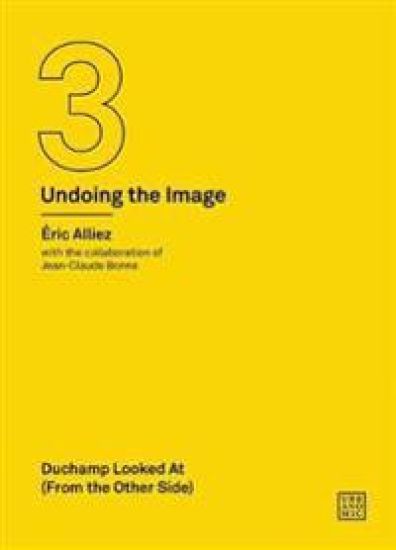
Duchamp Looked At (From the Other Side)

Duchamp Looked At (From the Other Side)

Eric Alliez; Jean-Claude Bonne

Urbanomic Media Ltd
2021
nidottu
A detailed examination of the motivations and precise coordinates of Duchamp's break from painting into the field of the linguistic sign. Matisse and Duchamp seem to incarnate ideal poles of the tension internal to modern art as it plunged into crisis the idea of the image-a polemical operation that opened the way to contemporary art's auto-problematization of experimental constructivism. Where Matisse subverted the aesthetic regime by bringing painting out of itself to invest its environment in a Bergsonian energetics of color, Duchamp cuts it offfrom the plastic arts through a reversal of Bergson's in-the-making. The readymadecaptures a literalized signifier of this perspective. Duchamp Looked At is an extraordinarily rich philosophical study that offers a startling new account of the dis/continuity between the problems of contemporary art and the new articulations Duchamp fabricated between image and idea, science and art, painting and language. Alliez and Bonne's meticulous archaeological survey rediscovers the real problems and motivations of "Duchamp-thought" through a close analysis of his entire oeuvre: from the Nudes in which the problem of representing movement is gradually displaced into the realm of the virtual, the image disqualified in favor of the diagram, to the pataphysical sciences of chance and the particular, the readymades, the Large Glass and Etant donnes-and beyond, as the artist carbonizes the gallery with 1200 Sacks of Coal and ties it up with Miles of String, in installations that take Duchamp beyond Duchamp.
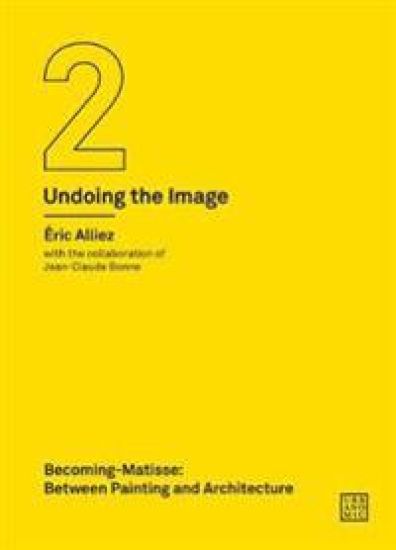
Becoming-Matisse

Becoming-Matisse

Eric Alliez

Urbanomic Media Ltd
2019
pokkari
A reevaluation of Matisse that reveals the complex function of his work and thought in contemporary art's escape from the image, from traditional forms of art, and even from the art form itself. Accused by his contemporaries of both arid overtheorisation and a hedonistic abandon to the pleasures of color, decried for a preoccupation with the merely decorative, retrospectively consigned to a subsidiary role in an official History of Art that sees the liberation of color from iconic conventions and symbolic associations as the inevitable precursor to the purified color of modernist formalis, Matisse, with his untimely singularity, his break with the History of Art, and the part he played in undoing the image is ripe for the reevaluation undertaken here with great panache by Eric Alliez and Jean-Claude Bonne, who with this volume restore Matisse to his place within the prehistory of contemporary art, while continuing to transform our understanding of the latter. It was Matisse who, with his understanding of the construction of colours as a means of vital expression, continued to exacerbate the fauves' decisive break with Form; in doing so, he also opened up painting to its outside, by cutting out color, and releasing it onto the walls and into architecture by way of a decorativity virtually generalized to the whole environment. With a series of detailed and compelling extended analyses of Matisse's works, we learn how "Matisse-thought" arrived at the magic formula expression=construction=decoration. This volume, the second "case study" in Alliez and Bonne's Undoing the Image, gives us a new Matisse extracted from cliches and stereotypes both popular and learned, revealing the complex function of his work and thought in contemporary art's escape from the image, from traditional forms of art, and even from the art form itself.
Wars and Capital

Wars and Capital

Éric Alliez; Maurizio Lazzarato

Semiotext (E)
2018
sidottu
A critique of capital through the lens of war, and a critique of war through the lens of the revolution of 1968." We are at war," declared the President of the French Republic on the evening of November 13, 2015. But what is this war, exactly? In Wars and Capital, Eric Alliez and Maurizio Lazzarato propose a counter-history of capitalism to recover the reality of the wars that are inflicted on us and denied to us. We experience not the ideal war of philosophers, but wars of class, race, sex, and gender; wars of civilization and the environment; wars of subjectivity that are raging within populations and that constitute the secret motor of liberal governmentality. By naming the enemy (refugees, migrants, Muslims), the new fascisms establish their hegemony on the processes of political subjectivation by reducing them to racist, sexist, and xenophobic slogans, fanning the flames of war among the poor and maintaining the total war philosophy of neoliberalism. Because war and fascism are the repressed elements of post-'68 thought, Alliez and Lazzarato not only read the history of capital through war but also read war itself through the strange revolution of '68, which made possible the passage from war in the singular to a plurality of wars-and from wars to the construction of new war machines against contemporary financialization. It is a question of pushing "'68 thought" beyond its own limits and redirecting it towards a new pragmatics of struggle linked to the continuous war of capital. It is especially important for us to prepare ourselves for the battles we will have to fight if we do not want to be always defeated.
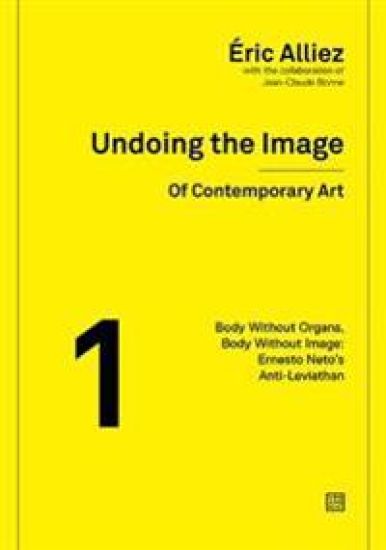
Body without Organs, Body without Image

Body without Organs, Body without Image

Éric Alliez

Urbanomic Media Ltd
2017
pokkari
A close analysis of the work of Brazilian artist Ernesto Neto reveals the fundamental stakes of a contemporary art in the process of undoing the image-form. The first volume of Eric Alliez and Jean-Claude Bonne's major work on contemporary art begins by outlining their exploratory and speculative project: not so much to produce a new "philosophy of art" as to enter into a space in-between philosophy and art-between a contemporary philosophy of contemporary art and an art contemporary with contemporary philosophy. But what exactly is the "contemporary"? And how can we make ourselves, philosophically, the contemporaries of works whose problematic nature no longer sits well under the categories of the "aesthetic," inherited from romanticism? In these case-studies of an art-thought that is inseparable from the continued construction of the very concept of a "contemporary art," philosophical analysis is continually displaced by the forces of works and practices of creation and reception that herald a new-processual and post-conceptual-configuration of art, with Matisse and Duchamp-Matisse-thought and Duchamp-thought-establishing a tension that, since the 1960s, has been "recharged" by the micropolitical options which have given rise to the critical and clinical problematisation of art. Moving through and beyond the thought of Deleuze and Guattari, the discovery of a diagrammatic regime of the contemporary synonymous with an undoing of the image of the aesthetic regime of art begins here with the work of Brazilian artist Ernesto Neto, as a close analysis of the diagrammatic forces at work in Leviathan Thot, Neto's major 2006 intervention in the Pantheon de la republique, reveals the fundamental stakes of a contemporary art in the process of undoing the image-form. Neto's "anarchitectural denunciation" takes on the (Hobbesian) metaphysical enunciation of the Leviathan-state, which his monstrous "counter-installation" recalls and reproblematizes by placing all of the Pantheon's physical and metaphysical coordinates into and under tension. Grappling with this foreign body both critically and clinically, Alliez and Bonne reveal how the "Neto Operation" engages with nothing less than the image of power in its relation to the power of the image that animates it and endows it with a discursive existence.
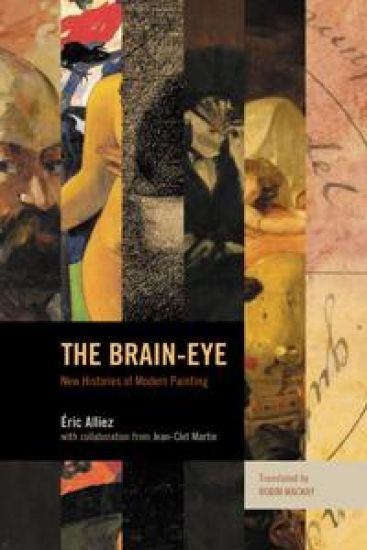
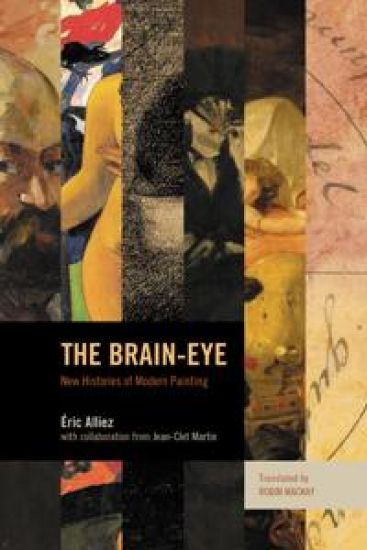
The Brain-Eye

The Brain-Eye

Eric Alliez

Rowman Littlefield International
2015
sidottu
A detailed and inventive study of the thinking at work in modern painting, drawing on a formidable body of scholarly evidence to challenge modernist and phenomenological readings of art history, The Brain-Eye presents a series of interlinked ‘case studies’ in which philosophical thought encounters the hallucinatory sensations unleashed by ‘painter-researchers.’ Rather than outlining a new ‘philosophy of art,’ The Brain-Eye details the singular problems pursued by each of its protagonists. Striking readings of the oeuvres of Delacroix, Seurat, Manet, Gauguin, and Cézanne recount the plural histories of artists who worked to free the differential forces of colour, discovered by Goethe in his Colour Theory, in the name of a “true hallucination” and of a logic proper to the Visual. A rigorous renewal of the philosophical thinking of visual art, The Brain-Eye explores the complex relations between concept and sensation, theory and practice, the discursive and the visual, and draws out the political and philosophical stakes of the aesthetic revolution in modern painting.
The Brain-Eye

The Brain-Eye

Eric Alliez

Rowman Littlefield International
2015
nidottu
A detailed and inventive study of the thinking at work in modern painting, drawing on a formidable body of scholarly evidence to challenge modernist and phenomenological readings of art history, The Brain-Eye presents a series of interlinked ‘case studies’ in which philosophical thought encounters the hallucinatory sensations unleashed by ‘painter-researchers.’ Rather than outlining a new ‘philosophy of art,’ The Brain-Eye details the singular problems pursued by each of its protagonists. Striking readings of the oeuvres of Delacroix, Seurat, Manet, Gauguin, and Cézanne recount the plural histories of artists who worked to free the differential forces of colour, discovered by Goethe in his Colour Theory, in the name of a “true hallucination” and of a logic proper to the Visual. A rigorous renewal of the philosophical thinking of visual art, The Brain-Eye explores the complex relations between concept and sensation, theory and practice, the discursive and the visual, and draws out the political and philosophical stakes of the aesthetic revolution in modern painting.
de L'Impossibilite de La Phenomenologie: Sur La Philosophie Francaise Contemporaine
L'examen de la division quasi-officielle du monde philosophique en deux blocs, phenomenologique et analytique, et ses prolongements en France - avance de la philosophie analytique, mais dans le sens d'une pratique post-analytique de la philosophie; renouveau des recherches phenomenologiques, mais tournant theologique de la phenomenologie francaise - permet de degager quelques surprenants effets en retour sur le roman historique de leur constitution. Au bilan, une lecture incontournable de la philosophie francaise de ces vingt dernieres annees dont on trouvera ici la premiere exposition systematique.
Signature of the World

Signature of the World

Eric Alliez

Mansell Publishing
2004
nidottu
The Signature of the World focuses on one of the most influential works of contemporary philosophy: What is Philosophy? by Gilles Deleuze and Felix Guattari, their last joint work after Anti-Oedipus and A Thousand Plateaus. It sets What is Philosophy? in the context of earlier work by the two thinkers and, in a manner sure to challenge and provoke, juxtaposes it to the work of both analytic philosophers and continental phenomenologists. Alliez explores the distinctive theory of thought put forth by Deleuze & Guattari from a series of angles, delving into their revolutionary, Spinozist treatment of the history of philosophy, elucidating their engagement with the metaphysics of current research programmes in the sciences and delineating their invention of a material meta-aesthetics capable of responding to the most radical experiments in contemporary art. Much recent philosophy has revelled in declaring the end of metaphysics, of ontology, and sometimes of philosophy itself. In sharp contrast, The Signature of the World is a forceful reminder of the power of ontology and the need for a materialist reinvention of metaphysics. The Signature of the World is here accompanied by two appendices, Deleuze Virtual Philosophy and On the Philosophy of Gilles Deleuze: An Introduction to (the) Matter, as well as a preface by Alberto Toscano.
Capital Times

Capital Times

Eric Alliez

University of Minnesota Press
1996
nidottu
Time is money, Benjamin Franklin once said, and in a reading of European philosophy, this text shows how true this adage is. A history of philosophy of time, and a comparison of ways of conceiving the temporal, this work attempts to unravel the theoretical frameworks that have given time its shape in Western civilization. It analyzes the social and political processes involved in conceptions of time in ancient and medieval tradition and sets them in the context of contemporary political and philosophical debates centering on the thought of Kant and Marx. It forces the reader to re-evaluate the philosophical and historical status of time in Western culture.