Kirjojen hintavertailu – 12 903 725 kirjaa ja 27 kauppaa

Kirjailija

Eric E. Bowne

Kirjat ja teokset yhdessä paikassa: 3 kirjaa, julkaisuja vuosilta 2005–2013, suosituimpiin kuuluu Light on the Path. Vertaile teosten hintoja ja tarkista saatavuus suomalaisista kirjakaupoista.

3 kirjaa

Kirjojen julkaisuvuodet: 2005–2013.

Light on the Path

Light on the Path

Eric E. Bowne; Steven C. Hahn; David J. Hally; Scott Jones; William Martin Jurgelski; Adam King; Stephen A. Kowalewski; Jerald T. Milanich

The University of Alabama Press
2006
nidottu
The past 20 years have witnessed a change in the study of the prehistory and history of the native peoples of the American South. This paradigm shift is the bridging of prehistory and history to fashion a seamless social history that includes not only the 16th-century Late Mississippian period and the 18th-century colonial period but also the largely forgotten - and critically important - century in between. The shift is in part methodological, for it involves combining methods from anthropology, history, and archaeology. It is also conceptual and theoretical, employing historical and archaeological data to reconstruct broad patterns of history - not just political history with Native Americans as a backdrop, nor simply an archaeology with added historical specificity, but a true social history of the Southeastern Indians, spanning their entire existence in the American South. The scholarship underlying this shift comes from many directions, but much of the groundwork can be attributed to Charles Hudson. The papers in this volume were contributed by Hudson's colleagues and former students (many now leading scholars themselves) in his honor. The assumption linking these papers is that of a historical transformation between Mississippian societies and the Indian societies of the historic era that requires explanation and critical analysis. In all of the chapters, the legacy of Hudson's work is evident. Anthropologists, archaeologists, and historians are storming the bridge that connects prehistory and history in a manner unimaginable 20 years ago. While there remains much work to do on the path toward understanding this transformation and constructing a complete social history of the Southeastern Indians, the work of Charles Hudson and his colleagues have shown the way.
Mound Sites of the Ancient South

Mound Sites of the Ancient South

Eric E. Bowne

University of Georgia Press
2013
pokkari
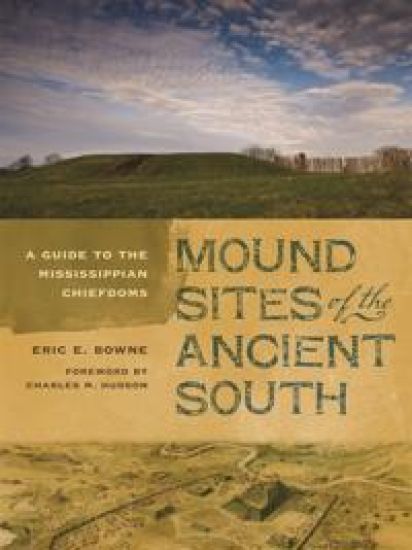
From approximately AD 900 to 1600, ancient Mississippian culture dominated today’s southeastern United States. These Native American societies, known more popularly as moundbuilders, had populations that numbered in the thousands, produced vast surpluses of food, engaged in longdistance trading, and were ruled by powerful leaders who raised large armies. Mississippian chiefdoms built fortified towns with massive earthen structures used as astrological monuments and burial grounds. The remnants of these cities—scattered throughout the Southeast from Florida north to Wisconsin and as far west as Texas—are still visible and awe-inspiring today. This heavily illustrated guide brings these settlements to life with maps, artists’ reconstructions, photos of artifacts, and historic and modern photos of sites, connecting our archaeological knowledge with what is visible when visiting the sites today. Anthropologist Eric E. Bowne discusses specific structures at each location and highlights noteworthy museums, artifacts, and cultural features. He also provides an introduction to Mississippian culture, offering background on subsistence and settlement practices, political and social organization, warfare, and belief systems that will help readers better understand these complex and remarkable places. Sites include Cahokia, Moundville, Etowah, and many more. A Friends Fund Publication
The Westo Indians

The Westo Indians

Eric E. Bowne

The University of Alabama Press
2005
nidottu
The Westo Indians, who lived in the Savannah River region during the second half of the 17th century, are mentioned in few primary documents and only infrequently in secondary literature. There are no known Westo archaeological sites; no artifacts can be linked to the group; and no more than a single word of their language is known to us today. Yet, from the extant evidence, it is believed that the Westos, who migrated from around Lake Erie by 1656, had a profound effect on the development of the colonial South. This volume reproduces excerpts from all 19 documents that indisputably reference the Westos, although the Europeans referred to them by a variety of names. Most of the information was written by Lords Proprietors who never met the Westos, or by a handful of Carolinians who did. But the author is able to chart a highly plausible history of this Native group who, for a period, thrived on the Southern frontier. The narrative traces their northeastern origins and how the Erle conflicts with the Five Nations Iroquois in the Beaver Wars forced them southward, where they found new economic opportunities in the lucrative slave trade. At the height of their influence, between 1659 and 1680, it is believed the Westos captured and sold several thousand Indians from Spanish Florida, often trading them for guns. Eventually, their military advantage over the Indians of the lower South was compromised by the rise of powerful confederacies of native peoples, who could acquire equivalent firearms from the Europeans. Even though the aggressive Westos declined, they had influenced profound change in the southeast. They furthered the demise of chiefly organization, helped to shift the emphasis from agricultural to hunting economies, and influenced the dramatic decrease in the number and diversity of native polities. ""Bowne has ferreted out an amazing amount of information on this previously very poorly known people. He makes a compelling case that the appearance of the Westos in the Southeast, and their encouragement of the slave trade, were critically important events in the colonial history of the region, an argument that...is careful, insightful, and well documented."" - Gregory A. Waselkov, author of Old Mobile Archaeology