Kirjojen hintavertailu – 12 903 724 kirjaa ja 27 kauppaa
Kirjailija
Erich Joos
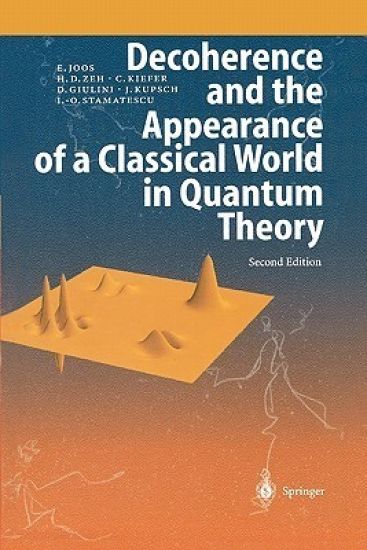
Kirjat ja teokset yhdessä paikassa: 3 kirjaa, julkaisuja vuosilta 2003–2015, suosituimpiin kuuluu Decoherence and the Appearance of a Classical World in Quantum Theory. Vertaile teosten hintoja ja tarkista saatavuus suomalaisista kirjakaupoista.
Franciskus av Assisi levde på 1200-talet, men är genom sin kärlek till naturen högst aktuell idag. Alldeles särskilt blev Franciskus älskad för sin intuitiva närhet till djur, han hade en unik förmåga att kommunicera med dem. Boken skildrar hans djupa vänskap med djur, med den milda tofslärkan likväl som med den vilda vargen. Detta är den första barnboken om Franciskus i Sverige.
When we were preparing the first edition of this book, the concept of de coherence was known only to a minority of physicists. In the meantime, a wealth of contributions has appeared in the literature - important ones as well as serious misunderstandings. The phenomenon itself is now experimen tally clearly established and theoretically well understood in principle. New fields of application, discussed in the revised book, are chaos theory, informa tion theory, quantum computers, neuroscience, primordial cosmology, some aspects of black holes and strings, and others. While the first edition arose from regular discussions between the authors, thus leading to a clear" entanglement" of their otherwise quite different chap ters, the latter have thereafter evolved more or less independently. While this may broaden the book's scope as far as applications and methods are con cerned, it may also appear confusing to the reader wherever basic assumptions and intentions differ (as they do). For this reason we have rearranged the or der of the authors: they now appear in the same order as the chapters, such that those most closely related to the "early" and most ambitious concept of decoherence are listed first. The first three authors (Joos, Zeh, Kiefer) agree with one another that decoherence (in contradistinction to the Copen hagen interpretation) allows one to eliminate primary classical concepts, thus neither relying on an axiomatic concept of observables nor on a probability interpretation of the wave function in terms of classical concepts.
When we were preparing the first edition of this book, the concept of de coherence was known only to a minority of physicists. In the meantime, a wealth of contributions has appeared in the literature - important ones as well as serious misunderstandings. The phenomenon itself is now experimen tally clearly established and theoretically well understood in principle. New fields of application, discussed in the revised book, are chaos theory, informa tion theory, quantum computers, neuroscience, primordial cosmology, some aspects of black holes and strings, and others. While the first edition arose from regular discussions between the authors, thus leading to a clear" entanglement" of their otherwise quite different chap ters, the latter have thereafter evolved more or less independently. While this may broaden the book's scope as far as applications and methods are con cerned, it may also appear confusing to the reader wherever basic assumptions and intentions differ (as they do). For this reason we have rearranged the or der of the authors: they now appear in the same order as the chapters, such that those most closely related to the "early" and most ambitious concept of decoherence are listed first. The first three authors (Joos, Zeh, Kiefer) agree with one another that decoherence (in contradistinction to the Copen hagen interpretation) allows one to eliminate primary classical concepts, thus neither relying on an axiomatic concept of observables nor on a probability interpretation of the wave function in terms of classical concepts.