Kirjojen hintavertailu – 12 903 725 kirjaa ja 27 kauppaa

Kirjailija

Erik Sherman

Kirjat ja teokset yhdessä paikassa: 9 kirjaa, julkaisuja vuosilta 2004–2026, suosituimpiin kuuluu Dewey. Vertaile teosten hintoja ja tarkista saatavuus suomalaisista kirjakaupoista.

9 kirjaa

Kirjojen julkaisuvuodet: 2004–2026.

Dewey

Dewey

Dwight Evans; Erik Sherman

Triumph Books (IL)
2026
Nidottu
Tervetuloa Pohjoismaiden suurimpaan verkkokirjakauppaan! Adlibris kannattaa sananvapautta, ja haluamme edistää kirjallisuuden ja tiedon saatavuutta.
Dewey

Dewey

Dwight Evans; Erik Sherman

TRIUMPH BOOKS
2024
sidottu
For twenty Major League seasons, the name Dwight Evans was synonymous with sterling defense and a potent bat. A Red Sox legend, he played in 2,505 games in Boston – second only to Carl Yastrzemski – and hit 379 home runs for the club, trailing only Yastrzemski and Ted Williams. Nobody hit more home runs in the American League and no player had more extra base hits in all of baseball than the man affectionately known as Dewey did during the decade of the 1980s, but it was his rifle-like right arm – and eight Gold Glove Awards – that established him as the best right fielder of his era. In Behind the Gold Glove, Evans and baseball historian Erik Sherman take Red Sox fans back to a glorious time in baseball, filled with unforgettable World Series appearances in 1975 and 1986, legendary teammates including fellow outfield mainstays Jim Rice and Fred Lynn, and some of the most memorable games in MLB history. Yet for all his greatness on the baseball field, the immense challenges that Evans and his family dealt with off it were even more impressive, a journey that Evans poignantly explores in detail like never before. A man who would become known for his class, dignity, and strength, Evans would use those attributes along with his wife Susan to help nurture and comfort two sons, Timothy and Justin, as they battled neurofibromatosis (NF) – commonly known as elephant man’s disease – a condition that causes tumors to form in the brain, spinal cord, and nerves. Part charming memoir of an underrated star from bygone era of baseball and part exploration of a man whose inner strength sustained him through the trials and tribulations surrounding the diagnosis, treatment, and deaths of two sons who were tragically afflicted with NF, Behind the Gold Glove is the long-awaited full story of Dewey from the man himself.

Daybreak at Chavez Ravine

Daybreak at Chavez Ravine

Erik Sherman

University of Nebraska Press
2023
sidottu
Finalist for the 2023 CASEY Award ? Finalist for the 2024 Seymour Medal Named a Best Baseball Book of 2023 by Sports Collectors Digest Fernando Valenzuela was only twenty years old when Tom Lasorda chose him as the Dodgers’ opening-day starting pitcher in 1981. Born in the remote Mexican town of Etchohuaquila, the left-hander had moved to the United States less than two years before. He became an instant icon, and his superlative rookie season produced Cy Young and Rookie of the Year awards-and a World Series victory over the Yankees. Forty years later, there hasn’t been a player since who created as many Dodgers fans. After the Dodgers’ move to Los Angeles from Brooklyn in the late 1950s, relations were badly strained between the organization and the Latin world. Mexican Americans had been evicted from their homes in Chavez Ravine, Los Angeles-some forcibly-for well below market value so the city could sell the land to team owner Walter O’Malley for a new stadium. For a generation of working-class Mexican Americans, the Dodgers became a source of great anguish over the next two decades. However, that bitterness toward the Dodgers vanished during the 1981 season when Valenzuela attracted the fan base the Dodgers had tried in vain to reach for years. El Toro, as he was called, captured the imagination of the baseball world. A hero in Mexico, a legend in Los Angeles, and a phenomenon throughout the United States, Valenzuela did more to change that tense political environment than anyone in the history of baseball. A new fan base flooded Dodger Stadium and ballparks around the United States whenever Valenzuela pitched in a phenomenon that quickly became known as Fernandomania, which continued throughout a Dodger career that included six straight All-Star game appearances. Daybreak at Chavez Ravine retells Valenzuela’s arrival and permanent influence on Dodgers history while bringing redemption to the organization’s controversial beginnings in LA. Through new interviews with players, coaches, broadcasters, and media, Erik Sherman reveals a new side of this intensely private man and brings fresh insight to the ways he transformed the Dodgers and started a phenomenon that radically altered the country’s cultural and sporting landscape.
Two Sides of Glory

Two Sides of Glory

Erik Sherman; Joe Castiglione

University of Nebraska Press
2021
sidottu
Following an epic American League Championship Series win over the California Angels and just one out from winning their first World Series in sixty-eight years, the 1986 Boston Red Sox lost Game Six to the New York Mets in unforgettable and devastating fashion. Then they lost Game Seven and the Series itself. Two Sides of Glory portrays the losing side of the story about one of baseball’s most riveting World Series match-ups. With the benefit of years of reflection from the men who made up the ’86 Sox, this will be the definitive book on this iconic yet most Shakespearian of Boston teams for years to come. After telling the Mets’ side of the story, Erik Sherman turns here to the Red Sox’s version, with recollections from players that are both insightful and surprisingly emotional. Bill Buckner, whose name became synonymous with a muffed grounder, speaks openly about the cruel aftermath. Pitcher Bruce Hurst broke down three times while being interviewed. Dwight Evans confesses in his interview that he had never before talked at length about the ’86 team. And Roger Clemens talks candidly not only about the ’86 squad but also accusations of alleged steroid abuse later in his career and the toll it has taken on his family. In each player’s retelling, there is the excitement of history never told and old mysteries answered. The story of the ’86 Red Sox is well known, but now, after thirty years, the players have opened up to Sherman like never before. It’s an in-depth, first-person account with the intriguing key players who made up this once-in-a-generation Boston team, and also a look at how the extremes of tantalizing victory and heart-wrenching failure shaped and influenced their lives-both on the field and off.
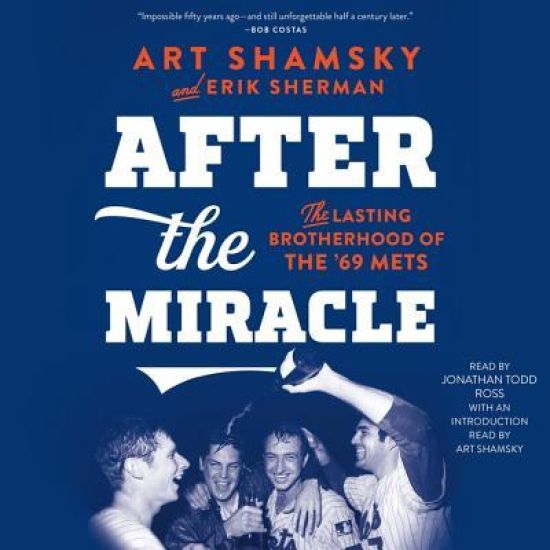
After the Miracle: The Lasting Brotherhood of the '69 Mets

After the Miracle: The Lasting Brotherhood of the '69 Mets

Art Shamsky; Erik Sherman

SIMON SCHUSTER
2020
nidottu
"A great and insightful" (Keith Hernandez, New York Mets legend and broadcaster) New York Times bestselling account of an iconic team in baseball history: the 1969 New York Mets--a last-place team that turned it all around in just one season--told by '69 Mets outfielder Art Shamsky, Hall of Fame pitcher Tom Seaver, and other teammates who reminisce about that legendary season and their enduring bonds decades later. The New York Mets franchise began in 1962 and the team finished in last place nearly every year. When the 1969 season began, fans weren't expecting much from "the Lovable Losers." But as the season progressed, the Mets inched closer to first place and then eventually clinched the National League pennant. They were underdogs against the formidable Baltimore Orioles, but beat them in five games to become world champions. No one had predicted it. In fact, fans could hardly believe it happened. Suddenly they were "the Miracle Mets." Playing right field for the '69 Mets was Art Shamsky, who had stayed in touch with his former teammates over the years. He hoped to get together with star pitcher Tom Seaver (who would win the Cy Young award as the best pitcher in the league in 1969 and go on to become the first Met elected to the Hall of Fame), but Seaver was ailing and could not travel. So, Shamsky organized a visit to "Tom Terrific" in California, accompanied by the #2 pitcher, Jerry Koosman, outfielder Ron Swoboda, and shortstop Bud Harrelson. Together they recalled the highlights of that amazing season as they reminisced about what changed the Mets' fortunes in 1969. In this "enjoyable tale of a storybook season" (Kirkus Reviews), and with the help of sportswriter Erik Sherman, Shamsky has written the "revealing" (New York Newsday) After the Miracle for the 1969 Mets. "This heartfelt, nostalgic memoir will delight baseball fans of all ages and allegiances" (Publishers Weekly). It's a book that every Mets fan must own.
After the Miracle: The Lasting Brotherhood of the '69 Mets
The inside account of an iconic team in baseball history: the 1969 New York Mets--a consistently last-place team that turned it all around in just one season--told by '69 Mets outfielder Art Shamsky, Hall of Fame pitcher Tom Seaver, and other teammates as they reminisce about what happened then and where they are today. The New York Mets franchise began in 1962 and the team finished in last place nearly every year. When the 1969 season began, fans weren't expecting much from "the Lovable Losers." But as the season progressed, the Mets inched closer to first place and then eventually clinched the National League pennant. They were underdogs against the formidable Baltimore Orioles, but beat them in five games to become world champions. No one had predicted it. In fact, fans could hardly believe it happened. Suddenly they were "the Miracle Mets." Playing right field for the '69 Mets was Art Shamsky, who had stayed in touch with his former teammates over the years. He hoped to get together with star pitcher Tom Seaver (who would win the Cy Young award as the best pitcher in the league in 1969 and go on to become the first Met elected to the Hall of Fame) but Seaver was ailing and could not travel. So, Shamsky organized a visit to Tom Terrific in California, accompanied by the #2 pitcher, Jerry Koosman, outfielder Ron Swoboda, and shortstop Bud Harrelson. Together they recalled the highlights of that amazing season as they reminisced about what changed the Mets' fortunes in 1969. With the help of sportswriter Erik Sherman, Shamsky has written After the Miracle for the 1969 Mets. This is a book that every Mets fan--and every baseball fan--must own.
Geocaching

Geocaching

Erik Sherman

APress
2004
nidottu
GeoCaching: Hike and Seek With Your GPS is a guide to the relatively new, and exponentially growing, activity of geocaching. It is a treasure hunting game using handheld GPS (global positioning system) receivers that is now played world-wide. Although invented in May of 2000, there are already hundreds of thousands of people who participate, and that number continues to rapidly grow. GeoCaching: Hike and Seek With Your GPS covers not only the fundamental principles and points of geocaching, but also covers such related topics as wilderness navigation, hiking, and outdoor safety. The reason to buy this book is that it combines 'how to' information - the necessary technical background in GPS, navigation, and hiking, along with some history of the geocaching activity as well as some narrative spots that give readers a sense of why they should get involved. The person who expressed interest in being the technical editor is well regarded in geocaching circles and highly knowledgeable and will ensure that the information is as directed to practical use as possible. This book is a comprehensive guide to geocaching, a leisure activity using GPS technology for a high tech treasure hunt game. It is the only book out on something that has been growing at exponential rates since its introduction in 2000 and that has received wide coverage on television, on radio, and in newspapers and magazines. It is particularly popular with extreme sports and high tech aficionados. Ur innehållet: Chapter 1 Starting Off Chapter 2 Cache On Chapter 3 The Technology Chapter 4 Lost In Style Chapter 5 A Good Walk Chapter 6 On The Hunt Chapter 7 In Hiding Chapter 8 Geovariations Appendix A Resources Appendix B Outdoor Safety [Komplett innehållsförteckning]