Kirjojen hintavertailu – 12 903 733 kirjaa ja 27 kauppaa

Kirjailija

Erik Thorbecke

Kirjat ja teokset yhdessä paikassa: 5 kirjaa, julkaisuja vuosilta 1960–2012, suosituimpiin kuuluu Methods of Interregional and Regional Analysis. Vertaile teosten hintoja ja tarkista saatavuus suomalaisista kirjakaupoista.

5 kirjaa

Kirjojen julkaisuvuodet: 1960–2012.

Exchange and Development

Exchange and Development

Peter A. Cornelisse; Erik Thorbecke

Edward Elgar Publishing Ltd
2012
nidottu
This innovative and important book develops a new framework for analysing exchange that takes place within and outside markets over the course of development. The authors argue that development and social and economic progress are greatly enhanced by a fluent and efficient exchange system. Conversely, the process of development encourages and facilitates trade. The authors introduce the concept of exchange configurations to capture the multiplicity of settings within which exchange occurs and the many different forms exchange and transactions can take. The book shows how exchange configurations can help to identify the factors that constrain the exchange process and lead to the formulation of effective reforms. It then uses a historical analysis of systems of exchange during different phases of development over the last two millennia to illustrate different exchange configurations. Exchange and Development will appeal to students at both the graduate and undergraduate level in the fields of economic development, international trade, microeconomics, institutional economics and economic history. Researchers in universities and policy makers in governments and international agencies will also draw much benefit from the entirely novel approach formulated in this book.
Exchange and Development

Exchange and Development

Peter A. Cornelisse; Erik Thorbecke

Edward Elgar Publishing Ltd
2010
sidottu
This innovative and important book develops a new framework for analysing exchange that takes place within and outside markets over the course of development. The authors argue that development and social and economic progress are greatly enhanced by a fluent and efficient exchange system. Conversely, the process of development encourages and facilitates trade. The authors introduce the concept of exchange configurations to capture the multiplicity of settings within which exchange occurs and the many different forms exchange and transactions can take. The book shows how exchange configurations can help to identify the factors that constrain the exchange process and lead to the formulation of effective reforms. It then uses a historical analysis of systems of exchange during different phases of development over the last two millennia to illustrate different exchange configurations. Exchange and Development will appeal to students at both the graduate and undergraduate level in the fields of economic development, international trade, microeconomics, institutional economics and economic history. Researchers in universities and policy makers in governments and international agencies will also draw much benefit from the entirely novel approach formulated in this book.
Methods of Interregional and Regional Analysis

Methods of Interregional and Regional Analysis

Walter Isard; Iwan J. Azis; Matthew P. Drennan; Ronald E. Miller; Sidney Saltzman; Erik Thorbecke

Ashgate Publishing Limited
1998
nidottu
This landmark textbook introduces students to the principles of regional science and focuses on the key methods used in regional analysis, including regional and interregional input-output analysis, econometrics (regional and spatial), programming and industrial and urban complex analysis, gravity and spatial interaction models, SAM and social accounting (welfare) analysis and applied general interregional equilibrium models. The coherent development of the materials contained in the set of chapters provides students with a comprehensive background and understanding of how to investigate key regional problems. For the research scholar, this publication constitutes an up-to-date source book of the basic elements of each major regional science technique. More significant, it points to new directions for future research and ways interregional and regional analytic approaches can be fused to realise much more probing attacks on regional and spatial problems - a contribution far beyond what is available in the literature.
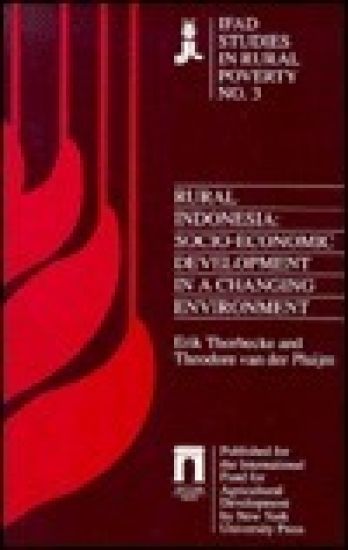
Rural Indonesia

Rural Indonesia

Erik Thorbecke; Theodore Van Der Pluijm

New York University Press
1992
sidottu
The formulation of a rural development strategy for any country is an extremely difficult and multi-faceted task, especially so for a country as large and diversified as Indonesia. Illustrating again how economic growth in urban areas rarely translates into a decrease in rural poverty, this volume identifies the impact of recent changes in the national economy on the rural poor, the interaction between the agricultural sector and the rural population, and patterns of food consumption, nutrition, and health. Drawing on the data and conclusions of thirteen years of IFAD experience in Indonesia, this book also examines the successes and failures of past practical recommendations for future programs. The authors highlight the need for greater employment opportunities, greater commodity and regional diversification and a special emphasis on poor rural women.
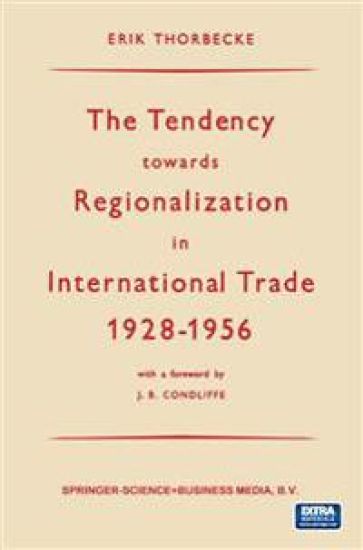
The Tendency towards Regionalization in International Trade 1928–1956
Professor Erik Thorbecke's study, here published, continues the empirical work undertaken by Folke Hilgerdt for the League of Nations. It is a study of actual trade and payments derived laboriously from the voluminous statistical data published by national governments and international institutions. The col­ lection, analysis and interpretation of this mass of data involved much patient industry, but in the process of brooding over the detail a truer understanding of the complex structure of world trade was gained than could be achieved in any other way. Trade of course is nearly always bilateral. When goods are re-exported they are, for the most part, refashioned and changed into essentially new utilities. What is multilateral or bilateral or regional in a system of international trade is the method of payment. The justification for multilateralism is the opportunity it affords for countries to specialize, so that one country may use the foreign exchange earned by its exports to buy imports from a third country. Indeed this statement in terms of countries obscures the ultimate realities. In a free multilateral system it is individuals who import and export. When they can freely buy and sell the foreign exchange acquired or required for their transactions, payments are multilateral and the network of trade extends widely across political boundaries. What Mr. Thorbecke shows is that political controls of pay­ ments have confined more trade within restricted channels.