Kirjojen hintavertailu – 12 859 828 kirjaa ja 27 kauppaa

Kirjailija

Erika Rackley

Kirjat ja teokset yhdessä paikassa: 6 kirjaa, julkaisuja vuosilta 2012–2025, suosituimpiin kuuluu University of South Wales 1st Year Law Pack. Vertaile teosten hintoja ja tarkista saatavuus suomalaisista kirjakaupoista.

6 kirjaa

Kirjojen julkaisuvuodet: 2012–2025.

Tort Law

Tort Law

Kirsty Horsey; Erika Rackley

Oxford University Press
2023
nidottu
Takes students from zero knowledge to engaged and critical thinkers. This best-selling undergraduate textbook from renowned authors Kirsty Horsey & Erika Rackley offers a lively, accessible, and thoughtful treatment of all key tort law topics, and includes carefully chosen learning features that encourage deep and critical thinking. Key features: - Problem questions at the beginning of chapters set the scene, immediately putting the law in context. Outline answers and an annotated version with issues and cases to consider offer students further insights - Author videos in every chapter enliven, explain, and enrich key topics - 'Counterpoint' and 'pause for reflection' boxes encourage students to think critically and engage with areas of controversy or reform - Annotated statutes and judgments explain the more difficult points of law and help students develop the invaluable skills of reading, interpreting, and analysing - Interactive decision trees provide a visual aid to understanding key torts, and cement that knowledge through direct, step-by-step engagement New to this edition: - Author videos and interactive decision trees - New and updated coverage of key legal developments, including Banks v Cadwalladr [2022] EWHC 1417 (QB) on defamation, Bloomberg LP (Appellant) v ZXC (Respondent) [2022] UKSC 5 on privacy, and Paul v Royal Wolverhampton NHS Trust; Polmear v Royal Cornwall Hospital NHS Trust; Purchase v Ahmed [2022] EWCA Civ 12 on psychiatric harm Digital formats and resources: This edition is available as an enhanced e-book, which offers an array of integrated resources to support learning. These include author videos, interactive decision trees, and support in tackling the problem question, as well as a mobile experience and convenient access, functionality tools, navigation features, and links: www.oxfordtextbooks.co.uk/ebooks A selection of online resources is available to paperback, Law Trove, and enhanced e-book users, including: - Outline answers to questions in the book - Annotated links to external web resources and videos - Downloadable annotated case judgments, statutes, and problem questions - Guidance on answering problem and essay questions - Additional content on elements of a claim in the tort of negligence and on product liability - Access to the enhanced e-book's videos and interactive decision trees

University of South Wales 1st Year Law Pack

University of South Wales 1st Year Law Pack

Kirsty Horsey; Erika Rackley; Steve Wilson; Helen Rutherford; Tony Storey; Natalie Wortley; Emily Finch; Stefan Fafinski; Nicola Monaghan; Richard Taylor; Damian Taylor; Matthew Dyson; Lisa Webley; Harriet Samuels; Robert G. Lee

Oxford University Press
2018
muu
A value pack compiled for University of South Wales for law students in their first year of study
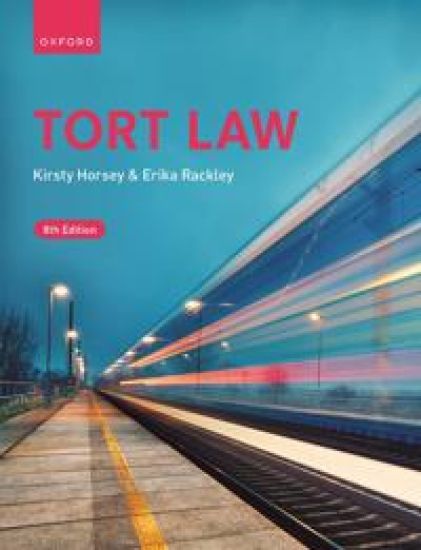
Tort Law

Tort Law

Kirsty Horsey; Erika Rackley

Oxford University Press
2025
nidottu
Takes students from zero knowledge to engaged and critical thinkers. This best-selling undergraduate textbook from renowned authors Kirsty Horsey & Erika Rackley offers a lively, accessible, and thoughtful treatment of all key tort law topics, and includes carefully chosen learning features that encourage deep and critical thinking. Key features: - Problem questions at the beginning of chapters set the scene, immediately putting the law in context. Outline answers and an annotated version with issues and cases to consider offer students further insights. - 'Counterpoint' and 'pause for reflection' boxes encourage students to think critically and engage with areas of controversy or reform - Annotated statutes and judgments explain the more difficult points of law and help students develop the invaluable skills of reading, interpreting, and analysing - Author videos in every chapter enliven, explain, and enrich key topics (available only on Law Trove and in the e-book) - Multiple-choice self-test questions at the end of each section allow students to test their understanding as they work through the book (available only on Law Trove and in the e-book) - Interactive decision trees provide a visual aid to understanding key torts, and cement that knowledge through direct, step-by-step engagement (available only on Law Trove and in the e-book) New to this edition: -Multiple-choice self-test questions throughout the book, with instant feedback (available only on Law Trove and in the e-book) - New and updated coverage of key legal developments, including Hassam & Anor v Rabot & Anor [2024] UKSC 11 on defences, McCulloch v Forth Valley Health Board [2023] UKSC 26 on breach, Michael Holmes v Poeton Holdings Ltd [2023] EWCA Civ 1377 on causation, Paul v Royal Wolverhampton NHS Trust; Polmear v Royal Cornwall Hospital NHS Trust; Purchase v Ahmed [2024] UKSC 1 on psychiatric harm, and Trustees of the Barry Congregation of Jehovah's Witnesses v BXB [2023] UKSC 15 on vicarious liability
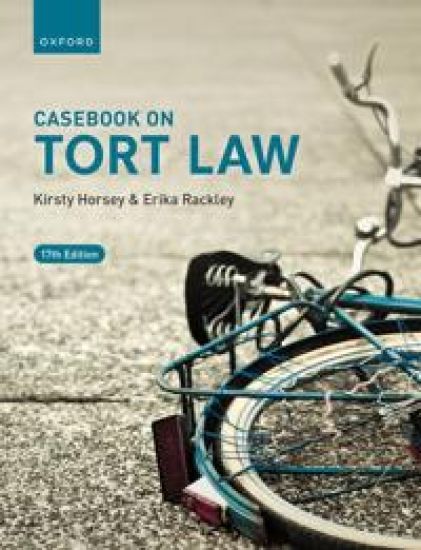
Casebook on Tort Law

Casebook on Tort Law

Kirsty Horsey; Erika Rackley

Oxford University Press
2024
nidottu
All the leading cases, illuminated by Horsey & Rackley's trademark clear and lively commentary. The essential companion for undergraduate tort law students, providing a comprehensive portable library of leading tort cases. Horsey & Rackley bring together a range of carefully edited extracts, combined with insightful commentary and annotated cases to help students identify and analyse the key elements. Key features: - The only text of its kind to provide a comprehensive collection of the leading tort law cases for undergraduates - Simple to navigate, pulling all key case law together into one easy-to-use volume which students can work through systematically or use to reference specific cases - Cases are accompanied by succinct author commentary highlighting the key elements of each case - Annotated cases help students understand and analyse material New to this edition: The seventeenth edition has been thoroughly revised to reflect recent developments in the law, including Fearn and others v The Board of Trustees of the Tate Gallery [2023] UKSC 4 on private nuisance, Riley v Murray Court of Appeal [2022] EWCA Civ 1146 on defamation, and Paul v Royal Wolverhampton NHS Trust; Polmear v Royal Cornwall Hospital NHS Trust; Purchase v Ahmed [2022] EWCA Civ 12 on psychiatric harm.
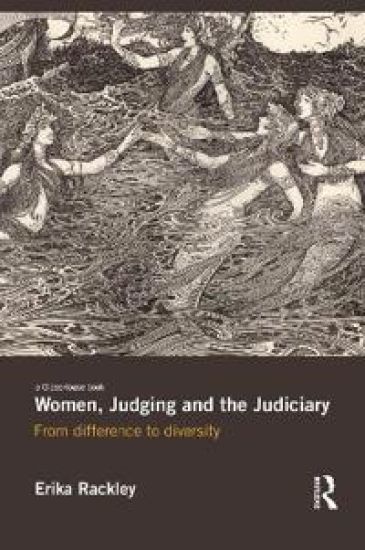
Women, Judging and the Judiciary

Women, Judging and the Judiciary

Erika Rackley

Routledge Cavendish
2014
nidottu
Women, Judging and the Judiciary examines debates about gender representation in the judiciary and the importance of judicial diversity. It offers a fresh look at the role of the (woman) judge and the process of judging and provides a new analysis of the assumptions which underpin and constrain debates about why we might want a more diverse judiciary, and how we might get one. Through a theoretical engagement with the concepts of diversity and difference in adjudication, Women, Judging and the Judiciary contends that prevailing images of the judge are enmeshed in notions of sameness and uniformity: images which are so familiar that their grip on our understandings of the judicial role are routinely overlooked. Failing to confront these instinctive images of the judge and of judging, however, comes at a price. They exclude those who do not fit this mould, setting them up as challengers to the judicial norm. Such has been the fate of the woman judge. But while this goes some way to explaining why, despite repeated efforts, our attempts to secure greater diversity in our judiciary have fallen short, it also points a way forward. For, by getting a clearer sense of what our judges really do and how they do it, we can see that women judges and judicial diversity more broadly do not threaten but rather enrich the judiciary and judicial decision-making. As such, the standard opponent to measures to increase judicial diversity – the necessity of appointment on merit – is in fact its greatest ally: a judiciary is stronger and the justice it dispenses better the greater the diversity of its members, so if we want the best judiciary we can get, we should want one which is fully diverse. Women, Judging and the Judiciary will be of interest to legal academics, lawyers and policy makers working in the fields of judicial diversity, gender and adjudication and, more broadly, to anyone interested in who our judges are and what they do.
Women, Judging and the Judiciary

Women, Judging and the Judiciary

Erika Rackley

Routledge Cavendish
2012
sidottu
Awarded the 2013 Birks Book Prize by the Society of Legal Scholars, Women, Judging and the Judiciary expertly examines debates about gender representation in the judiciary and the importance of judicial diversity. It offers a fresh look at the role of the (woman) judge and the process of judging and provides a new analysis of the assumptions which underpin and constrain debates about why we might want a more diverse judiciary, and how we might get one. Through a theoretical engagement with the concepts of diversity and difference in adjudication, Women, Judging and the Judiciary contends that prevailing images of the judge are enmeshed in notions of sameness and uniformity: images which are so familiar that their grip on our understandings of the judicial role are routinely overlooked. Failing to confront these instinctive images of the judge and of judging, however, comes at a price. They exclude those who do not fit this mould, setting them up as challengers to the judicial norm. Such has been the fate of the woman judge. But while this goes some way to explaining why, despite repeated efforts, our attempts to secure greater diversity in our judiciary have fallen short, it also points a way forward. For, by getting a clearer sense of what our judges really do and how they do it, we can see that women judges and judicial diversity more broadly do not threaten but rather enrich the judiciary and judicial decision-making. As such, the standard opponent to measures to increase judicial diversity – the necessity of appointment on merit – is in fact its greatest ally: a judiciary is stronger and the justice it dispenses better the greater the diversity of its members, so if we want the best judiciary we can get, we should want one which is fully diverse. Women, Judging and the Judiciary will be of interest to legal academics, lawyers and policy makers working in the fields of judicial diversity, gender and adjudication and, more broadly, to anyone interested in who our judges are and what they do.