Kirjojen hintavertailu – 12 875 307 kirjaa ja 26 kauppaa

Kirjailija

Ermanno Bencivenga

Kirjat ja teokset yhdessä paikassa: 19 kirjaa, julkaisuja vuosilta 1994–2026, suosituimpiin kuuluu The Philosophy of (Artificial) Intelligence. Vertaile teosten hintoja ja tarkista saatavuus suomalaisista kirjakaupoista.

19 kirjaa

Kirjojen julkaisuvuodet: 1994–2026.

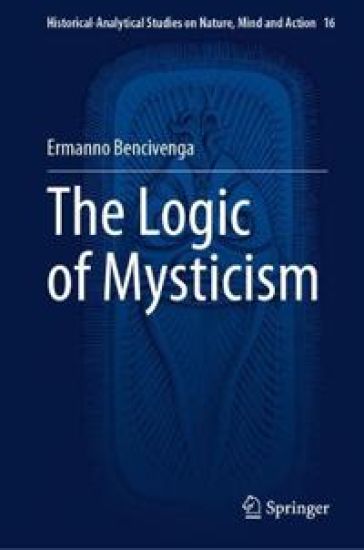
The Logic of Mysticism

The Logic of Mysticism

Ermanno Bencivenga

Springer International Publishing AG
2025
sidottu
This book reconciles the worlds of mysticism and logic, building on the author’s previous groundbreaking work in oceanic logic. Historically, the seemingly distinct domains of mysticism and logic have been viewed through a narrow lens through which logic and mysticism have been considered fundamentally separate from each other. The author expands on this concept and argues that logic can be understood in a broader sense. The book reveals that mystics engage in rigorous reasoning, and their writings provide fertile ground for the advancement of logical discourse. The text references insights from the fifth century B. C. through the Middle Ages to the present day, offering a compelling argument for the harmonious integration of logic and mysticism. It challenges conventional wisdom and opens new avenues for understanding the depths of human thought, making it of great interest to those interested in philosophical logic as well as history of science.
A Theory of Language and Mind

A Theory of Language and Mind

Ermanno Bencivenga

University of California Press
2021
sidottu
In his most recent book, Ermanno Bencivenga offers a stylistically and conceptually exciting investigation of the nature of language, mind, and personhood and the many ways the three connect. Bencivenga, one of the most iconoclastic voices to emerge in contemporary American philosophy, contests the basic assumptions of analytic (and also, to an extent, postmodern) approaches to these topics. His exploration leads through fascinating discussions of education, courage, pain, time and history, selfhood, subjectivity and objectivity, reality, facts, the empirical, power and transgression, silence, privacy and publicity, and play—all themes that are shown to be integral to our thinking about language. Relentessly bending the rules, Bencivenga frustrates our expectations of a "proper" theory of language. He invokes the transgressions of Nietzsche and Wittgenstein even as he appropriates the aphoristic style of Wittgenstein's Tractatus. Written in a philosophically playful and experimental mode, A Theory of Language and Mind draws the reader into a sense of continual surprise, therapeutic discomfort, and discovery. This title is part of UC Press's Voices Revived program, which commemorates University of California Press’s mission to seek out and cultivate the brightest minds and give them voice, reach, and impact. Drawing on a backlist dating to 1893, Voices Revived makes high-quality, peer-reviewed scholarship accessible once again using print-on-demand technology. This title was originally published in 1997.

A Theory of Language and Mind

A Theory of Language and Mind

Ermanno Bencivenga

University of California Press
2020
pokkari
In his most recent book, Ermanno Bencivenga offers a stylistically and conceptually exciting investigation of the nature of language, mind, and personhood and the many ways the three connect. Bencivenga, one of the most iconoclastic voices to emerge in contemporary American philosophy, contests the basic assumptions of analytic (and also, to an extent, postmodern) approaches to these topics. His exploration leads through fascinating discussions of education, courage, pain, time and history, selfhood, subjectivity and objectivity, reality, facts, the empirical, power and transgression, silence, privacy and publicity, and play—all themes that are shown to be integral to our thinking about language. Relentessly bending the rules, Bencivenga frustrates our expectations of a "proper" theory of language. He invokes the transgressions of Nietzsche and Wittgenstein even as he appropriates the aphoristic style of Wittgenstein's Tractatus. Written in a philosophically playful and experimental mode, A Theory of Language and Mind draws the reader into a sense of continual surprise, therapeutic discomfort, and discovery. This title is part of UC Press's Voices Revived program, which commemorates University of California Press’s mission to seek out and cultivate the brightest minds and give them voice, reach, and impact. Drawing on a backlist dating to 1893, Voices Revived makes high-quality, peer-reviewed scholarship accessible once again using print-on-demand technology. This title was originally published in 1997.

Theories of the Logos

Theories of the Logos

Ermanno Bencivenga

Springer International Publishing AG
2018
nidottu
This book offers insight into the nature of meaningful discourse. It presents an argument of great intellectual scope written by an author with more than four decades of experience. Readers will gain a deeper understanding into three theories of the logos: analytic, dialectical, and oceanic. The author first introduces and contrasts these three theories. He then assesses them with respect to their basic parameters: necessity, truth, negation, infinity, as well as their use in mathematics. Analytic Aristotelian logic has traditionally claimed uniqueness, most recently in its Fregean and post-Fregean variants. Dialectical logic was first proposed by Hegel. The account presented here cuts through the dense, often incomprehensible Hegelian text. Oceanic logic was never identified as such, but the author gives numerous examples of its use from the history of philosophy. The final chapter addresses the plurality of the three theories and of how we should deal with it. The author first worked in analytic logic in the 1970s and 1980s, first researched dialectical logic in the 1990s, and discovered oceanic logic in the 2000s. This book represents the culmination of reflections that have lasted an entire scholarly career.
Theories of the Logos

Theories of the Logos

Ermanno Bencivenga

Springer International Publishing AG
2017
sidottu
This book offers insight into the nature of meaningful discourse. It presents an argument of great intellectual scope written by an author with more than four decades of experience. Readers will gain a deeper understanding into three theories of the logos: analytic, dialectical, and oceanic. The author first introduces and contrasts these three theories. He then assesses them with respect to their basic parameters: necessity, truth, negation, infinity, as well as their use in mathematics. Analytic Aristotelian logic has traditionally claimed uniqueness, most recently in its Fregean and post-Fregean variants. Dialectical logic was first proposed by Hegel. The account presented here cuts through the dense, often incomprehensible Hegelian text. Oceanic logic was never identified as such, but the author gives numerous examples of its use from the history of philosophy. The final chapter addresses the plurality of the three theories and of how we should deal with it. The author first worked in analytic logic in the 1970s and 1980s, first researched dialectical logic in the 1990s, and discovered oceanic logic in the 2000s. This book represents the culmination of reflections that have lasted an entire scholarly career.
The Discipline of Subjectivity

The Discipline of Subjectivity

Ermanno Bencivenga

Princeton University Press
2016
sidottu
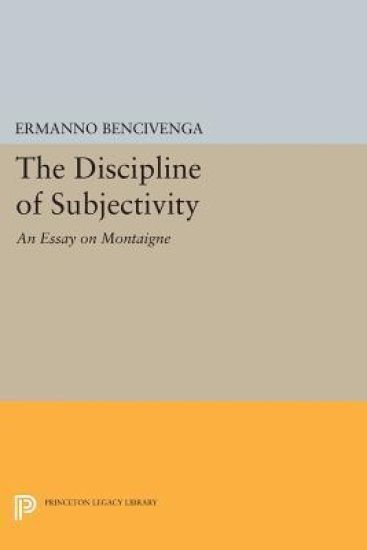
Through an interpretation of Montaigne's philosophical vision as expressed in his Essays, Ermanno Bencivenga contributes to the current debate about the "death of the subject" by developing a view of the self as a project of continuous construction rather than the source and foundation of knowledge. This latter, Cartesian conception of self-consciousness as a logical and epistemological starting point is, Bencivenga contends, delusive: the certainty it provides is more akin to faith than to a cognitive state. How then do we acquire knowledge of the self? Montaigne makes for a productive case study in this regard: he declares that he himself is the matter of his book, and that nothing but the constitution of his own self is his business. A study of Montaigne reveals that the fundamental category missing in the Cartesian conception of the self is that of practical effort. The self is not a ready-made entity, available for inspection and analysis, but something whose generation requires exercise, training, and discipline. It is the result of an operation that must be performed not just once, but, as in all training, over and over again until it becomes second nature. Bencivenga characterizes the particular training required by the project of constituting a subject as a revolutionary, transgressive, critical one, which shares with philosophical activity a profoundly playful irrelevance to the "ready to hand." Originally published in 1990. The Princeton Legacy Library uses the latest print-on-demand technology to again make available previously out-of-print books from the distinguished backlist of Princeton University Press. These editions preserve the original texts of these important books while presenting them in durable paperback and hardcover editions. The goal of the Princeton Legacy Library is to vastly increase access to the rich scholarly heritage found in the thousands of books published by Princeton University Press since its founding in 1905.
The Discipline of Subjectivity

The Discipline of Subjectivity

Ermanno Bencivenga

Princeton University Press
2014
pokkari
Through an interpretation of Montaigne's philosophical vision as expressed in his Essays, Ermanno Bencivenga contributes to the current debate about the "death of the subject" by developing a view of the self as a project of continuous construction rather than the source and foundation of knowledge. This latter, Cartesian conception of self-consciousness as a logical and epistemological starting point is, Bencivenga contends, delusive: the certainty it provides is more akin to faith than to a cognitive state. How then do we acquire knowledge of the self? Montaigne makes for a productive case study in this regard: he declares that he himself is the matter of his book, and that nothing but the constitution of his own self is his business. A study of Montaigne reveals that the fundamental category missing in the Cartesian conception of the self is that of practical effort. The self is not a ready-made entity, available for inspection and analysis, but something whose generation requires exercise, training, and discipline. It is the result of an operation that must be performed not just once, but, as in all training, over and over again until it becomes second nature. Bencivenga characterizes the particular training required by the project of constituting a subject as a revolutionary, transgressive, critical one, which shares with philosophical activity a profoundly playful irrelevance to the "ready to hand." Originally published in 1990. The Princeton Legacy Library uses the latest print-on-demand technology to again make available previously out-of-print books from the distinguished backlist of Princeton University Press. These editions preserve the original texts of these important books while presenting them in durable paperback and hardcover editions. The goal of the Princeton Legacy Library is to vastly increase access to the rich scholarly heritage found in the thousands of books published by Princeton University Press since its founding in 1905.
Return From Exile

Return From Exile

Ermanno Bencivenga

Lexington Books
2013
sidottu
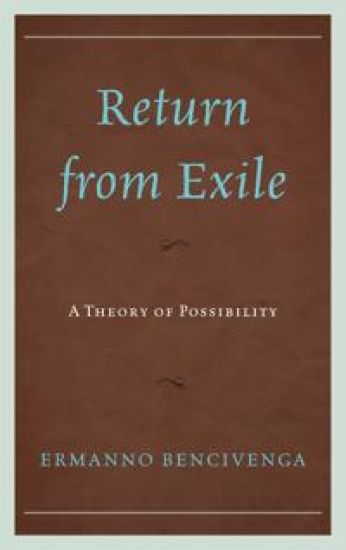
In modern thought, possibility has been exiled to other worlds, in a move best typified by Leibniz. And the move has obvious repercussions in popular culture, where possibility is lived mostly as an exotic evasion, whose outcome--consistently with the Leibnizian model--reinforces the hold of conventional reality, elevating it all the way to a necessity. Return from Exile: A Theory of Possibility sees this outcome as a challenge. It is divided into three main parts. In the first, Ermanno Bencivenga presents the Leibnizian model in some detail, together with its heirs in the contemporary semantics of modal logic. The second part consists of taking a path through our philosophical tradition looking for means of answering the challenge; in the course of doing this, Bencivenga brings out important concepts—first and foremost, the multiplicity of the self and the political need to bring unity to this multiplicity. The third part provides an elaborate response to the challenge, in the form of a metaphysical theory that is centered not on objects but on patterns, repeatable entities, and on the dialogue that exists, or does not exist, among patterns—a dialogue that constitutes (human and non-human) subjects. This alternative account to the modern understanding of possibility, wherein reality is literally constituted of multiple possibilities, will be of great value to students and scholars in philosophy, critical theory, political science, and anthropology. Eschewing many traditional fetters of academic writing, it can also be read by anyone interested in these topics.
Olipa toisen kerran

Olipa toisen kerran

Ermanno Bencivenga

Eurooppalaisen filosofian seura
2013
nidottu

Halvin toimitettuna 27,90 €

Mitä tapahtuu, kun kirjanmerkki kyllästyy olemaan kirjanmerkki? Miten ihmisille käy, kun asiat tulevat hulluiksi? Ermanno Bencivengan oivalluttavat sadut sopivat sekä lapsille että aikuisille. Satu ei välttämättä auta vain lasta nukahtamaan. Satu voi myös auttaa sekä lasta että aikuista oivaltamaan. Italialaisen filosofin Ermanno Bencivengan (s. 1950) tiiviit tarinat vievät lukijansa elämän peruskysymysten äärelle ja arkisten asioiden rikkauteen. Millaista olisi olla kuolematon? Miksi jalanjäljet kadehtivat jalkoja? Ja miten kävi kirjalle, joka ei tahtonut tulla luetuksi? Olipa toisen kerran sisältää viisikymmentäkaksi satua, joissa ei pyritä opettamaan vaan tuottamaan oivalluksia. Tuokiokuvat ihmisten, eläinten ja esineiden elämästä pysähdyttävät, ja oman leimansa meitä ympäröivän maailman ällistelylle antaa lämminhenkinen huumori. Olipa toisen kerran antaa ajattelemisen aihetta kaikenikäisille. Jokainen aivoitus voi olla arvokas.
Exercises in Constructive Imagination

Exercises in Constructive Imagination

Ermanno Bencivenga

Springer
2012
nidottu
Philosophy in this century has often self-consciously presented itself as aiming at the destruction or deconstruction of the philosophical tradition or even of theorizing as such. The basis for such self-description may well be a deep-seated anxiety about death; but whatever its grounds, the procession of distinguished intellectuals who seem mostly concerned with who gets to turn off the light on philosophy on his/her way out is one main reason why philosophy seems to have lost its grip on public opinion and public policy. Which is ironical, because there is often considerable constructive work going on under the pretence of all this `destruction', but the superficial rhetoric has more currency and impact than the substance of that work. This book brings back the spirit of bold, imaginative, even outrageous theorizing into philosophy, and contains a series of examples of it, venturing playfully into quantum mechanics and political theory, psychoanalysis and environmental ethics, philosophy of language and sociology, without any attempt at `systematically exhausting' these disparate fields but rather using them as suggestive excuses and arenas for the display of intellectual creativity. There are numerous echoes among the various pieces, and between them and other works by the same author; but again these resonances are not systematized. The result is more to be seen as a collection of snapshots of an intellectual landscape than as a hierarchical regimentation of it.
Ethics Vindicated

Ethics Vindicated

Ermanno Bencivenga

Oxford University Press Inc
2006
sidottu
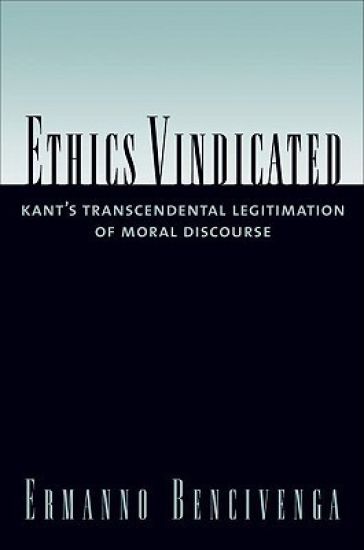
Can we regard ourselves as having free will? What is the place of values in a world of facts? What grounds the authority of moral injunctions, and why should we care about them? Unless we provide satisfactory answers to these questions, ethics has no credible status and is likely to be subsumed by psychology, history, or rational decision theory. According to Ermanno Bencivenga, this outcome is both common and regrettable. Bencivenga points to Immanuel Kant for the solution. Kant's philosophy is a sustained, bold, and successful effort aiming at offering us the answers we need. Ethics Vindicated is a clear and thorough account of this effort that builds on Bencivenga's previous interpretation of transcendental philosophy (as articulated in his Kant's Copernican Revolution) and draws on the entire Kantian corpus.
Dancing Souls

Dancing Souls

Ermanno Bencivenga

Lexington Books
2002
sidottu
This new book by Ermanno Bencivenga expands upon his earlier work, which explores the issue of the multiplicity of the subject in contemporary philosophy. In Dancing Souls Bencivenga addresses the crucial question of how the subject can be one and multiple at the same time. Without reducing multiplicity to juxtaposition (or phenomenological schizophrenia), or simple unity to objectivity, Bencivenga locates the subject's unity between various existential positions. He finds that this phenomenon is like the disciplined movement of the dancer through space. Bencivenga explores the structure of this ontological betweenness in its various levels of complexity from the most intimately personal to the communal and the political. Written in a style that is at once highly informed by scholarship while also remaining very personal and honest, Bencivenga does not provide easy answers but struggles with the reader. The novel and engaging form of this book, along with its unique treatment of some of the most perennially engaging philosophical questions will satisfy the most serious scholars, while also appealing to educated readers interested in social ethics and existentialism.
Exercises in Constructive Imagination

Exercises in Constructive Imagination

Ermanno Bencivenga

Springer
2000
sidottu
Philosophy in this century has often self-consciously presented itself as aiming at the destruction or deconstruction of the philosophical tradition or even of theorizing as such. The basis for such self-description may well be a deep-seated anxiety about death; but whatever its grounds, the procession of distinguished intellectuals who seem mostly concerned with who gets to turn off the light on philosophy on his/her way out is one main reason why philosophy seems to have lost its grip on public opinion and public policy. Which is ironical, because there is often considerable constructive work going on under the pretence of all this `destruction', but the superficial rhetoric has more currency and impact than the substance of that work. This book brings back the spirit of bold, imaginative, even outrageous theorizing into philosophy, and contains a series of examples of it, venturing playfully into quantum mechanics and political theory, psychoanalysis and environmental ethics, philosophy of language and sociology, without any attempt at `systematically exhausting' these disparate fields but rather using them as suggestive excuses and arenas for the display of intellectual creativity. There are numerous echoes among the various pieces, and between them and other works by the same author; but again these resonances are not systematized. The result is more to be seen as a collection of snapshots of an intellectual landscape than as a hierarchical regimentation of it.
Hegel's Dialectical Logic

Hegel's Dialectical Logic

Ermanno Bencivenga

Oxford University Press Inc
2000
sidottu
This clear, accessible account of Hegelian logic makes a case for its enormous seductiveness, its surprising presence in the collective consciousness, and the dangers associated therewith. Offering comprehensive coverage of Hegel's important works, Bencivenga avoids getting bogged down in short-lived scholarly debates to provide a work of permanent significance and usefulness.
Freedom: A Dialogue

Freedom: A Dialogue

Ermanno Bencivenga

Hackett Publishing Co, Inc
1997
sidottu
Translated by Bencivenga from the original Italian of his philosophical best-seller, this dialogue provides a comprehensive statement on the role of freedom in the realms of morality, psychology, metaphysics, and aesthetics. Bencivenga lets his four characters embrace a wide range of topics in their eclectic discussion, including considerations of quantum physics and deconstruction, the Gothic novel and detective stories, the structure of desire and the mathematics of infinity, penetrating comments on Freud, Raymond Chandler, and Wertverlufe, and a reasonable explanation of why Kants first Critique is longer than both the second and the third. What results is less a systematic account than a composite picture for the student of philosophy to piece together.
Freedom: A Dialogue

Freedom: A Dialogue

Ermanno Bencivenga

Hackett Publishing Co, Inc
1997
nidottu
Translated by Bencivenga from the original Italian of his philosophical best-seller, this dialogue provides a comprehensive statement on the role of freedom in the realms of morality, psychology, metaphysics, and aesthetics. Bencivenga lets his four characters embrace a wide range of topics in their eclectic discussion, including considerations of quantum physics and deconstruction, the Gothic novel and detective stories, the structure of desire and the mathematics of infinity, penetrating comments on Freud, Raymond Chandler, and Wertverlufe, and a reasonable explanation of why Kants first Critique is longer than both the second and the third. What results is less a systematic account than a composite picture for the student of philosophy to piece together.
Philosophy in Play

Philosophy in Play

Ermanno Bencivenga

Hackett Publishing Co, Inc
1994
nidottu
Translated by the author from his Tre Dialoghi, published in 1989 by Bollati Boringhieri Editore. In this lively collection of dialogues, Bencivenga endeavors to be true to the nature of philosophical practice- its constant superseding of its own results, its open-endedness, its paradoxical turning of a position into its opposite- as he explores issues ranging from feminism to metaphysics, from the philosophy of science to aesthetics, as well as the intrinsically dialogic nature of philosophical activity itself.
Philosophy in Play

Philosophy in Play

Ermanno Bencivenga

Hackett Publishing Co, Inc
1994
sidottu
Translated by the author from his Tre Dialoghi, published in 1989 by Bollati Boringhieri Editore. In this lively collection of dialogues, Bencivenga endeavors to be true to the nature of philosophical practice- its constant superseding of its own results, its open-endedness, its paradoxical turning of a position into its opposite- as he explores issues ranging from feminism to metaphysics, from the philosophy of science to aesthetics, as well as the intrinsically dialogic nature of philosophical activity itself.