
Kirjailija
Ernst Kapp
Kirjat ja teokset yhdessä paikassa: 5 kirjaa, julkaisuja vuosilta 1968–2022, suosituimpiin kuuluu Principes D'Une Philosophie de La Technique. Vertaile teosten hintoja ja tarkista saatavuus suomalaisista kirjakaupoista.
5 kirjaa
Kirjojen julkaisuvuodet: 1968–2022.

Elements of a Philosophy of Technology
Ernst Kapp; Siegfried Zielinski
University of Minnesota Press
2018
nidottu
The first philosophy of technology, constructing humans as technological and technology as an underpinning of all culture Ernst Kapp was a foundational scholar in the fields of media theory and philosophy of technology. His 1877 Elements of a Philosophy of Technology is a visionary study of the human body and its relationship with the world that surrounds it. At the book’s core is the concept of “organ projection”: the notion that humans use technology in an effort to project their organs to the outside, to be understood as “the soul apparently stepping out of the body in the form of a sending-out of mental qualities” into the world of artifacts. Kapp applies this theory of organ projection to various areas of the material world-the axe externalizes the arm, the lens the eye, the telegraphic system the neural network. From the first tools to acoustic instruments, from architecture to the steam engine and the mechanic routes of the railway, Kapp’s analysis shifts from “simple” tools to more complex network technologies to examine the projection of relations. What emerges from Kapp’s prophetic work is nothing less than the emergence of early elements of a cybernetic paradigm.

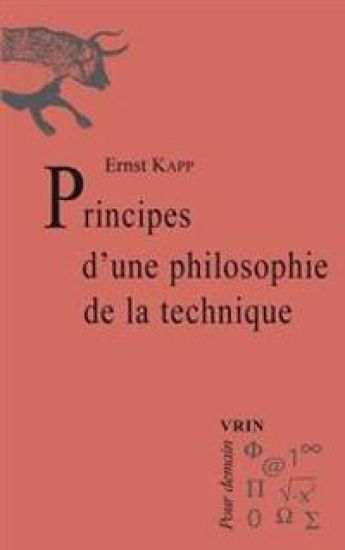
L'expression philosophie de la technique est nee avec ce livre, en 1877. Il s'agit pour Ernst Kapp d'une philosophie de la hache, du marteau, de la vis et de la machine a vapeur. Georges Canguilhem y voyait l'une des premieres tentatives pour constituer une philosophie biologique de la technique, c'est-a-dire pour penser les outils et les machines en tant que prolongement et exteriorisation de l'activite des corps vivants: Cet ouvrage, classique en Allemagne, est a ce point meconnu en France, que certains des psychologues qui ont repris, a partir des etudes de Kohler et de Guillaume, le probleme de l'utilisation des outils par les animaux et de l'intelligence animale, attribuent cette theorie de la projection a Espinas lui-meme, sans savoir qu'Espinas declare tres explicitement a plusieurs reprises qu'il l'emprunte a Kapp. Selon la theorie de la projection dont les fondements philosophiques remontent, a travers von Hartmann et La Philosophie de l'Inconscient, jusqu'a Schopenhauer, les premiers outils ne sont que le prolongement des organes humains en mouvement. Le silex, la massue, le levier prolongent et etendent le mouvement organique de percussion du bras. (...) Ce que les Allemands ont constitue par la voie philosophique (...) nous le voyons repris, et autant qu'on peut savoir sans derivation directe, par Leroi-Gourhan dans son livre Milieu et Techniques .