
Kirjailija
Ernst Mach
Kirjat ja teokset yhdessä paikassa: 70 kirjaa, julkaisuja vuosilta 1914–2026, suosituimpiin kuuluu Popular Scientific Lectures (Cram Edition). Vertaile teosten hintoja ja tarkista saatavuus suomalaisista kirjakaupoista.
70 kirjaa
Kirjojen julkaisuvuodet: 1914–2026.
Space And Geometry In The Light Of Physiological, Psychological And Physical Inquiry
Ernst Mach
Literary Licensing, LLC
2014
sidottu
""Space and Geometry in the Light of Physiological, Psychological and Physical Inquiry"" is a comprehensive exploration of the nature of space and geometry, written by the Austrian physicist and philosopher Ernst Mach. The book delves into the relationship between space and the human mind, examining how our physiological and psychological processes shape our perception of the world around us. Mach also explores the physical properties of space, including its curvature and the role of gravity in shaping the universe. Throughout the book, Mach draws on a range of scientific disciplines, including physics, psychology, and physiology, to provide a nuanced and multifaceted understanding of space and geometry. This work is considered a seminal contribution to the field of philosophy of science and has had a lasting impact on our understanding of the nature of space and the universe. This Is A New Release Of The Original 1906 Edition. This scarce antiquarian book is a facsimile reprint of the old original and may contain some imperfections such as library marks and notations. Because we believe this work is culturally important, we have made it available as part of our commitment for protecting, preserving, and promoting the world's literature in affordable, high quality, modern editions, that are true to their original work.
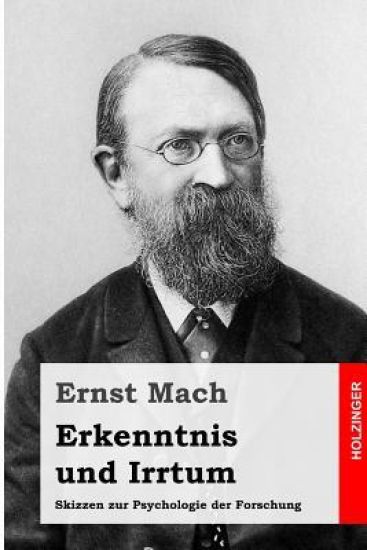
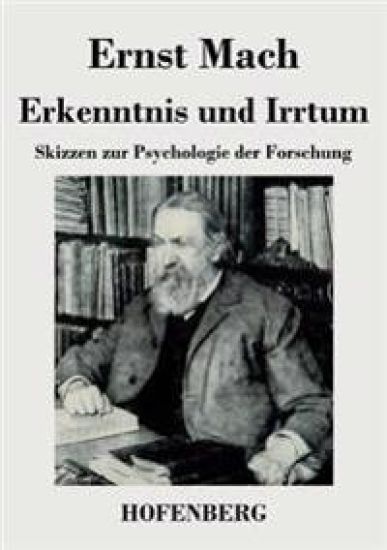
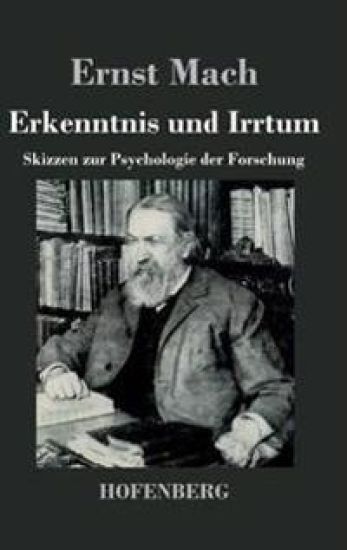
Erkenntnis Und Irrtum: Skizzen Zur Psychologie Der Forschung
Ernst Mach
Createspace Independent Publishing Platform
2014
nidottu
Ernst Mach: Erkenntnis und Irrtum. Skizzen zur Psychologie der Forschung Edition Holzinger. Taschenbuch Berliner Ausgabe, 2017, 4. Auflage Durchgesehener Neusatz mit einer Biographie des Autors bearbeitet und eingerichtet von Michael Holzinger Erstdruck: Leipzig (Johann Ambrosius Barth) 1905. Der Text folgt der postum erschienenen 3. durchgesehenen Auflage: Leipzig (Johann Ambrosius Barth) 1917; der Anhang bleibt unber cksichtigt. Widmung: Wilhelm Schuppe in herzlicher Verehrung gewidmet. Textgrundlage ist die Ausgabe: Ernst Mach: Erkenntnis und Irrtum. Skizzen zur Psychologie der Forschung. Dritte durchgesehene Auflage, Leipzig: Johann Ambrosius Barth, 1917. Herausgeber der Reihe: Michael Holzinger Reihengestaltung: Viktor Harvion Umschlaggestaltung unter Verwendung des Bildes: Ernst Mach, Heliograv re von H. F. J tte, 1902 Gesetzt aus der Minion Pro, 11 pt.
Space and Geometry in the Light of Physiological, Psychological and Physical Inquiry
Ernst Mach
Literary Licensing, LLC
2014
nidottu
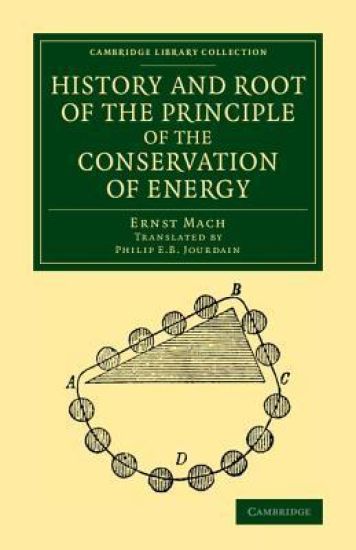
History and Root of the Principle of the Conservation of Energy
Ernst Mach
Cambridge University Press
2014
pokkari
The Austrian scientist Ernst Mach (1838–1916) carried out work of importance in several fields of enquiry, including physics, physiology and psychology. In this short work, first published in German in 1872 and translated here into English in 1911 by Philip E. B. Jourdain (1879–1919) from the 1909 second edition, Mach discusses the formulation of one of science's most fundamental theories. He provides his interpretation of the principle of the conservation of energy, claiming its foundations are not in mechanical physics. Mach's 1868 work on the definition of mass - one of his most significant contributions to mechanics - has been incorporated here. His perspective on the topic as a whole remains relevant to those interested in the history of science and the theory of knowledge. Also reissued in this series in English translation are Mach's The Science of Mechanics (1893) and Popular Scientific Lectures (1895).
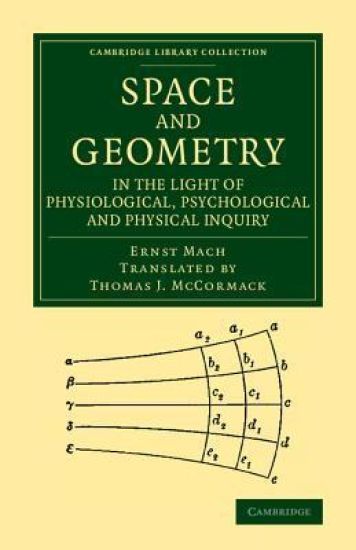
Space and Geometry in the Light of Physiological, Psychological and Physical Inquiry
Ernst Mach
Cambridge University Press
2014
pokkari
The Austrian scientist Ernst Mach (1838–1916) carried out work of importance in many fields of enquiry, including physics, physiology, psychology and philosophy. Published in this English translation of 1906, these essays examine geometry from three different perspectives. Mach argues that, as our ideas about space are created by the senses and how we experience our environment, researchers must not consider the subject from a mathematical standpoint alone. In the first essay, he explains how humans generate spatial concepts. Next, he discusses the psychology of geometry, its empirical origins, and its development. In the final piece, he writes from the viewpoint of a physicist, outlining how various mathematicians, such as Carl Friedrich Gauss and Bernhard Riemann, have contributed to our geometrical understanding. Also reissued in this series in English translation are Mach's The Science of Mechanics (1893) and Popular Scientific Lectures (1895).
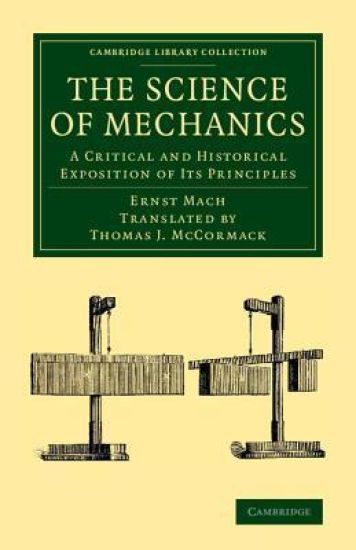
Ernst Mach (1838–1916), the first scientist to study objects moving faster than the speed of sound, propounded a scientific philosophy which called for a strict adherence to observable data. He maintained that the sole purpose of scientific study is to provide the simplest possible description of detectable phenomena. In this work, first published in German in 1883 and here translated in 1893 by Thomas J. McCormack (1865–1932) from the 1888 second edition, Mach begins with a historical discussion of mechanical principles. He then proceeds to a critique of Newton's concept of 'absolute' space and time, reflecting Mach's rejection of theoretical concepts in the absence of definitive evidence. Although historically controversial, Mach's ideas and attitudes informed philosophers as influential as Russell and Wittgenstein, and his insistence upon a 'relative' idea of space and time provided much of the philosophical basis for Einstein's theory of general relativity decades later.
xi should hope for "first and foremost" from any historical investigation, including his own, was that "it may not be too tedious. " II That hope is generally realized in Mach's historical writings, most of which are as lively and interesting now as they were when they appeared. Mach did not follow any existing model of historical or philosophical or scientific exposition, but went at things his own way combining the various approaches as needed to reach the goals he set for himself. When he is at his best we get a sense of the Mach whom William James met on a visit to Prague, the Mach whose four hours of "unforgettable conversation" gave the forty year old, well traveled James the strongest "impression of pure intellectual genius" he had yet received, and whose "absolute simplicity of manner and winningness of smile" captivated him completely. 12 Consider, for example, the first few chapters of this book, Principles of the Theory of Heat, which Mach devotes to the notion of temperature, that most fundamental of all thermal concepts. He begins by trying to trace the path that leads from our sensations of hot and cold to a numerical temperature scale.
Mach, E: Grundlinien Der Lehre Von Den Bewegungsempfindungen
Ernst Mach
KESSINGER PUBLISHING, LLC
2010
nidottu
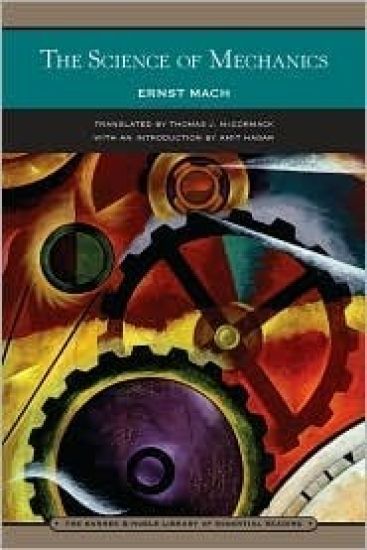
“I believe even that those who consider themselves as opponents of Mach are hardly aware of how much of Mach’s way of thinking they imbibed, so to speak, with their mother’s milk.” – Albert EinsteinErnst Mach’s Science of Mechanics(1883) remains one of the classics in the history and the philosophy of science. In this scholarly masterpiece Mach wished to eliminate all “metaphysical” concepts and to construct science with as few and as simple postulates as possible, explicating these solely in terms of experience. This ideology behind Science of Mechanics, known also as “Mach’s Principle” when applied to the notion of Newtonian absolute space, was acknowledged by Einstein as the inspiration that led him to his general theory of relativity. The book has had an enormous influence on generations of scientists, historians, and philosophers, within the domains of physics and even outside it, and some of the twentieth century’s most important ideas, such as positivism, behaviorism, empiricism, conventionalism, and pragmatism, can be traced to its pages.


Vorwort des Gesamtherausgebers zur ERNST-MACH-STUDIENAUSGABE (EMS) Ernst Mach (1838-1916) gehört ohne Zweifel zu den großen Wegbereitern des modernen, naturwissenschaftlich geprägten Weltbildes. Er war in einer Person Physiker, Philosoph, Wissenschaftshistoriker und Wissenschaftstheoretiker und leistete als "Naturforscher" auf all diesen Gebieten Außerordentliches. Seine empiristische Erkenntnislehre und Wissenschaftsauffassung (mit prominenten Kontrahenten wie Ludwig Boltzmann oder Max Planck) übte einen großen Einfluss aus: auf seine Zeitgenossen und die jüngere Physikergeneration aus, z. B. auf Pierre Duhem, Henri Poincar?, Albert Einstein und vor allem auf die Mitglieder des Wiener Kreises mit dem "Verein Ernst Mach" um Moritz Schlick, in der nächsten Generation bis hin zu Paul Feyerabend. Bereits zu Lebzeiten war Mach ein vieldiskutierter Wissenschaftler in der Philosophie, Physik, Physiologie, Psychologie (Gestalttheorie) und Nationalökonomie, aber auch mit einer bemerkenswerten Rezeption in der Literatur, Kunst und Musik. Demgegenüber war die Kritik von Lenin am Machschen "Empiriokritizismus" bis zum Umbruch 1989/90 folgenreich.. Die wissenschaftliche Aktualität und Relevanz von Ernst Mach zeigt sich in der heutigen Diskussion zur Philosophie, Geschichte und Theorie der Wissenschaften (History and Philosophy of Science) nach der historisch-pragmatischen Wende. Die EMS wird die Hauptwerke, und zwar 6 Monographien von Ernst Mach mit Einleitungen und Anmerkungen von heutigen ExpertenInnen publizieren und damit fast das gesamte Werk nach der letzten autorisierten Ausgabe des Autors wieder zugänglich machen: Die Mechanik, Die Analyse der Empfindungen, Erkenntnis und Irrtum, Populärwissenschaftliche Vorlesungen, Die Prinzipien der Wärmelehre, Die Prinzipien der physikalischen Optik. Daneben sind weitere 3 Bände mit den wichtigsten Schriften zur Physik bzw. zur Psychologie, Physiologie, Psychophysik, Medizin und Musik, sowie zur Wissenschaftsgeschichte und Wissenschaftsphilosophie vorgesehen. Ein Forschungsband mit einer Auswahl aus der Korrespondenz soll die Edition ergänzen. Die Herausgeber hoffen, dass damit das beeindruckende Lebenswerk von Ernst Mach in der heutigen Forschung und Lehre, aber auch in der breiteren Öffentlichkeit eine verdiente Aufnahme und Neubewertung erfährt. Mein Dank gilt den Mitgliedern des Herausgeber-Komitees, Michael Heidelberger, Dieter Hoffmann, Elisabeth Nemeth, Wolfgang Reiter und Gereon Wolters als Herausgeber des vorliegenden ersten Bandes, nicht zuletzt Herrn Wolfgang Sohst vom xenomoi Verlag für seine Initiative zur Realisierung der EMS. (Friedrich Stadler)