Kirjojen hintavertailu – 12 859 828 kirjaa ja 27 kauppaa

Kirjailija

Erwin Bulte

Kirjat ja teokset yhdessä paikassa: 4 kirjaa, julkaisuja vuosilta 2018–2022, suosituimpiin kuuluu Institutions and Agrarian Development. Vertaile teosten hintoja ja tarkista saatavuus suomalaisista kirjakaupoista.

4 kirjaa

Kirjojen julkaisuvuodet: 2018–2022.

African Farmers, Value Chains and Agricultural Development

African Farmers, Value Chains and Agricultural Development

Alan de Brauw; Erwin Bulte

Springer Nature Switzerland AG
2022
nidottu
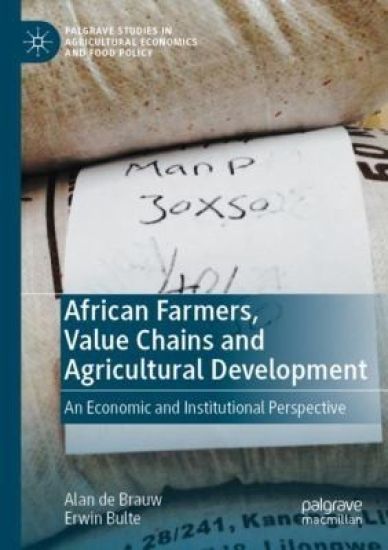
This book provides a thorough introduction to and examination of agricultural value chains in Sub-Saharan Africa. First, the authors introduce the economic theory of agri-food value chains and value chain governance, focusing on domestic and regional trade in (and consumption of) food crops in a low-income country context. In addition to mainstream and heterodox thinking about value chain development, the book pays attention to political economy considerations. The book also reviews the empirical evidence on value chain development and performance in Africa. It adopts multiple lenses to examine agricultural value chains, zooming out from the micro level (e.g., relational contracting in a context of market imperfections) to the meso level (e.g., distributional implications of various value chain interventions, inclusion of specific social groups) and the macro level (underlying income, population and urbanization trends, volumes and prices, etc.). Furthermore, this book places value chain development in the context of a process the authors refer to as structural transformation 2.0, which refers to a process where production factors (labor, land and capital) move from low-productivity agriculture to high-productivity agriculture. Finally, throughout the book the authors interpret the evidence in light of three important debates: (i) how competitive are rural factor and product markets, and what does this imply for distribution and innovation? (ii) what role do foreign investment and factor proportions play in the development of agri-food value chains in Africa? (iii) what complementary government policies can help facilitate a process of agricultural value chain transformation, towards high-productive activities and enhancing the capacity of value chains to generate employment opportunities and food security for a growing population.

African Farmers, Value Chains and Agricultural Development

African Farmers, Value Chains and Agricultural Development

Alan de Brauw; Erwin Bulte

Springer Nature Switzerland AG
2021
sidottu
This book provides a thorough introduction to and examination of agricultural value chains in Sub-Saharan Africa. First, the authors introduce the economic theory of agri-food value chains and value chain governance, focusing on domestic and regional trade in (and consumption of) food crops in a low-income country context. In addition to mainstream and heterodox thinking about value chain development, the book pays attention to political economy considerations. The book also reviews the empirical evidence on value chain development and performance in Africa. It adopts multiple lenses to examine agricultural value chains, zooming out from the micro level (e.g., relational contracting in a context of market imperfections) to the meso level (e.g., distributional implications of various value chain interventions, inclusion of specific social groups) and the macro level (underlying income, population and urbanization trends, volumes and prices, etc.). Furthermore, this book places value chain development in the context of a process the authors refer to as structural transformation 2.0, which refers to a process where production factors (labor, land and capital) move from low-productivity agriculture to high-productivity agriculture. Finally, throughout the book the authors interpret the evidence in light of three important debates: (i) how competitive are rural factor and product markets, and what does this imply for distribution and innovation? (ii) what role do foreign investment and factor proportions play in the development of agri-food value chains in Africa? (iii) what complementary government policies can help facilitate a process of agricultural value chain transformation, towards high-productive activities and enhancing the capacity of value chains to generate employment opportunities and food security for a growing population.
Institutions and Agrarian Development

Institutions and Agrarian Development

Erwin Bulte; Paul Richards; Maarten Voors

Springer Nature Switzerland AG
2019
nidottu
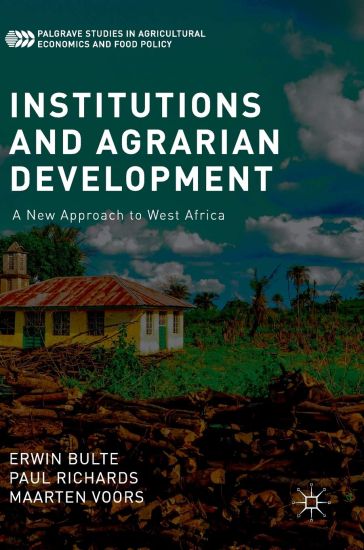
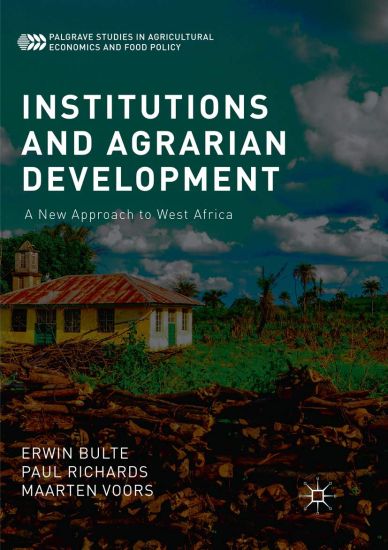
This book argues that development strategies have thus far failed in Western Africa because the many challenges afflicting the area have yet to be explored and understood from the perspective of institutional resources. With a particular focus on three countries on the bend of the Upper West African coast – Guinea, Liberia and Sierra Leone – this book offers a theory to account for the nature of these institutional elements, to test deductions against evidence, and finally to propose a reset for rural development policy to make fuller use of local institutional resources. Based on quantitative analysis and eight years of multidisciplinary field research, this volume features several large-scale RCTs in the domain of rural development, local governance, and nature conservation. The authors address one of the biggest topics in agricultural and development economics today: the structural transformation of poor, agrarian economies, and they do so through the important and unique lens ofinstitutions.
Institutions and Agrarian Development

Institutions and Agrarian Development

Erwin Bulte; Paul Richards; Maarten Voors

Springer International Publishing AG
2018
sidottu
This book argues that development strategies have thus far failed in Western Africa because the many challenges afflicting the area have yet to be explored and understood from the perspective of institutional resources. With a particular focus on three countries on the bend of the Upper West African coast – Guinea, Liberia and Sierra Leone – this book offers a theory to account for the nature of these institutional elements, to test deductions against evidence, and finally to propose a reset for rural development policy to make fuller use of local institutional resources. Based on quantitative analysis and eight years of multidisciplinary field research, this volume features several large-scale RCTs in the domain of rural development, local governance, and nature conservation. The authors address one of the biggest topics in agricultural and development economics today: the structural transformation of poor, agrarian economies, and they do so through the important and unique lens ofinstitutions.