Kirjojen hintavertailu – 12 859 828 kirjaa ja 27 kauppaa

Kirjailija

Esther Benbassa

Kirjat ja teokset yhdessä paikassa: 12 kirjaa, julkaisuja vuosilta 1995–2020, suosituimpiin kuuluu Religion : i historia, samtid och framtid. Vertaile teosten hintoja ja tarkista saatavuus suomalaisista kirjakaupoista.

12 kirjaa

Kirjojen julkaisuvuodet: 1995–2020.

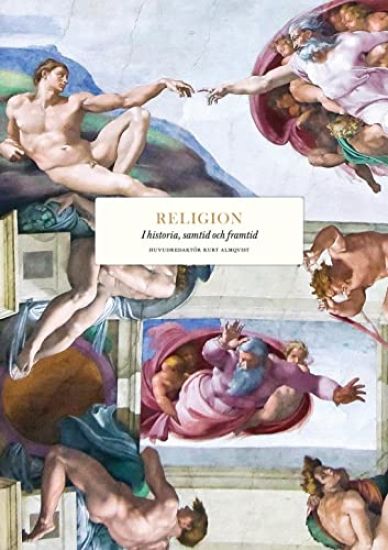
Religion : i historia, samtid och framtid

Religion : i historia, samtid och framtid

Janne Haaland Matlary; Daniel T. Potts; Julius J. Lipner; Robin Osborne; John Scheid; Martin Goodman; Diarmaid Macculloch; Elaine Pagels; Reza Aslan; Wouter J. Hanegraaff; Gary Lachman; Malise Ruthven; Marco Pasi; William O’Reilly; Ariel Glucklich; Wolfgang Palaver; Mona Siddiqui; Candida R. Moss; Esther Benbassa; Richard Miles; A.N. Wilson; Jessica Frazier; Simon May; Armin W. Geertz; Harvey Whitehouse; Pär Stenbäck; Benedetta Berti; Göran Rosenberg; Jayne Svenungsson; Adrian Wooldridge; Chakravarthi Ram-Prasad

Bokförlaget Stolpe
2020
sidottu
Tron på en styrande, övergripande, himmelsk princip har följt människan genom historien. Mer än 80 procent av världens befolkning har idag en religiös tillhörighet och även i sekulära stater fortsätter religionen att spela en viktig roll. Det går inte att förstå politik och internationella relationer idag utan att inkludera religionen som en aspekt av det kulturella sammanhanget. Essäerna i denna antologi, som härrör från Engelsbergsseminariet 2014, spänner över en mångfald ämnen i dagens såväl som gårdagens samhällen. De utforskar religionen i relation till människans villkor och skildrar hur den manifesterar sig i individens egna upplevelser. För att förstå oss själva behöver vi också förstå religionen.
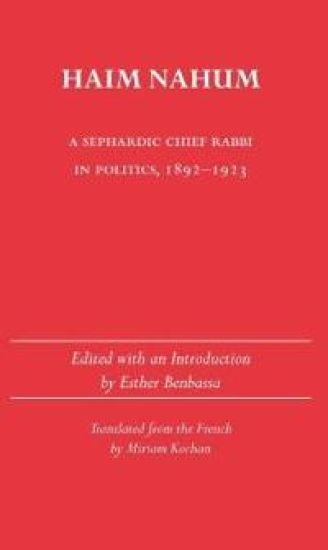
Haim Nahum

Haim Nahum

Esther Benbassa

The University of Alabama Press
1995
nidottu
Relates the history of Turkish Jewry during the last decades of the Ottoman empire. This story is told through the life and work of one of its central figures, Haim Nahum (1872-1960), Chief Rabbi of the Ottoman Empire from 1909 to 1920.
Jude sein nach Gaza

Jude sein nach Gaza

Esther Benbassa

Les Editions Du Crieur Public
2019
pokkari
Das Buch Jude sein nach Gaza ist ein ethischer Aufschrei der renommierten j dischen Professorin Esther Benbassa anl sslich der Leiden der Zivilbev lkerung Gazas w hrend des letzten Feldzuges Israels. F r sie f hrt das Angedenken an die durch den Holocaust vernichteten Juden zu der Verpflichtung Israels sich human und ethisch zu verhalten. Sie zeigt, wie die Shoah das israelische sowie das j dische Selbstverst ndnis pr gt und leitet aus dem Gedenken an den Holocaust das Gebot ab, auch die Leiden der Pal stinenser anzuerkennen. Zugleich vergibt sie pal stinensischen Politikern weder verpasste Friedensm glichkeiten noch den Terrorismus. Sie verteidigt Israels Existenz, tritt f r einen pal stinensischen Staat ein und analysiert die Gr nde ungenutzter Friedenschancen. Dieses Buch l st in Frankreich intensive Diskussionen aus und ist dort ein Bestseller.
A Sephardi Life in Southeastern Europe

A Sephardi Life in Southeastern Europe

Esther Benbassa; Aron Rodrigue

University of Washington Press
2015
sidottu
Autobiographical texts are rare in the Sephardi world. Gabriel Arié's writings provide a special perspective on the political, economic, and cultural changes undergone by the Eastern Sephardi community in the decades before its dissolution, in regions where it had been constituted since the expulsion from Spain in 1492. His history is a fascinating memoir of the Sephardi and Levantine bourgeoisie of the time. For his entire life, Arié—teacher, historian, community leader, and businessman—was caught between East and West. Born in a small provincial town in Ottoman Bulgaria in 1863, he witnessed the disappearance of a social and political order that had lasted for centuries and its replacement by new ideas and new ways of life, which would irreversibly transform Jewish existence. A Sephardi Life in Southeastern Europe publishes in full the autobiography (covering the years 1863-1906) and journal (1906-39) of Gabriel Arié, along with selections from his letters to the Alliance Israélite Universelle. An introduction by Esther Benbassa and Aron Rodrigue analyzes his life and examines the general and the Jewish contexts of the Levant at the end of the nineteenth and the beginning of the twentieth centuries.
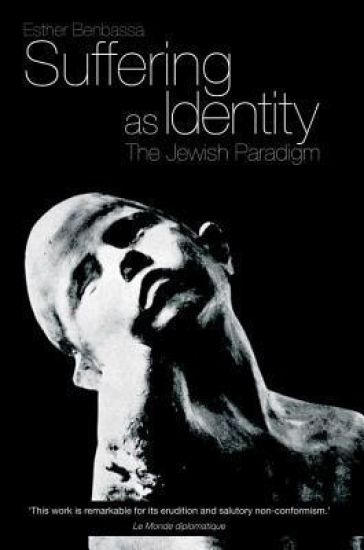
Suffering as Identity

Suffering as Identity

Esther Benbassa

Verso Books
2010
nidottu
Reaching from biblical times to the present day, Esther Benbassa's prize-winning exploration of Jewish identity is both epic and comprehensive. She shows how in the Jewish world, the representation and ritualization of suffering have shaped the history of both the people and the religion. Benbassa argues that the nineteenth century gave rise to a Jewish 'lachrymose' historiography, and that Jewish history was increasingly seen to be a 'vale of tears'-a development that has become even more pronounced since the Holocaust. The treatment of the Holocaust in the State of Israel now has the form of a civil religion. In principle within reach of everyone, the 'duty of memory' and the uniqueness of the genocide have mitigated for many Jews the loss of other traditions. The Israeli government invokes the memory of the Holocaust to neutralize threats to its interests-ensuring that suffering continues to be a central part of Jewish identity and positioning the State of Israeli as a redemptive force.
The Jew and the Other

The Jew and the Other

Esther Benbassa; Jean-Christophe Attias

Cornell University Press
2004
sidottu
In the current situation of polarization in the Middle East, it is easy to lose sight of the fact that a long tradition of dialogue and openness toward the "Other" exists in many strands of Jewish thought. Himself or herself the quintessential Other in a world in which she or he has existed dispersed, in exile, as a minority, the Jew has consistently envisioned the self in relation to surrounding societies. Esther Benbassa and Jean-Christophe Attias show that alterity is a useful and morally compelling notion with which to structure Judaism's historically specific and politically charged encounters with deity, femininity, the Christian West, and the Muslim East. In Benbassa and Attias's view, the Other may be rejected, but it is also a mirror, both reminding the Jew of ethical duties and constituting a source of temptation and danger. Sometimes, the authors find, the Other is the enemy. They note that it is with the enemy that peace is made, peace with the Other and peace with the self. The Jew and the Other, which is an extended commentary on a dozen Biblical verses and which follows the five books of the Pentateuch, offers the history of that encounter as an inextricable part of the Jewish condition and is itself a meditation on this encounter.
The Jew and the Other

The Jew and the Other

Esther Benbassa; Jean-Christophe Attias

Cornell University Press
2004
pokkari
In the current situation of polarization in the Middle East, it is easy to lose sight of the fact that a long tradition of dialogue and openness toward the "Other" exists in many strands of Jewish thought. Himself or herself the quintessential Other in a world in which she or he has existed dispersed, in exile, as a minority, the Jew has consistently envisioned the self in relation to surrounding societies. Esther Benbassa and Jean-Christophe Attias show that alterity is a useful and morally compelling notion with which to structure Judaism's historically specific and politically charged encounters with deity, femininity, the Christian West, and the Muslim East. In Benbassa and Attias's view, the Other may be rejected, but it is also a mirror, both reminding the Jew of ethical duties and constituting a source of temptation and danger. Sometimes, the authors find, the Other is the enemy. They note that it is with the enemy that peace is made, peace with the Other and peace with the self. The Jew and the Other, which is an extended commentary on a dozen Biblical verses and which follows the five books of the Pentateuch, offers the history of that encounter as an inextricable part of the Jewish condition and is itself a meditation on this encounter.
Israel, the Impossible Land

Israel, the Impossible Land

Jean-Christophe Attias; Esther Benbassa

Stanford University Press
2002
sidottu
What has the land of Israel meant for the Jewish imagination? This book provides a lively and readable answer, covering Biblical times to the present. Its aim is to pierce the mystery of the images of Israel, to grasp their meaning and function, to trace their origins and history, and to resituate in historical terms the fertile mythology that has peopled and continues to people the Jewish imagination, interposing a screen between a people and their land. Describing the real, however, is not sufficient to disqualify the myths. The authors believe, with the famous French historian Pierre Vidal-Naquet, that: "Things are not so simple. Myth is not opposed to the real as the false to the true; myth accompanies the real." Today, Israel is an undeniable fact and no longer has to legitimize its existence. It is in the midst of living through the crises of adulthood. The authors simply want to reconstitute and trace the genealogies of these contemporary crises. Only upon a clear understanding of this present and this past can a future be constructed.
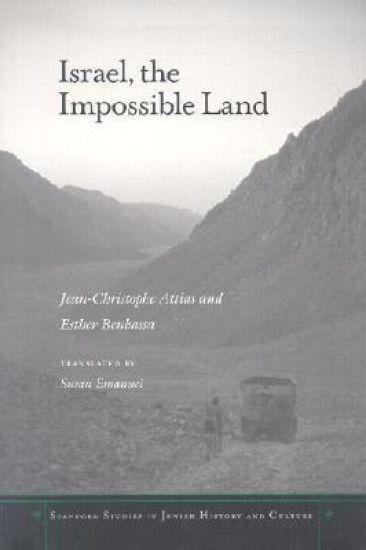
Israel, the Impossible Land

Israel, the Impossible Land

Jean-Christophe Attias; Esther Benbassa

Stanford University Press
2002
pokkari
What has the land of Israel meant for the Jewish imagination? This book provides a lively and readable answer, covering Biblical times to the present. Its aim is to pierce the mystery of the images of Israel, to grasp their meaning and function, to trace their origins and history, and to resituate in historical terms the fertile mythology that has peopled and continues to people the Jewish imagination, interposing a screen between a people and their land. Describing the real, however, is not sufficient to disqualify the myths. The authors believe, with the famous French historian Pierre Vidal-Naquet, that: "Things are not so simple. Myth is not opposed to the real as the false to the true; myth accompanies the real." Today, Israel is an undeniable fact and no longer has to legitimize its existence. It is in the midst of living through the crises of adulthood. The authors simply want to reconstitute and trace the genealogies of these contemporary crises. Only upon a clear understanding of this present and this past can a future be constructed.
The Jews of France

The Jews of France

Esther Benbassa

Princeton University Press
2001
pokkari
In the first English-language edition of a general, synthetic history of French Jewry from antiquity to the present, Esther Benbassa tells the intriguing tale of the social, economic, and cultural vicissitudes of a people in diaspora. With verve and insight, she reveals the diversity of Jewish life throughout France's regions, while showing how Jewish identity has constantly redefined itself in a country known for both the Rights of Man and the Dreyfus affair. Beginning with late antiquity, she charts the migrations of Jews into France and traces their fortunes through the making of the French kingdom, the Revolution, the rise of modern anti-Semitism, and the current renewal of interest in Judaism. As early as the fourth century, Jews inhabited Roman Gaul, and by the reign of Charlemagne, some figured prominently at court. The perception of Jewish influence on France's rulers contributed to a clash between church and monarchy that would culminate in the mass expulsion of Jews in the fourteenth century. The book examines the re-entry of small numbers of Jews as New Christians in the Southwest and the emergence of a new French Jewish population with the country's acquisition of Alsace and Lorraine. The saga of modernity comes next, beginning with the French Revolution and the granting of citizenship to French Jews. Detailed yet quick-paced discussions of key episodes follow: progress made toward social and political integration, the shifting social and demographic profiles of Jews in the 1800s, Jewish participation in the economy and the arts, the mass migrations from Eastern Europe at the turn of the twentieth century, the Dreyfus affair, persecution under Vichy, the Holocaust, and the postwar arrival of North African Jews. Reinterpreting such themes as assimilation, acculturation, and pluralism, Benbassa finds that French Jews have integrated successfully without always risking loss of identity. Published to great acclaim in France, this book brings important current issues to bear on the study of Judaism in general, while making for dramatic reading.
Sephardi Jewry

Sephardi Jewry

Esther Benbassa; Aron Rodrigue

University of California Press
2000
pokkari
Until the publication of this remarkably comprehensive history of the Sephardi diaspora, only limited attention had been given to the distinctive Judeo-Spanish cultural entity that flourished in the Balkans and Asia Minor for more than four centuries. Yet the great majority of Sephardi Jews, after their expulsion from Spain in 1492 and subsequently from Portugal, found their way to this region, drawn by the political stability and relatively tolerant rule of the Ottoman Empire, as well as by promising socioeconomic conditions. Esther Benbassa and Aron Rodrigue show how Sephardi society and culture developed in the Levant, sharing language, religion, customs, and communal life as they did nowhere else, both during prosperous times and during the declining fortunes of the seventeenth and eighteenth centuries. The impact of westernization, the end of Ottoman power, and the rise of fragmenting nation-states transformed this vital community in the modern era. And, like many other Jewish communities, the unique Judeo-Spanish culture was dispersed and destroyed by the Holocaust and the migrations of the twentieth century. "Sephardi Jewry" presents its vivid history in a readable, well-documented narrative.
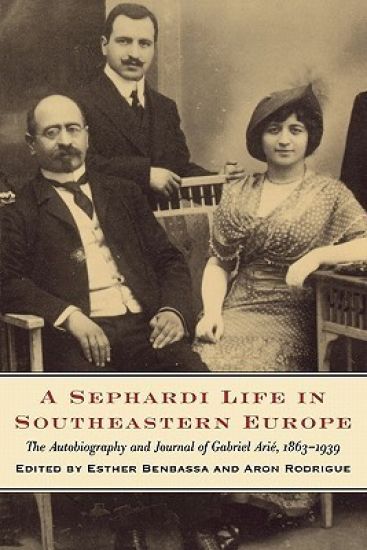
A Sephardi Life in Southeastern Europe

A Sephardi Life in Southeastern Europe

Esther Benbassa; Aron Rodrigue

University of Washington Press
1998
pokkari
Autobiographical texts are rare in the Sephardi world. Gabriel Arié's writings provide a special perspective on the political, economic, and cultural changes undergone by the Eastern Sephardi community in the decades before its dissolution, in regions where it had been constituted since the expulsion from Spain in 1492. His history is a fascinating memoir of the Sephardi and Levantine bourgeoisie of the time. For his entire life, Arié—teacher, historian, community leader, and businessman—was caught between East and West. Born in a small provincial town in Ottoman Bulgaria in 1863, he witnessed the disappearance of a social and political order that had lasted for centuries and its replacement by new ideas and new ways of life, which would irreversibly transform Jewish existence. A Sephardi Life in Southeastern Europe publishes in full the autobiography (covering the years 1863-1906) and journal (1906-39) of Gabriel Arié, along with selections from his letters to the Alliance Israélite Universelle. An introduction by Esther Benbassa and Aron Rodrigue analyzes his life and examines the general and the Jewish contexts of the Levant at the end of the nineteenth and the beginning of the twentieth centuries.