Kirjojen hintavertailu – 12 859 829 kirjaa ja 27 kauppaa

Kirjailija

Etienne Perret

Kirjat ja teokset yhdessä paikassa: 7 kirjaa, julkaisuja vuosilta 2014–2025, suosituimpiin kuuluu Chipless RFID Handbook: Fundamentals and Applications. Vertaile teosten hintoja ja tarkista saatavuus suomalaisista kirjakaupoista.

7 kirjaa

Kirjojen julkaisuvuodet: 2014–2025.

Chipless RFID Handbook: Fundamentals and Applications

Chipless RFID Handbook: Fundamentals and Applications

Fátima Villa-González; Daniel Valderas; Etienne Perret; Antonio Lázaro; Simone Genovesi; Rahul Bhattacharyya

Springer International Publishing AG
2025
sidottu
Chipless radio frequency identification (RFID) technology has emerged as a cost-effective alternative to conventional automated identification systems like RFID, QR codes, and barcodes. Simultaneously, it enables a wide array of novel applications, including recycling, structural health monitoring, and food safety, among many others. In this handbook, the authors provide an in-depth exploration of the design, manufacturing, and implementation guidelines of chipless RFID systems, including information encoding in chipless tags, the design of radar-based ultra-wideband (UWB) readers and antennas, as well as dedicated signal processing in time- and frequency-domain. This book is not only a practical resource for understanding the core principles and capabilities of chipless RFID, but also a rich source of expert knowledge for those wishing to deepen their understanding or explore particular applications. With real-world examples and detailed guidelines, the Chipless RFID Handbook serves as both a beginner-friendly introduction and an advanced reference on this emerging technology.
Chipless RFID Authentication

Chipless RFID Authentication

Zeshan Ali; Etienne Perret; Nicolas Barbot; Romain Siragusa

ISTE LTD AND JOHN WILEY SONS INC
2022
sidottu
Chipless RFID Authentication examines the development of highly secure product authentication systems for manufactured products by using chipless radio frequency identification (RFID) technology. The absence of a chip and its compatibility with mass production make chipless RFID an alternative to barcodes. This book discusses how, by using natural randomness inherent to the fabrication process, each chipless RFID tag has a unique signature that can never be reproduced, even if someone tries to copy the label. The book first explores the state-of-the-art of existing authentication and anti-counterfeiting methods based on their security level. Next, a methodology describing the characterization of chipless RFID tags for the authentication application is presented, followed by a discussion of the extraction of aspect-independent parameters for chipless RFID tags. After proposing designs for the tags, the book presents the realization and characterization of the labels (which exhibit naturally occurring randomness) for authentication, using printed circuit boards and inkjet printing on polyethylene terephthalate.
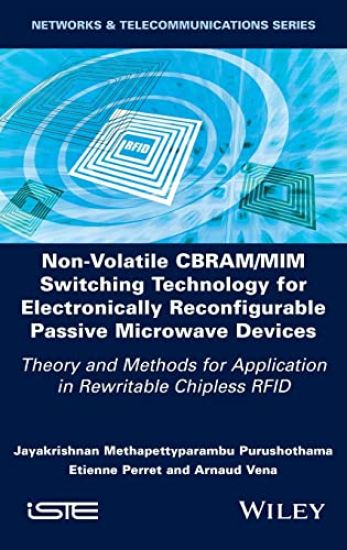
Non-Volatile CBRAM/MIM Switching Technology for Electronically Reconfigurable Passive Microwave Devices

Non-Volatile CBRAM/MIM Switching Technology for Electronically Reconfigurable Passive Microwave Devices

Jayakrishnan M. Purushothama; Etienne Perret; Arnaud Vena

ISTE LTD AND JOHN WILEY SONS INC
2022
sidottu
This book presents the applications of non-volatile CBRAM/MIM switching technology for electronically reconfigurable passive RF and microwave devices, together with theory and methods for application in rewritable chipless RFID tags. Conductive Bridging Random Access Memory (CBRAM) is a renowned and commercially used non-volatile memory concept. Having evolved over the past few decades, it is currently identified as an efficient non-volatile RF switching technology. This book presents recent research on this topic, focusing on the development of a new generation of low-cost non-volatile RF switches and their applications, demonstrating both high performance and flexibility of implementation. It includes the experimental realization of various prototypes of RF and microwave devices utilizing this technology, along with relevant analysis of mathematical and electrical models, and detailed discussions of future aspects. All devices presented are compatible with mass industrial production at an economically efficient budget through optimized fabrication steps, without the requirement of sophisticated “clean room” processes among them.
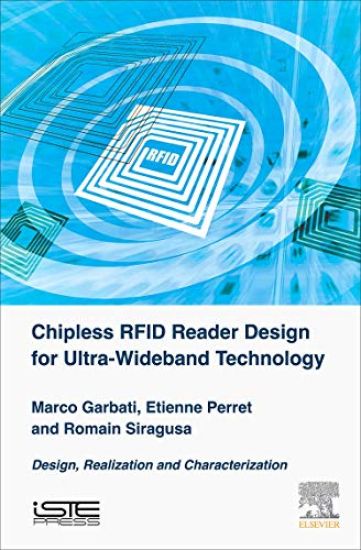
Chipless RFID Reader Design for Ultra-Wideband Technology

Chipless RFID Reader Design for Ultra-Wideband Technology

Marco Garbati; Etienne Perret; Romain Siragusa

ISTE Press Ltd - Elsevier Inc
2018
sidottu
Chipless RFID Reader Design for Ultra-Wideband Technology: Design, Realization and Characterization deals with the efficient design of Field Programmable Gate Array (FPGA) based embedded systems for chipless readers, providing a reading technique based on polarization diversity that is shown with the aim of reading cross-polarized, chipless tags independently from their orientation. This approach is valuable because it does not give any constraint at the tag design level. This book presents the state-of-the-art of chipless RFID systems, also providing useful comparisons. The international regulations that limit the UWB emission are taken into consideration, along with design guidance. Two designed, realized, and characterized reader prototypes are proposed. Sampling noise reduction, reading time, and cost effectiveness are also introduced and taken into consideration.
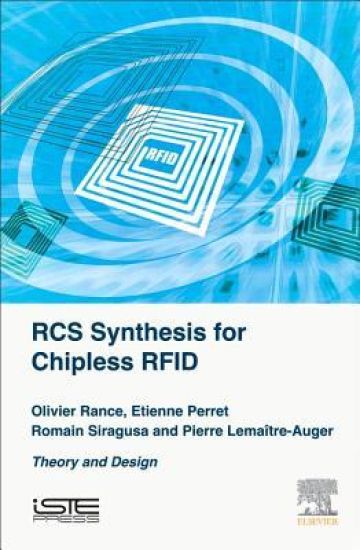
RCS Synthesis for Chipless RFID

RCS Synthesis for Chipless RFID

Olivier Rance; Etienne Perret; Romain Siragusa; Pierre Lemaitre-Auger

ISTE Press Ltd - Elsevier Inc
2017
sidottu
The considerable growth of RFID is currently accompanied by the development of numerous identification technologies that complement those already available while seeking to answer new problems. Chipless RFID is one example. The goal is to both significantly reduce the price of the tag and increase the amount of information it contains, in order to compete with the barcode while retaining the benefits of a flexible reading approach based on radio communication. To solve the problem of the number of bits, this book describes the possibility of coding the information at the level of the overall shape of the RCS of the tag, which would facilitate reaching very large quantities. The design of the tags then returns to the resolution of the inverse problem of the electromagnetic signature. The proposed design methodology regularizes the problem by decomposing the signature on a basis of elementary patterns whose signature is chosen in advance.
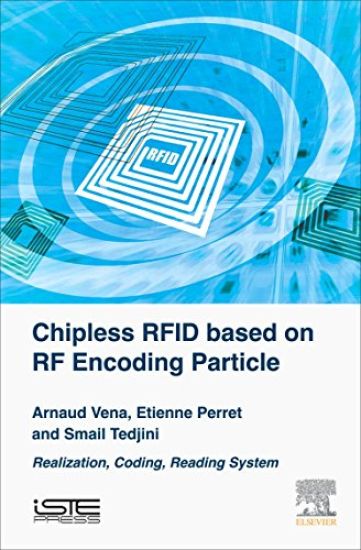
Chipless RFID based on RF Encoding Particle

Chipless RFID based on RF Encoding Particle

Arnaud Vena; Etienne Perret; Smail Tedjini

ISTE Press Ltd - Elsevier Inc
2016
sidottu
Chipless RFID based on RF Encoding Particle: Realization, Coding and Reading System explores the field of chipless identification based on the RF Encoding Particle (REP). The book covers the possibility of collecting information remotely with RF waves (RFID) with totally passive tags without wire, batteries, and chips, and even printed on paper. Despite the many benefits of RFID, deployment is still hindered by several economic and technological factors. Among these barriers are the high cost of tags, lack of reliability and security in the information contained in the RFID chip, and how tags are 'recycled.' This book focuses on the development of chipless RFID tags, representing a new family of low cost tags. With this technology information is extracted from the electromagnetic response of the tag, which depends only on its geometry. Various solutions have been developed by the authors to increase the amount of information, reduce the surface of the tag, or improve the robustness of detection. Considerations such as realization using paper substrate, the development of a low cost detection system, and measurements in a real environment have been addressed for practical implementation.
Radio Frequency Identification and Sensors

Radio Frequency Identification and Sensors

Etienne Perret

ISTE Ltd and John Wiley Sons Inc
2014
sidottu
This book deals with the field of identification and sensors, more precisely the possibility of collecting information remotely with RF waves (RFID). The book introduces the technology of chipless RFID starting from classical RFID and barcode, and explores the field of identification and sensors without wire, without batteries, without chip, and with tags that can even be printed on paper. A technique for automatic design of UHF RFID tags is presented , aiming at making the tags as insensitive as possible to the environment (with the ability to increase the reading range reliability), or, conversely, making them sensitive in order to produce sensors, meanwhile keeping their unique ID. The RFID advantages are discussed, along with its numerous features, and comparisons with the barcode technology are presented. After that, the new chipless RFID technology is introduced on the basis of the previous conclusions. Original technological approaches are introduced and discussed in order to demonstrate the practical and economic potential of the chipless technology.