Kirjojen hintavertailu – 12 903 735 kirjaa ja 27 kauppaa

Kirjailija

Eugene Ostashevsky

Kirjat ja teokset yhdessä paikassa: 6 kirjaa, julkaisuja vuosilta 2017–2022, suosituimpiin kuuluu The Fire Horse. Vertaile teosten hintoja ja tarkista saatavuus suomalaisista kirjakaupoista.

6 kirjaa

Kirjojen julkaisuvuodet: 2017–2022.

The Feeling Sonnets

The Feeling Sonnets

Eugene Ostashevsky

New York Review of Books
2022
nidottu
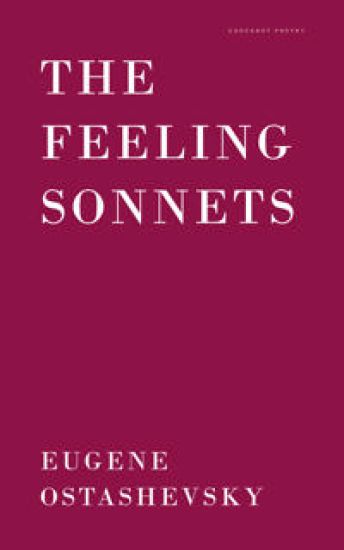
Slyly funny, inventive, and virtuosic, this new collection from a Russian-American master challenges poetic convention and explores themes of alienhood, translation, and human emotion. In Eugene Ostashevsky's The Feeling Sonnets--his fourth collection of poems-- words, idioms, sentences, and poetic conventions are dislodged and defamiliarized in order to convey the experience of living in a land, and a language, apart. The book consists of four cycles of fourteen unrhymed, unmetered sonnets. The first cycle asks about the relationship between interpretation and emotion, whether "we feel the feelings that we call ours." The second cycle, mainly composed of "daughter sonnets," describes bringing up children in a foreign country and a foreign language. The third cycle, called "Die Schreibblockade," German for writer's block, talks about foreign-language processing of inherited historical trauma, in this case the siege of Leningrad from 1941 to 1944. The fourth cycle is about translation. The sonnets are followed by a short libretto, commissioned by the Italian composer Lucia Ronchetti, about Ravel's interaction with Paul Wittgenstein over the Piano Concerto for the Left Hand.
The Fire Horse

The Fire Horse

Eugene Ostashevsky

The New York Review of Books, Inc
2017
sidottu
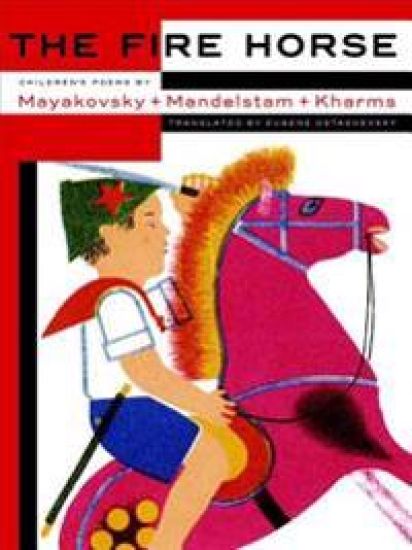
Whimsical and revolutionary poems and art by some of Russia's foremost avant-garde writers and illustrators A boy wants a toy horse big enough to ride, but where can his father find it? Not in the stores, which means it's got to be built from scratch. How? With the help of expert workers, from the carpenter to the painter, working together as one. And now the bold boy is ready to ride off in defense of the future Two trams, Click and Zam, are cousins. Click goes out for a day on the tracks and before long he's so tired he doesn't know where he is or how to get back. All he knows is he's got to find Zam. Click is looking for Zam and Zam is looking for Click, and though for a while it seems like nobody knows where to find Click, good and faithful Zam is not to be deterred. Peter's a car, Vasco's a steamboat, and Mikey's a plane. They're all running like mad and going great guns until, whoops, there's a big old cow, just a plain old cow, standing in the road. What then? The early years of the Soviet Union were a golden age for children's literature. The Fire Horse brings together three classics from the era in which some of Russia's most celebrated poets, Vladimir Mayakovsky, Osip Mandelstam, and Daniil Kharms, teamed up with some of its finest artists, Lidia Popova, Boris Ender, and Vladimir Konashevich. Brilliantly translated by the poet Eugene Ostashevsky, this is poetry that is as whimsical and wonderful as it is revolutionary.
The Pirate Who Does Not Know The Value Of Pi

The Pirate Who Does Not Know The Value Of Pi

Eugene Ostashevsky

The New York Review of Books, Inc
2017
nidottu
An original collection from one of the most active poets in contemporary literature. The Pirate Who Does Not Know the Value of Pi is a poem-novel about the relationship between a pirate and a parrot who, after capturing a certain quantity of prizes, are shipwrecked on a deserted island, where they proceed to discuss whether they would have been able to communicate with people indigenous to the island, had there been any. Characterized by multilingual punning, humor puerile and set-theoretical, philosophical irony and narrative handicaps, Eugene Ostashevsky's new large-scale project draws on sources as various as early modern texts about pirates and animal intelligence, old-school hip-hop, and game theory to pursue the themes of emigration, incomprehension, untranslatability, and the otherness of others.