Kirjojen hintavertailu – 12 903 735 kirjaa ja 27 kauppaa

Kirjailija

Evarist Giné

Kirjat ja teokset yhdessä paikassa: 5 kirjaa, julkaisuja vuosilta 1997–2021, suosituimpiin kuuluu Lectures on Probability Theory and Statistics. Vertaile teosten hintoja ja tarkista saatavuus suomalaisista kirjakaupoista.

5 kirjaa

Kirjojen julkaisuvuodet: 1997–2021.

Mathematical Foundations of Infinite-Dimensional Statistical Models

Mathematical Foundations of Infinite-Dimensional Statistical Models

Evarist Giné; Richard Nickl

Cambridge University Press
2021
pokkari
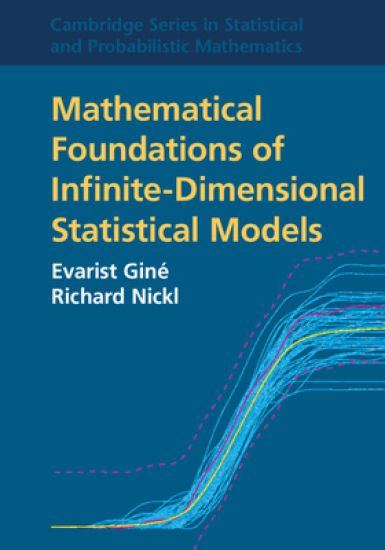
In nonparametric and high-dimensional statistical models, the classical Gauss–Fisher–Le Cam theory of the optimality of maximum likelihood estimators and Bayesian posterior inference does not apply, and new foundations and ideas have been developed in the past several decades. This book gives a coherent account of the statistical theory in infinite-dimensional parameter spaces. The mathematical foundations include self-contained 'mini-courses' on the theory of Gaussian and empirical processes, approximation and wavelet theory, and the basic theory of function spaces. The theory of statistical inference in such models - hypothesis testing, estimation and confidence sets - is presented within the minimax paradigm of decision theory. This includes the basic theory of convolution kernel and projection estimation, but also Bayesian nonparametrics and nonparametric maximum likelihood estimation. In a final chapter the theory of adaptive inference in nonparametric models is developed, including Lepski's method, wavelet thresholding, and adaptive inference for self-similar functions. Winner of the 2017 PROSE Award for Mathematics.
Mathematical Foundations of Infinite-Dimensional Statistical Models

Mathematical Foundations of Infinite-Dimensional Statistical Models

Evarist Giné; Nickl Richard

Cambridge University Press
2015
sidottu
In nonparametric and high-dimensional statistical models, the classical Gauss-Fisher-Le Cam theory of the optimality of maximum likelihood estimators and Bayesian posterior inference does not apply, and new foundations and ideas have been developed in the past several decades. This book gives a coherent account of the statistical theory in infinite-dimensional parameter spaces. The mathematical foundations include self-contained 'mini-courses' on the theory of Gaussian and empirical processes, on approximation and wavelet theory, and on the basic theory of function spaces. The theory of statistical inference in such models - hypothesis testing, estimation and confidence sets - is then presented within the minimax paradigm of decision theory. This includes the basic theory of convolution kernel and projection estimation, but also Bayesian nonparametrics and nonparametric maximum likelihood estimation. In the final chapter, the theory of adaptive inference in nonparametric models is developed, including Lepski's method, wavelet thresholding, and adaptive inference for self-similar functions.
Decoupling

Decoupling

Victor de la Peña; Evarist Giné

Springer-Verlag New York Inc.
2012
nidottu
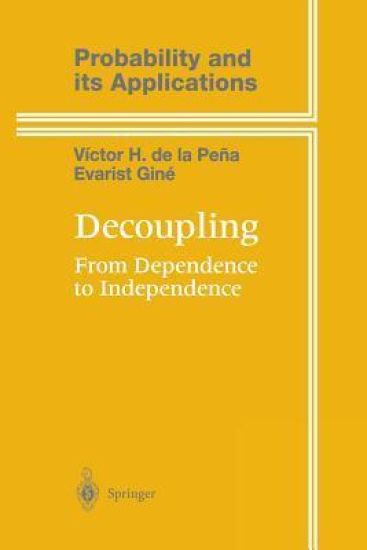
Decoupling theory provides a general framework for analyzing problems involving dependent random variables as if they were independent. It was born in the early eighties as a natural continuation of martingale theory and has acquired a life of its own due to vigorous development and wide applicability. The authors provide a friendly and systematic introduction to the theory and applications of decoupling. The book begins with a chapter on sums of independent random variables and vectors, with maximal inequalities and sharp estimates on moments which are later used to develop and interpret decoupling inequalities. Decoupling is first introduced as it applies in two specific areas, randomly stopped processes (boundary crossing problems) and unbiased estimation (U-- statistics and U--processes), where it has become a basic tool in obtaining several definitive results. In particular, decoupling is an essential component in the development of the asymptotic theory of U-- statistics and U--processes. The authors then proceed with the theory of decoupling in full generality. Special attention is given to comparison and interplay between martingale and decoupling theory, and to applications. Among other results, the applications include limit theorems, momemt and exponential inequalities for martingales and more general dependence structures, results with biostatistical implications, and moment convergence in Anscombe's theorem and Wald's equation for U--statistics. This book is addressed to researchers in probability and statistics and to graduate students. The expositon is at the level of a second graduate probability course, with a good portion of the material fit for use in a first year course. Victor de la Pe$a is Associate Professor of Statistics at Columbia University and is one of the more active developers of decoupling
Decoupling

Decoupling

Victor de la Peña; Evarist Giné

Springer-Verlag New York Inc.
1998
sidottu
Decoupling theory provides a general framework for analyzing problems involving dependent random variables as if they were independent. It was born in the early eighties as a natural continuation of martingale theory and has acquired a life of its own due to vigorous development and wide applicability. The authors provide a friendly and systematic introduction to the theory and applications of decoupling. The book begins with a chapter on sums of independent random variables and vectors, with maximal inequalities and sharp estimates on moments which are later used to develop and interpret decoupling inequalities. Decoupling is first introduced as it applies in two specific areas, randomly stopped processes (boundary crossing problems) and unbiased estimation (U-- statistics and U--processes), where it has become a basic tool in obtaining several definitive results. In particular, decoupling is an essential component in the development of the asymptotic theory of U-- statistics and U--processes. The authors then proceed with the theory of decoupling in full generality. Special attention is given to comparison and interplay between martingale and decoupling theory, and to applications. Among other results, the applications include limit theorems, momemt and exponential inequalities for martingales and more general dependence structures, results with biostatistical implications, and moment convergence in Anscombe's theorem and Wald's equation for U--statistics. This book is addressed to researchers in probability and statistics and to graduate students. The expositon is at the level of a second graduate probability course, with a good portion of the material fit for use in a first year course. Victor de la Pe$a is Associate Professor of Statistics at Columbia University and is one of the more active developers of decoupling