
Kirjojen hintavertailu – 12 903 725 kirjaa ja 27 kauppaa

Kirjailija

Ezio Venturino

Kirjat ja teokset yhdessä paikassa: 2 kirjaa, julkaisuja vuosilta 2007–2019, suosituimpiin kuuluu Spatiotemporal Patterns in Ecology and Epidemiology. Vertaile teosten hintoja ja tarkista saatavuus suomalaisista kirjakaupoista.

2 kirjaa

Kirjojen julkaisuvuodet: 2007–2019.

Spatiotemporal Patterns in Ecology and Epidemiology

Spatiotemporal Patterns in Ecology and Epidemiology

Horst Malchow; Sergei V. Petrovskii; Ezio Venturino

CRC Press
2019
nidottu
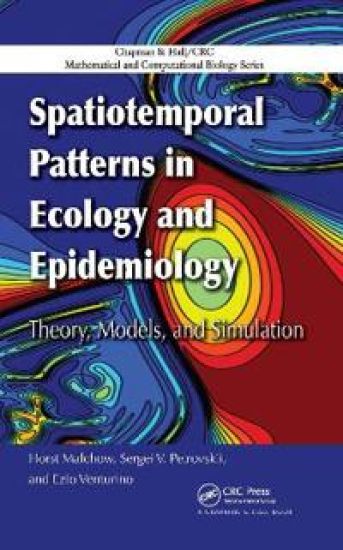
Although the spatial dimension of ecosystem dynamics is now widely recognized, the specific mechanisms behind species patterning in space are still poorly understood and the corresponding theoretical framework is underdeveloped. Going beyond the classical Turing scenario of pattern formation, Spatiotemporal Patterns in Ecology and Epidemiology: Theory, Models, and Simulation illustrates how mathematical modeling and numerical simulations can lead to greater understanding of these issues. It takes a unified approach to population dynamics and epidemiology by presenting several ecoepidemiological models where both the basic interspecies interactions of population dynamics and the impact of an infectious disease are explicitly considered. The book first describes relevant phenomena in ecology and epidemiology, provides examples of pattern formation in natural systems, and summarizes existing modeling approaches. The authors then explore nonspatial models of population dynamics and epidemiology. They present the main scenarios of spatial and spatiotemporal pattern formation in deterministic models of population dynamics. The book also addresses the interaction between deterministic and stochastic processes in ecosystem and epidemic dynamics, discusses the corresponding modeling approaches, and examines how noise and stochasticity affect pattern formation. Reviewing the significant progress made in understanding spatiotemporal patterning in ecological and epidemiological systems, this resource shows that mathematical modeling and numerical simulations are effective tools in the study of population ecology and epidemiology.
Spatiotemporal Patterns in Ecology and Epidemiology

Spatiotemporal Patterns in Ecology and Epidemiology

Horst Malchow; Sergei V. Petrovskii; Ezio Venturino

Chapman Hall/CRC
2007
sidottu
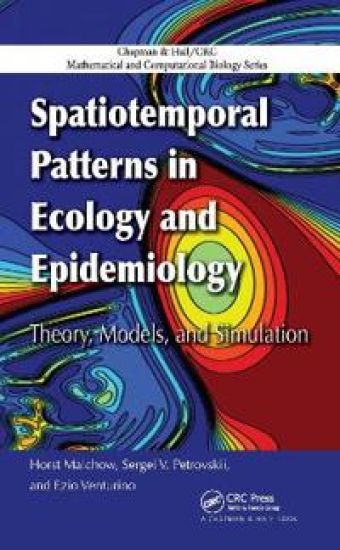
Although the spatial dimension of ecosystem dynamics is now widely recognized, the specific mechanisms behind species patterning in space are still poorly understood and the corresponding theoretical framework is underdeveloped. Going beyond the classical Turing scenario of pattern formation, Spatiotemporal Patterns in Ecology and Epidemiology: Theory, Models, and Simulation illustrates how mathematical modeling and numerical simulations can lead to greater understanding of these issues. It takes a unified approach to population dynamics and epidemiology by presenting several ecoepidemiological models where both the basic interspecies interactions of population dynamics and the impact of an infectious disease are explicitly considered. The book first describes relevant phenomena in ecology and epidemiology, provides examples of pattern formation in natural systems, and summarizes existing modeling approaches. The authors then explore nonspatial models of population dynamics and epidemiology. They present the main scenarios of spatial and spatiotemporal pattern formation in deterministic models of population dynamics. The book also addresses the interaction between deterministic and stochastic processes in ecosystem and epidemic dynamics, discusses the corresponding modeling approaches, and examines how noise and stochasticity affect pattern formation. Reviewing the significant progress made in understanding spatiotemporal patterning in ecological and epidemiological systems, this resource shows that mathematical modeling and numerical simulations are effective tools in the study of population ecology and epidemiology.