Kirjojen hintavertailu – 12 903 735 kirjaa ja 27 kauppaa

Kirjailija

Fabio Mercurio

Kirjat ja teokset yhdessä paikassa: 3 kirjaa, julkaisuja vuosilta 2006–2016, suosituimpiin kuuluu Interest Rate Models - Theory and Practice. Vertaile teosten hintoja ja tarkista saatavuus suomalaisista kirjakaupoista.

3 kirjaa

Kirjojen julkaisuvuodet: 2006–2016.

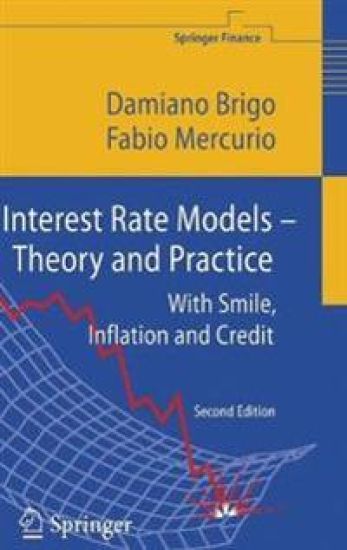
Interest Rate Models - Theory and Practice

Interest Rate Models - Theory and Practice

Damiano Brigo; Fabio Mercurio

Springer-Verlag Berlin and Heidelberg GmbH Co. K
2016
nidottu
The 2nd edition of this successful book has several new features. The calibration discussion of the basic LIBOR market model has been enriched considerably, with an analysis of the impact of the swaptions interpolation technique and of the exogenous instantaneous correlation on the calibration outputs. A discussion of historical estimation of the instantaneous correlation matrix and of rank reduction has been added, and a LIBOR-model consistent swaption-volatility interpolation technique has been introduced. The old sections devoted to the smile issue in the LIBOR market model have been enlarged into several new chapters. New sections on local-volatility dynamics, and on stochastic volatility models have been added, with a thorough treatment of the recently developed uncertain-volatility approach. Examples of calibrations to real market data are now considered. The fast-growing interest for hybrid products has led to new chapters. A special focus here is devoted to the pricing of inflation-linked derivatives. The three final new chapters of this second edition are devoted to credit. Since Credit Derivatives are increasingly fundamental, and since in the reduced-form modeling framework much of the technique involved is analogous to interest-rate modeling, Credit Derivatives -- mostly Credit Default Swaps (CDS), CDS Options and Constant Maturity CDS - are discussed, building on the basic short rate-models and market models introduced earlier for the default-free market. Counterparty risk in interest rate payoff valuation is also considered, motivated by the recent Basel II framework developments.

LIBOR Market Models and Smile

LIBOR Market Models and Smile

Fabio Mercurio

John Wiley Sons Inc
2006
sidottu
LIBOR Market Models and Smile: Latest Extensions and their Applications describes the most popular extensions to the LIBOR market model and analyses their most practical behavior on market data. This allows readers to compare and understand the implications of their choice of model.
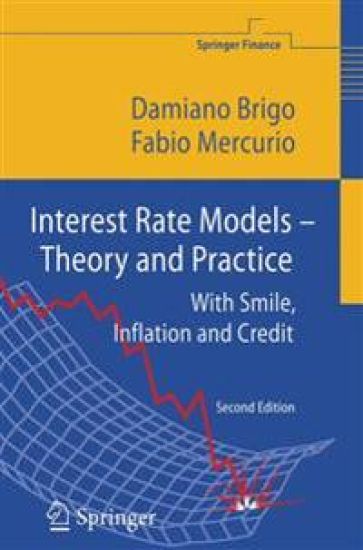
Interest Rate Models - Theory and Practice

Interest Rate Models - Theory and Practice

Damiano Brigo; Fabio Mercurio

Springer-Verlag Berlin and Heidelberg GmbH Co. K
2006
sidottu
The 2nd edition of this successful book has several new features. The calibration discussion of the basic LIBOR market model has been enriched considerably, with an analysis of the impact of the swaptions interpolation technique and of the exogenous instantaneous correlation on the calibration outputs. A discussion of historical estimation of the instantaneous correlation matrix and of rank reduction has been added, and a LIBOR-model consistent swaption-volatility interpolation technique has been introduced. The old sections devoted to the smile issue in the LIBOR market model have been enlarged into several new chapters. New sections on local-volatility dynamics, and on stochastic volatility models have been added, with a thorough treatment of the recently developed uncertain-volatility approach. Examples of calibrations to real market data are now considered. The fast-growing interest for hybrid products has led to new chapters. A special focus here is devoted to the pricing of inflation-linked derivatives. The three final new chapters of this second edition are devoted to credit. Since Credit Derivatives are increasingly fundamental, and since in the reduced-form modeling framework much of the technique involved is analogous to interest-rate modeling, Credit Derivatives -- mostly Credit Default Swaps (CDS), CDS Options and Constant Maturity CDS - are discussed, building on the basic short rate-models and market models introduced earlier for the default-free market. Counterparty risk in interest rate payoff valuation is also considered, motivated by the recent Basel II framework developments.