Kirjojen hintavertailu – 12 903 729 kirjaa ja 27 kauppaa

Kirjailija

Falleh R. Al-Solamy

Kirjat ja teokset yhdessä paikassa: 9 kirjaa, julkaisuja vuosilta 2025–2026, suosituimpiin kuuluu Differential Geometry. Vertaile teosten hintoja ja tarkista saatavuus suomalaisista kirjakaupoista.

9 kirjaa

Kirjojen julkaisuvuodet: 2025–2026.

Differential Geometry

Differential Geometry

Elisabetta Barletta; Sorin Dragomir; Mohammad Hasan Shahid; Falleh R. Al-Solamy

Springer Nature Switzerland AG
2025
sidottu
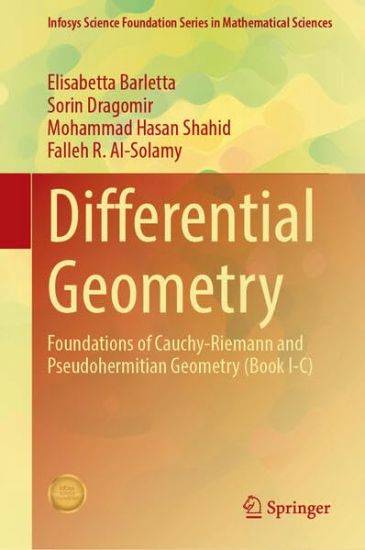
This book, Differential Geometry: Foundations of Cauchy–Riemann and Pseudohermitian Geometry (Book I-C), is the third in a series of four books presenting a choice of topics, among fundamental and more advanced, in Cauchy–Riemann (CR) and pseudohermitian geometry, such as Lewy operators, CR structures and the tangential CR equations, the Levi form, Tanaka–Webster connections, sub-Laplacians, pseudohermitian sectional curvature, and Kohn–Rossi cohomology of the tangential CR complex. Recent results on submanifolds of Hermitian and Sasakian manifolds are presented, from the viewpoint of the geometry of the second fundamental form of an isometric immersion. The book has two souls, those of Complex Analysis versus Riemannian geometry, and attempts to fill in the gap among the two. The other three books of the series are: Differential Geometry: Manifolds, Bundles, Characteristic Classes (Book I-A) Differential Geometry: Riemannian Geometry and Isometric Immersions (Book I-B) Differential Geometry: Advanced Topics in Cauchy–Riemann and Pseudohermitian Geometry (Book I-D) The four books belong to an ampler book project “Differential Geometry, Partial Differential Equations, and Mathematical Physics”, by the same authors, and aim to demonstrate how certain portions of differential geometry (DG) and the theory of partial differential equations (PDEs) apply to general relativity and (quantum) gravity theory. These books supply some of the ad hoc DG and PDEs machinery yet do not constitute a comprehensive treatise on DG or PDEs, but rather authors’ choice based on their scientific (mathematical and physical) interests. These are centered around the theory of immersions—isometric, holomorphic, and CR—and pseudohermitian geometry, as devised by Sidney Martin Webster for the study of nondegenerate CR structures, themselves a DG manifestation of the tangential CR equations.
Differential Geometry

Differential Geometry

Elisabetta Barletta; Sorin Dragomir; Mohammad Hasan Shahid; Falleh R. Al-Solamy

Springer Nature Switzerland AG
2025
sidottu
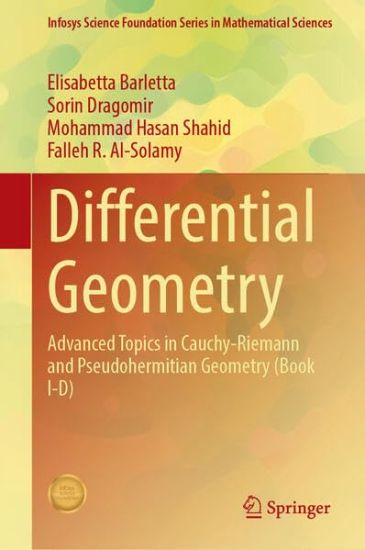
This book, Differential Geometry: Advanced Topics in CR and Pseudohermitian Geometry (Book I-D), is the fourth in a series of four books presenting a choice of advanced topics in Cauchy–Riemann (CR) and pseudohermitian geometry, such as Fefferman metrics, global behavior of tangential CR equations, Rossi spheres, the CR Yamabe problem on a CR manifold-with-boundary, Jacobi fields of the Tanaka–Webster connection, the theory of CR immersions versus Lorentzian geometry. The book also discusses boundary values of proper holomorphic maps of balls, Beltrami equations on Rossi spheres within the Koranyi–Reimann theory of quasiconformal mappings of CR manifolds, and pseudohermitian analogs to the Gauss–Ricci–Codazzi equations in the study of CR immersions between strictly pseudoconvex CR manifolds. The other three books of the series are: Differential Geometry: Manifolds, Bundles, Characteristic Classes (Book I-A) Differential Geometry: Riemannian Geometry and Isometric Immersions (Book I-B) Differential Geometry: Foundations of Cauchy-Riemann and Pseudohermitian Geometry (Book I-C) The four books belong to an ampler book project, “Differential Geometry, Partial Differential Equations, and Mathematical Physics”, by the same authors and aim to demonstrate how certain portions of differential geometry (DG) and the theory of partial differential equations (PDEs) apply to general relativity and (quantum) gravity theory. These books supply some of the ad hoc DG and PDEs machinery yet do not constitute a comprehensive treatise on DG or PDEs, but rather authors’ choice based on their scientific (mathematical and physical) interests. These are centered around the theory of immersions—isometric, holomorphic, and CR—and pseudohermitian geometry, as devised by Sidney Martin Webster for the study of nondegenerate CR structures, themselves a DG manifestation of the tangential CR equations.
Differential Geometry

Differential Geometry

Elisabetta Barletta; Sorin Dragomir; Mohammad Hasan Shahid; Falleh R. Al-Solamy

SPRINGER VERLAG, SINGAPORE
2025
sidottu
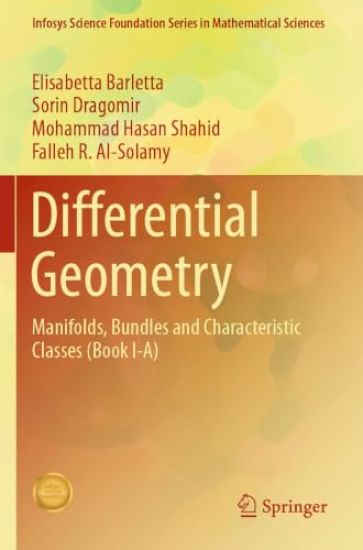
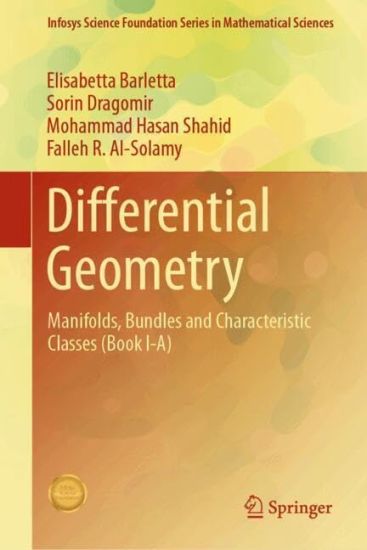
This book, Di?erential Geometry: Manifolds, Bundles and Characteristic Classes (Book I-A), is the ?rst in a captivating series of four books presenting a choice of topics, among fundamental and more advanced, in di?erential geometry (DG), such as manifolds and tensor calculus, di?erentiable actions and principal bundles, parallel displacement and exponential mappings, holonomy, complex line bundles and characteristic classes. The inclusion of an appendix on a few elements of algebraic topology provides a didactical guide towards the more advanced Algebraic Topology literature. The subsequent three books of the series are: Di?erential Geometry: Riemannian Geometry and Isometric Immersions (Book I-B) Di?erential Geometry: Foundations of Cauchy-Riemann and Pseudohermitian Geometry (Book I-C) Di?erential Geometry: Advanced Topics in Cauchy–Riemann and Pseudohermitian Geometry (Book I-D) The four books belong to an ampler book project (Di?erential Geometry, Partial Di?erential Equations, and Mathematical Physics, by the same authors) and aim to demonstrate how certain portions of DG and the theory of partial di?erential equations apply to general relativity and (quantum) gravity theory. These books supply some of the ad hoc DG machinery yet do not constitute a comprehensive treatise on DG, but rather Authors’ choice based on their scienti?c (mathematical and physical) interests. These are centered around the theory of immersions - isometric, holomorphic, and Cauchy-Riemann (CR) -and pseudohermitian geometry, as devised by Sidney Martin Webster for the study of nondegenerate CR structures, themselves a DG manifestation of the tangential CR equations.
Complex Geometry and Mathematical Physics

Complex Geometry and Mathematical Physics

Elisabetta Barletta; Dragomir Sorin; Shahid Mohammad Hasan; Falleh R. Al-Solamy

Springer Verlag Singapore
2026
Sidottu
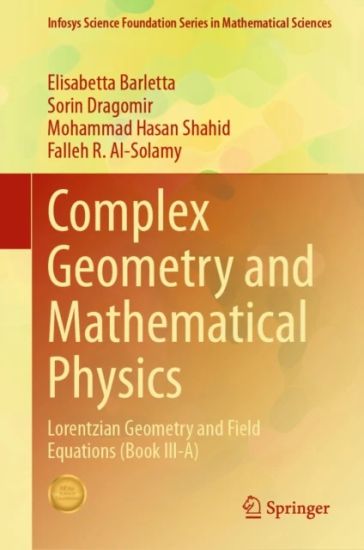
This book, Complex Geometry and Mathematical Physics: Lorentzian Geometry and Field Equations (Book III-A), presents results from Lorentzian geometry (causality theory of spacetimes, submanifolds of Lorentzian manifolds, compact Lorentzian holonomy) and general relativity and gravitation theory. The first in a captivating series of three books, it demonstrates the bond between physics and geometry such as the mathematical structure of Maxwell’s equations predicting Minkowskian geometry, geodesic motion in the Newtonian limit, Kepler’s problem and Mercury’s perihelic shift, Morse theory for light rays). The book also includes discussion on certain quantum mechanical aspects (bending of light in quantum gravity) and the structure of Einstein’s (linearized) field equations in empty space or in the presence of matter. The other two books of the series are: Complex Geometry and Mathematical Physics: Classical and Quantum Singularities of Space-Times (Book III-B) Complex Geometry and Mathematical Physics: Complex Analysis versus General Relativity Theory (Book III-C) "Complex Geometry and Mathematical Physics" is part of the ampler book project "Differential Geometry, Partial Differential Equations and Mathematical Physics" by the same Authors, and aims to demonstrate the interaction between complex analysis and complex geometry on one hand, and general relativity and (quantum) gravity theory on the other, with an emphasis on the modern and contemporary trends of applying ideas from GRG theory to certain problems arising in complex analysis, such as the many pathologies of the Diederich–Fornæss worm domains.
Complex Geometry and Mathematical Physics

Complex Geometry and Mathematical Physics

Elisabetta Barletta; Dragomir Sorin; Shahid Mohammad Hasan; Falleh R. Al-Solamy

Springer Verlag Singapore
2026
Sidottu
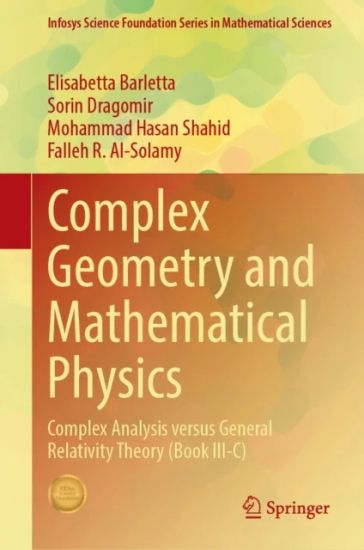
This book, Complex Geometry and Mathematical Physics: Complex Analysis versus General Relativity Theory (Book III-C), examines the impact of results from complex analysis and complex geometry on certain aspects of mathematical physics, such as quantization theory, with an emphasis on the novel aspects in A. Odzijewicz’s scientific creation, as related to the use of complex analysis tools (for example, weighted Bergman kernels) in the calculation of transition probability amplitudes from a classical state (identified to a coherent state) of a mechanical system. The third in a captivating series of three books, it is devoted to applying ideas and methods from GRG (that is, from the theory of singularities—classical and quantum—of spacetimes) to complex analysis. The other two books of the series are: Complex Geometry and Mathematical Physics: Lorentzian Geometry and Field Equations (Book III-A) Complex Geometry and Mathematical Physics: Classical and Quantum Singularities of Space-Times (Book III-B) "Complex Geometry and Mathematical Physics" is part of the ampler book project "Differential Geometry, Partial Differential Equations and Mathematical Physics", by the same Authors, and aims to demonstrate the interaction between complex analysis and complex geometry on one hand, and general relativity and (quantum) gravity theory on the other, with an emphasis on the modern and contemporary trends of applying ideas from GRG theory to certain problems arising in complex analysis, such as the many pathologies of the Diederich–Fornæss worm domains.
Differential Geometry

Differential Geometry

Elisabetta Barletta; Dragomir Sorin; Shahid Mohammad Hasan; Falleh R. Al-Solamy

Springer Nature Switzerland AG
2026
Nidottu
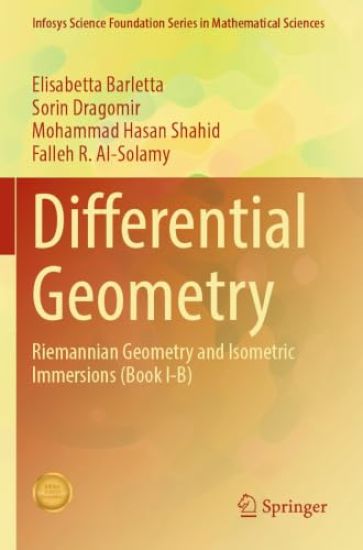
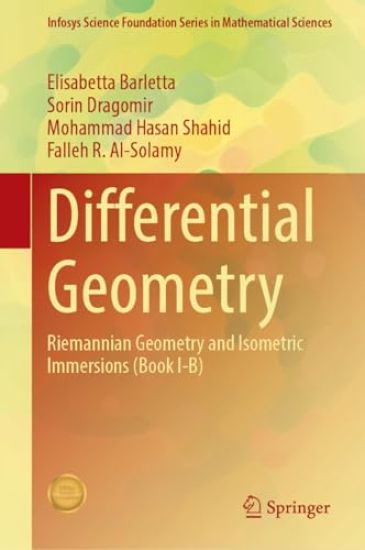
This book, Differential Geometry: Riemannian Geometry and Isometric Immersions (Book I-B), is the second in a captivating series of four books presenting a choice of topics, among fundamental and more advanced in differential geometry (DG). Starting with the basics of semi-Riemannian geometry, the book aims to develop the understanding of smooth 1-parameter variations of geodesics of, and correspondingly of, Jacobi fields. A few algebraic aspects required by the treatment of the Riemann–Christoffel four-tensor and sectional curvature are successively presented. Ricci curvature and Einstein manifolds are briefly discussed. The Sasaki metric on the total space of the tangent bundle over a Riemannian manifold is built, and its main properties are investigated. An important integration technique on a Riemannian manifold, related to the geometry of geodesics, is presented for further applications. The other three books of the series are Differential Geometry 1: Manifolds, Bundle and Characteristic Classes (Book I-A)Differential Geometry 3: Foundations of Cauchy-Riemann and Pseudohermitian Geometry (Book I-C)Differential Geometry 4: Advanced Topics in Cauchy–Riemann and Pseudohermitian Geometry (Book I-D) The four books belong to a larger book project (Differential Geometry, Partial Differential Equations, and Mathematical Physics) by the same authors, aiming to demonstrate how certain portions of DG and the theory of partial differential equations apply to general relativity and (quantum) gravity theory. These books supply some of the ad hoc DG machinery yet do not constitute a comprehensive treatise on DG, but rather authors’ choice based on their scientific (mathematical and physical) interests. These are centered around the theory of immersions—isometric, holomorphic, Cauchy–Riemann (CR)—and pseudohermitian geometry, as devised by Sidney Martin Webster for the study of nondegenerate CR structures, themselves a DG manifestation of the tangential CR equations.
Differential Geometry

Differential Geometry

Elisabetta Barletta; Dragomir Sorin; Shahid Mohammad Hasan; Falleh R. Al-Solamy

Springer Verlag Singapore
2026
Nidottu
This book, Differential Geometry: Manifolds, Bundles and Characteristic Classes (Book I-A), is the first in a captivating series of four books presenting a choice of topics, among fundamental and more advanced, in differential geometry (DG), such as manifolds and tensor calculus, differentiable actions and principal bundles, parallel displacement and exponential mappings, holonomy, complex line bundles and characteristic classes. The inclusion of an appendix on a few elements of algebraic topology provides a didactical guide towards the more advanced Algebraic Topology literature. The subsequent three books of the series are: Differential Geometry: Riemannian Geometry and Isometric Immersions (Book I-B) Differential Geometry: Foundations of Cauchy-Riemann and Pseudohermitian Geometry (Book I-C) Differential Geometry: Advanced Topics in Cauchy–Riemann and Pseudohermitian Geometry (Book I-D) The four books belong to an ampler book project (Differential Geometry, Partial Differential Equations, and Mathematical Physics, by the same authors) and aim to demonstrate how certain portions of DG and the theory of partial differential equations apply to general relativity and (quantum) gravity theory. These books supply some of the ad hoc DG machinery yet do not constitute a comprehensive treatise on DG, but rather Authors’ choice based on their scientific (mathematical and physical) interests. These are centered around the theory of immersions - isometric, holomorphic, and Cauchy-Riemann (CR) -and pseudohermitian geometry, as devised by Sidney Martin Webster for the study of nondegenerate CR structures, themselves a DG manifestation of the tangential CR equations.
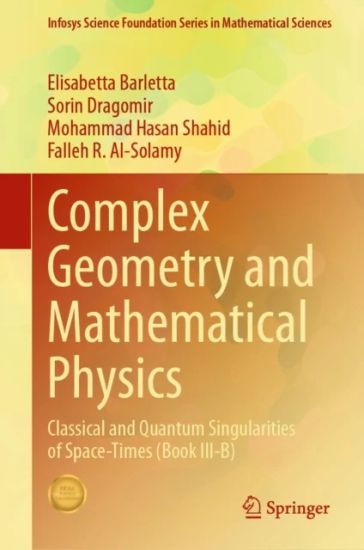
Differential Geometry

Differential Geometry

Elisabetta Barletta; Sorin Dragomir; Mohammad Hasan Shahid; Falleh R. Al-Solamy

Springer Nature Switzerland AG
2025
sidottu
This book, Differential Geometry: Riemannian Geometry and Isometric Immersions (Book I-B), is the second in a captivating series of four books presenting a choice of topics, among fundamental and more advanced in differential geometry (DG). Starting with the basics of semi-Riemannian geometry, the book aims to develop the understanding of smooth 1-parameter variations of geodesics of, and correspondingly of, Jacobi fields. A few algebraic aspects required by the treatment of the Riemann–Christoffel four-tensor and sectional curvature are successively presented. Ricci curvature and Einstein manifolds are briefly discussed. The Sasaki metric on the total space of the tangent bundle over a Riemannian manifold is built, and its main properties are investigated. An important integration technique on a Riemannian manifold, related to the geometry of geodesics, is presented for further applications. The other three books of the series are Differential Geometry 1: Manifolds, Bundle and Characteristic Classes (Book I-A)Differential Geometry 3: Foundations of Cauchy-Riemann and Pseudohermitian Geometry (Book I-C)Differential Geometry 4: Advanced Topics in Cauchy–Riemann and Pseudohermitian Geometry (Book I-D) The four books belong to a larger book project (Differential Geometry, Partial Differential Equations, and Mathematical Physics) by the same authors, aiming to demonstrate how certain portions of DG and the theory of partial differential equations apply to general relativity and (quantum) gravity theory. These books supply some of the ad hoc DG machinery yet do not constitute a comprehensive treatise on DG, but rather authors’ choice based on their scientific (mathematical and physical) interests. These are centered around the theory of immersions—isometric, holomorphic, Cauchy–Riemann (CR)—and pseudohermitian geometry, as devised by Sidney Martin Webster for the study of nondegenerate CR structures, themselves a DG manifestation of the tangential CR equations.