Kirjojen hintavertailu – 12 903 725 kirjaa ja 27 kauppaa
Kirjailija
Ferdinand Verhulst
Kirjat ja teokset yhdessä paikassa: 11 kirjaa, julkaisuja vuosilta 1996–2026, suosituimpiin kuuluu Averaging for Nonlinear Dynamics with Applications and Numerical Bifurcations. Vertaile teosten hintoja ja tarkista saatavuus suomalaisista kirjakaupoista.
This primer on averaging theorems provides a practical toolbox for applied mathematicians, physicists, and engineers seeking to apply the well-known mathematical theory to real-world problems. With a focus on practical applications, the book introduces new approaches to dissipative and Hamiltonian resonances and approximations on timescales longer than 1/e. Accessible and clearly written, the book includes numerous examples ranging from elementary to complex, making it an excellent basic reference for anyone interested in the subject. The prerequisites have been kept to a minimum, requiring only a working knowledge of calculus and ordinary and partial differential equations (ODEs and PDEs). In addition to serving as a valuable reference for practitioners, the book could also be used as a reading guide for a mathematics seminar on averaging methods. Whether you're an engineer, scientist, or mathematician, this book offers a wealth of practicaltools and theoretical insights to help you tackle a range of mathematical problems.
The book describes the life of Henri Poincaré, his work style and in detail most of his unique achievements in mathematics and physics. Apart from biographical details, attention is given to Poincaré's contributions to automorphic functions, differential equations and dynamical systems, celestial mechanics, mathematical physics in particular the theory of the electron and relativity, topology (analysis situs). A chapter on philosophy explains Poincaré's conventionalism in mathematics and his view of conventionalism in physics; the latter has a very different character. In the foundations of mathematics his position is between intuitionism and axiomatics. One of the purposes of the book is to show how Poincaré reached his fundamentally new results in many different fields, how he thought and how one should read him. One of the new aspects is the description of two large fields of his attention: dynamical systems as presented in his book on `new methods for celestial mechanics' and his theoretical physics papers. At the same time it will be made clear how analysis and geometry are intertwined in Poincaré's thinking and work. In dynamical systems this becomes clear in his description of invariant manifolds, his association of differential equation flow with mappings and his fixed points theory. There is no comparable book on Poincaré, presenting such a relatively complete vision of his life and achievements. There exist some older biographies in the French language, but they pay only restricted attention to his actual work. The reader can obtain from this book many insights in the working of a very original mind while at the same time learning about fundamental results for modern science
The book describes the life of Henri Poincaré, his work style and in detail most of his unique achievements in mathematics and physics. Apart from biographical details, attention is given to Poincaré's contributions to automorphic functions, differential equations and dynamical systems, celestial mechanics, mathematical physics in particular the theory of the electron and relativity, topology (analysis situs). A chapter on philosophy explains Poincaré's conventionalism in mathematics and his view of conventionalism in physics; the latter has a very different character. In the foundations of mathematics his position is between intuitionism and axiomatics. One of the purposes of the book is to show how Poincaré reached his fundamentally new results in many different fields, how he thought and how one should read him. One of the new aspects is the description of two large fields of his attention: dynamical systems as presented in his book on `new methods for celestial mechanics' and his theoretical physics papers. At the same time it will be made clear how analysis and geometry are intertwined in Poincaré's thinking and work. In dynamical systems this becomes clear in his description of invariant manifolds, his association of differential equation flow with mappings and his fixed points theory. There is no comparable book on Poincaré, presenting such a relatively complete vision of his life and achievements. There exist some older biographies in the French language, but they pay only restricted attention to his actual work. The reader can obtain from this book many insights in the working of a very original mind while at the same time learning about fundamental results for modern science
Perturbation theory, one of the most intriguing and essential topics in mathematics, and its applications to the natural and engineering sciences is the main focus of this workbook. In a systematic introductory manner, this unique book deliniates boundary layer theory for ordinary and partial differential equations, multi-timescale phenomena for nonlinear oscillations, diffusion and nonlinear wave equations. The book provides analysis of simple examples in the context of the general theory, as well as a final discussion of the more advanced problems. Precise estimates and excursions into the theoretical background makes this workbook valuable to both the applied sciences and mathematics fields. As a bonus in its last chapter the book includes a collection of rare and useful pieces of literature, such as the summary of the Perturbation theory of Matrices. Detailed illustrations, stimulating examples and exercises as well as a clear explanation of the underlying theory makes this workbook ideal for senior undergraduate and beginning graduate students in applied mathematics as well as science and engineering fields.
Perturbation theory and in particular normal form theory has shown strong growth during the last decades. So it is not surprising that the authors have presented an extensive revision of the first edition of the Averaging Methods in Nonlinear Dynamical Systems book. There are many changes, corrections and updates in chapters on Basic Material and Asymptotics, Averaging, and Attraction. Chapters on Periodic Averaging and Hyperbolicity, Classical (first level) Normal Form Theory, Nilpotent (classical) Normal Form, and Higher Level Normal Form Theory are entirely new and represent new insights in averaging, in particular its relation with dynamical systems and the theory of normal forms. Also new are surveys on invariant manifolds in Appendix C and averaging for PDEs in Appendix E. Since the first edition, the book has expanded in length and the third author, James Murdock has been added. Review of First Edition "One of the most striking features of the book is the nice collection of examples, which range from the very simple to some that are elaborate, realistic, and of considerable practical importance. Most of them are presented in careful detail and are illustrated with profuse, illuminating diagrams." - Mathematical Reviews
Perturbation theory and in particular normal form theory has shown strong growth during the last decades. So it is not surprising that the authors have presented an extensive revision of the first edition of the Averaging Methods in Nonlinear Dynamical Systems book. There are many changes, corrections and updates in chapters on Basic Material and Asymptotics, Averaging, and Attraction. Chapters on Periodic Averaging and Hyperbolicity, Classical (first level) Normal Form Theory, Nilpotent (classical) Normal Form, and Higher Level Normal Form Theory are entirely new and represent new insights in averaging, in particular its relation with dynamical systems and the theory of normal forms. Also new are surveys on invariant manifolds in Appendix C and averaging for PDEs in Appendix E. Since the first edition, the book has expanded in length and the third author, James Murdock has been added. Review of First Edition "One of the most striking features of the book is the nice collection of examples, which range from the very simple to some that are elaborate, realistic, and of considerable practical importance. Most of them are presented in careful detail and are illustrated with profuse, illuminating diagrams." - Mathematical Reviews
Perturbation theory, one of the most intriguing and essential topics in mathematics, and its applications to the natural and engineering sciences is the main focus of this workbook. In a systematic introductory manner, this unique book deliniates boundary layer theory for ordinary and partial differential equations, multi-timescale phenomena for nonlinear oscillations, diffusion and nonlinear wave equations. The book provides analysis of simple examples in the context of the general theory, as well as a final discussion of the more advanced problems. Precise estimates and excursions into the theoretical background makes this workbook valuable to both the applied sciences and mathematics fields. As a bonus in its last chapter the book includes a collection of rare and useful pieces of literature, such as the summary of the Perturbation theory of Matrices. Detailed illustrations, stimulating examples and exercises as well as a clear explanation of the underlying theory makes this workbook ideal for senior undergraduate and beginning graduate students in applied mathematics as well as science and engineering fields.
When a mechanical system consists of two or more coupled vibrating components, the vibration of one of the component subsystems may destabilize the motion of the other components. This destabilization effect is called autoparametric resonance. It is a concept that has important engineering applications. For example, vibrations in a pipeline induced by high-speed gas flows must be considered in the design and operation of the pipeline. This book is the first completely devoted to the subject of autoparametric resonance in an engineering context. Using the tools of nonlinear analysis, the authors show how to carry out the first crucial step, that is, how to determine the regions of parameter space where the semi-trivial solution is unstable. They describe what happens in these regions and then discuss non-trivial solutions and their stability. The study of autoparametric systems is a lively area of current research in engineering and applied mathematics, and this book will appeal to graduate students and research workers in both disciplines.
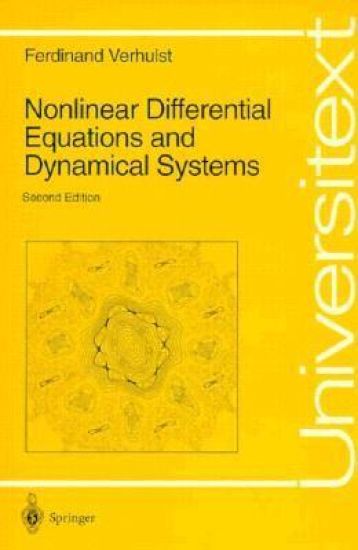
For lecture courses that cover the classical theory of nonlinear differential equations associated with Poincare and Lyapunov and introduce the student to the ideas of bifurcation theory and chaos, this text is ideal. Its excellent pedagogical style typically consists of an insightful overview followed by theorems, illustrative examples, and exercises.