Kirjojen hintavertailu – 12 903 724 kirjaa ja 27 kauppaa

Kirjailija

Fergus McNeill

Kirjat ja teokset yhdessä paikassa: 10 kirjaa, julkaisuja vuosilta 2007–2018, suosituimpiin kuuluu Changing Offending Behaviour. Vertaile teosten hintoja ja tarkista saatavuus suomalaisista kirjakaupoista.

10 kirjaa

Kirjojen julkaisuvuodet: 2007–2018.

Pervasive Punishment

Pervasive Punishment

Fergus McNeill

Emerald Publishing Limited
2018
nidottu
Winner of the 2021 ESC Book Award. Despite its dramatic proliferation and diversification in recent decades, supervisory forms of punishment in the community (like probation, parole and unpaid work) have been largely invisible in scholarly and public discussion of criminal justice and its development in late-modern societies. The long-standing pre-occupation with the prison, and more recent concerns about 'mass incarceration' have allowed the emergence of 'mass supervision' to remain in the shadows. Pervasive Punishment insists that we remedy this neglect and exemplifies how we can do so. Drawing on thirty years of personal, practice and research experiences, it offers a compelling and rich account of the scale and social distribution of mass supervision, of the processes by which it has been legitimated, and of how it is experienced by those subject to it. Its innovative approach invites readers to look at, listen to and imagine punishment beyond the prison, through the use of innovative and creative methods including photography, song-writing and story-telling to explore and to represent 'mass supervision'. By so doing, this book offers new insights into how and why combining social science and creative practice can help develop a different kind of democratic dialogue about contentious social issues like crime and punishment. Though focused on the UK and the USA, the methods used in and analysis developed in this book will be of interest to scholars, students and practitioners elsewhere.
Reimagining Rehabilitation

Reimagining Rehabilitation

Lol Burke; Steve Collett; Fergus McNeill

Routledge
2018
sidottu
This book aims to make the case for and provide some of the resources necessary to reimagine rehabilitation for twenty-first-century criminal justice. Outlining an approach to rehabilitation which takes into account wider democratic processes, political structures and mechanisms of resource allocation, the authors develop a new model of rehabilitation comprising four forms – personal, legal, social and moral. Personal rehabilitation concerns how individuals make their journeys away from offending and towards reintegration and how they can be supported to do so, whilst legal rehabilitation concerns the role of the criminal courts in the process of restricting and then restoring the rights and status of citizens. Moral rehabilitation is concerned with the ethical basis of the interactions between the individual who has offended and the people and organisations charged with providing rehabilitative services. Social rehabilitation explores the crucial contribution civil society can make to rehabilitation, exploring this through the lens of citizenship, community and social capital. Drawing on the conceptual insights offered in the late Stan Cohen’s seminal work – Visions of Social Control – and specifically his insistence that modern social institutions can aspire to doing good and doing justice, the authors argue that these values can underpin a moral pragmatism in designing social interventions that must go beyond achieving simply instrumental ends. Reimaging rehabilitation within the context of social action and social justice, this book is essential reading for students and scholars alike, particularly those engaged with criminal justice policy, probation and offender rehabilitation.
Reimagining Rehabilitation

Reimagining Rehabilitation

Lol Burke; Steve Collett; Fergus McNeill

Routledge
2018
nidottu
This book aims to make the case for and provide some of the resources necessary to reimagine rehabilitation for twenty-first-century criminal justice. Outlining an approach to rehabilitation which takes into account wider democratic processes, political structures and mechanisms of resource allocation, the authors develop a new model of rehabilitation comprising four forms – personal, legal, social and moral. Personal rehabilitation concerns how individuals make their journeys away from offending and towards reintegration and how they can be supported to do so, whilst legal rehabilitation concerns the role of the criminal courts in the process of restricting and then restoring the rights and status of citizens. Moral rehabilitation is concerned with the ethical basis of the interactions between the individual who has offended and the people and organisations charged with providing rehabilitative services. Social rehabilitation explores the crucial contribution civil society can make to rehabilitation, exploring this through the lens of citizenship, community and social capital. Drawing on the conceptual insights offered in the late Stan Cohen’s seminal work – Visions of Social Control – and specifically his insistence that modern social institutions can aspire to doing good and doing justice, the authors argue that these values can underpin a moral pragmatism in designing social interventions that must go beyond achieving simply instrumental ends. Reimaging rehabilitation within the context of social action and social justice, this book is essential reading for students and scholars alike, particularly those engaged with criminal justice policy, probation and offender rehabilitation.
Reducing Reoffending

Reducing Reoffending

Fergus McNeill; Bill Whyte

CRC Press
2017
sidottu
Reducing Reoffending provides a critical overview of social work and community justice in Scotland, taking full account of recent developments. The book is divided into three comprehensive sections. Part one of the book provides a critical analysis of the challenge of reducing reoffending in Scotland and locates this challenge within its historical context. Part one also reviews the available evidence about when, how and why people stop offending; about desistance from crime. This analysis exposes not only the complexities of desistance processes, but also the many difficulties that offenders face in making the related transition. Part two of the book provides an account of the legal contexts of criminal justice social work services in Scotland analysing both the role that social work plays in the sentencing process and its role in supervising offenders in the community. The final part the book addresses questions of how the practice of supervision might be best developed so as to support desistance and reduce reoffending, though the books final conclusion is that reducing reoffending requires a much broader commitment to promoting and realising justice in the community.
Cut Out

Cut Out

Fergus McNeill

Hodder Paperback
2015
pokkari
The perfect book for fans of serial killer thrillers and crime writers such as Peter James, Mark Billingham and Peter RobinsonWhat if your upstairs neighbour wished their life was more like yours? Exactly like yours? Nigel never meant for it to happen. At first, he just wanted to be Matt's friend. But when he discovers he can hear what is going on in the flat below him, his fascination with his new neighbour drifts into obsession. Rearranging his furniture to recreate the layout of the rooms downstairs. Buying the same clothes, going through Matt's post, his things. And it would have been all right. Innocent enough. If Matt hadn't brought the girl home. That's when things started to spiral out of control ... Detective Inspector Harland has to unravel the disturbing truth, but this is a case that stretches far beyond an unfortunate friendship. Praise for Fergus McNeil 'A chilling game of cat and mouse that should keep you awake long after bedtime. DI Harland is a welcome addition to the growing ranks of British detectives' Peter Robinson, bestselling author of the DCI Banks series 'Let's welcome Fergus McNeill to the ranks of British Crime fiction innovators; he has found a darker shade of noir' Quintin Jardine, bestselling author of the Constable Bob Skinner series 'Creepy, compelling and completely convincing' Erin Kelly, bestselling author of He Said/ She Said 'A gripping first novel' Irish Independent
Changing Offending Behaviour

Changing Offending Behaviour

Fergus McNeill; Clark Baim; Lydia Fransham/Guthrie

Jessica Kingsley Publishers
2014
pokkari
A one-stop resource of practical exercises for professionals to use in direct work with offenders aged 16+. Changing Offending Behaviour is a guide to the essentials of rehabilitation theory which also equips the reader with ready-to-use photocopiable exercises and activities to help put the theory into practice in rehabilitation work with adult offenders. Drawing on a range of evidence-based methodologies, theories and treatment approaches, including Cognitive Behavioural Therapy (CBT), Attachment Theory, Relationally-based Therapies, Social Learning Theory, Motivational Interviewing and the Cycle of Change, this resource provides exercises to increase self-understanding, examine patterns of behaviour, and build empathy and other crucial skills. All the exercises are culturally aware and designed for maximum flexibility to meet different needs and learning styles. Covering must-know theory and packed with practical exercises that work, this is an indispensable resource for probation workers and related professionals.
Knife Edge

Knife Edge

Fergus McNeill

Hodder Paperback
2014
pokkari

Halvin toimitettuna 15,20 €

The perfect book for fans of serial killer thrillers and crime writers such as Peter James, Mark Billingham and Peter RobinsonHe didn't intend to let her get so closeBut Robert Naysmith's girlfriend Kim has become important to him. So he decides to tell her his deadly secret. He wants her to recognise the power he holds. He hopes he won't have to kill herDetective Inspector Harland hasn't forgotten the serial killer who got away from him. But with nothing to go on, he fears he will never bring him to justice. Until he is seconded to investigate the brutal murder of a woman in her Bristol home. A random attack, a murderer who has carefully covered his tracks . . . alarm bells start ringing. Then Harland meets Kim. One last game of life and death is about to begin. Praise for Fergus McNeil 'A chilling game of cat and mouse that should keep you awake long after bedtime. DI Harland is a welcome addition to the growing ranks of British detectives' Peter Robinson, bestselling author of the DCI Banks series 'Let's welcome Fergus McNeill to the ranks of British Crime fiction innovators; he has found a darker shade of noir' Quintin Jardine, bestselling author of the Constable Bob Skinner series 'Creepy, compelling and completely convincing' Erin Kelly, bestselling author of He Said/ She Said 'A gripping first novel' Irish Independent
Eye Contact

Eye Contact

Fergus McNeill

Hodder Paperback
2013
pokkari

Halvin toimitettuna 16,80 €

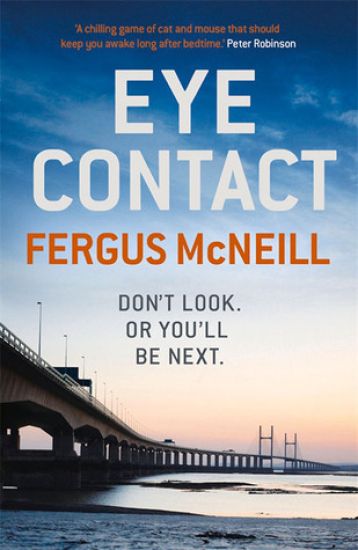
A crime novel that's perfect for fans of Peter James or Peter Robinson. If you look him in the eye, you're dead. From the outside, Robert Naysmith is a successful businessman, handsome and charming. But for years he's been playing a deadly game. He doesn't choose his victims. Each is selected at random - the first person to make eye contact after he begins 'the game' will not have long to live. Their fate is sealed. When the body of a young woman is found on Severn Beach, Detective Inspector Harland is assigned the case. It's only when he links it to an unsolved murder in Oxford that the police begin to guess at the awful scale of the crimes. But how do you find a killer who strikes without motive?
So You Think You Know Me?

So You Think You Know Me?

Allan Weaver; Mike Nellis; Fergus McNeill

Waterside Press
2008
nidottu
Hence, a never-ending escalation of his violent activities, creating tensions for his family, friends and often dubious associates in the seaside town where he grew up. "So You Think You Know Me?" is infused with contradictions in which the Allan Weaver who commits sometimes unspeakable acts of mayhem and aggression is not the Allan Weaver telling the story from inside his own head: an often vulnerable, sensitive, articulate and (if somewhat crazily) balanced individual to whom his own actions never seem to make any sense beyond a misguided insistence on living up to his tough guy image and reputation. That there can be any tidy ending to this gritty true account of a life spent in residential homes, Borstal, prison and always at a respectful distance from the police and other authority figures is remarkable - as are his own comments on a present-day Criminal Justice System that he believes is still failing young people for reasons which are given in the book. It is essential reading for anyone involved with serious young offenders, especially those of a violent disposition.
Reducing Reoffending

Reducing Reoffending

Fergus McNeill; Bill Whyte

Willan Publishing
2007
nidottu
Reducing Reoffending provides a critical overview of social work and community justice in Scotland, taking full account of recent developments. The book is divided into three comprehensive sections. Part one of the book provides a critical analysis of the challenge of reducing reoffending in Scotland and locates this challenge within its historical context. Part one also reviews the available evidence about when, how and why people stop offending; about desistance from crime. This analysis exposes not only the complexities of desistance processes, but also the many difficulties that offenders face in making the related transition. Part two of the book provides an account of the legal contexts of criminal justice social work services in Scotland analysing both the role that social work plays in the sentencing process and its role in supervising offenders in the community. The final part the book addresses questions of how the practice of supervision might be best developed so as to support desistance and reduce reoffending, though the books final conclusion is that reducing reoffending requires a much broader commitment to promoting and realising justice in the community.