Kirjojen hintavertailu – 12 903 725 kirjaa ja 27 kauppaa

Kirjailija

Fergus Millar

Kirjat ja teokset yhdessä paikassa: 15 kirjaa, julkaisuja vuosilta 1973–2015, suosituimpiin kuuluu The History of the Jewish People in the Age of Jesus Christ: Volume 1. Vertaile teosten hintoja ja tarkista saatavuus suomalaisista kirjakaupoista.

15 kirjaa

Kirjojen julkaisuvuodet: 1973–2015.

The History of the Jewish People in the Age of Jesus Christ: Volume 3.i

The History of the Jewish People in the Age of Jesus Christ: Volume 3.i

Emil Schürer; Geza Vermes; Fergus Millar

T. T.Clark Ltd
2015
nidottu
Emil Schürer's Geschichte des judischen Volkes im Zeitalter Jesu Christi, originally published in German between 1874 and 1909 and in English between 1885 and 1891, is a critical presentation of Jewish history, institutions, and literature from 175 B. C. to A. D. 135. It has rendered invaluable services to scholars for nearly a century. The present work offers a fresh translation and a revision of the entire subject-matter. The bibliographies have been rejuvenated and supplemented; the sources are presented according to the latest scholarly editions; and all the new archaeological, epigraphical, numismatic and literary evidence, including the Dead Sea Scrolls and the Bar Kokhba documents, has been introduced into the survey. Account has also been taken of the progress in historical research, both in the classical and Jewish fields. This work reminds students of the profound debt owed to nineteenth-century learning, setting it within a wider framework of contemporary knowledge, and provides a foundation on which future historians of Judaism in the age of Jesus may build.
The History of the Jewish People in the Age of Jesus Christ: Volume 3.ii and Index

The History of the Jewish People in the Age of Jesus Christ: Volume 3.ii and Index

Emil Schürer; Fergus Millar; Geza Vermes

T. T.Clark Ltd
2015
nidottu
Emil Schürer's Geschichte des judischen Volkes im Zeitalter Jesu Christi, originally published in German between 1874 and 1909 and in English between 1885 and 1891, is a critical presentation of Jewish history, institutions, and literature from 175 B. C. to A. D. 135. It has rendered invaluable services to scholars for nearly a century. The present work offers a fresh translation and a revision of the entire subject-matter. The bibliographies have been rejuvenated and supplemented; the sources are presented according to the latest scholarly editions; and all the new archaeological, epigraphical, numismatic and literary evidence, including the Dead Sea Scrolls and the Bar Kokhba documents, has been introduced into the survey. Account has also been taken of the progress in historical research, both in the classical and Jewish fields. This work reminds students of the profound debt owed to nineteenth-century learning, setting it within a wider framework of contemporary knowledge, and provides a foundation on which future historians of Judaism in the age of Jesus may build.
The History of the Jewish People in the Age of Jesus Christ: Volume 2

The History of the Jewish People in the Age of Jesus Christ: Volume 2

Emil Schürer; Geza Vermes; Fergus Millar

T. T.Clark Ltd
2015
nidottu
Emil Schürer's Geschichte des judischen Volkes im Zeitalter Jesu Christi, originally published in German between 1874 and 1909 and in English between 1885 and 1891, is a critical presentation of Jewish history, institutions, and literature from 175 B. C. to A. D. 135. It has rendered invaluable services to scholars for nearly a century. The present work offers a fresh translation and a revision of the entire subject-matter. The bibliographies have been rejuvenated and supplemented; the sources are presented according to the latest scholarly editions; and all the new archaeological, epigraphical, numismatic and literary evidence, including the Dead Sea Scrolls and the Bar Kokhba documents, has been introduced into the survey. Account has also been taken of the progress in historical research, both in the classical and Jewish fields. This work reminds students of the profound debt owed to nineteenth-century learning, setting it within a wider framework of contemporary knowledge, and provides a foundation on which future historians of Judaism in the age of Jesus may build.
The History of the Jewish People in the Age of Jesus Christ: Volume 1

The History of the Jewish People in the Age of Jesus Christ: Volume 1

Emil Schürer; Fergus Millar; Geza Vermes

T. T.Clark Ltd
2015
nidottu
Emil Schürer's Geschichte des judischen Volkes im Zeitalter Jesu Christi, originally published in German between 1874 and 1909 and in English between 1885 and 1891, is a critical presentation of Jewish history, institutions, and literature from 175 B. C. to A. D. 135. It has rendered invaluable services to scholars for nearly a century. The present work offers a fresh translation and a revision of the entire subject-matter. The bibliographies have been rejuvenated and supplemented; the sources are presented according to the latest scholarly editions; and all the new archaeological, epigraphical, numismatic and literary evidence, including the Dead Sea Scrolls and the Bar Kokhba documents, has been introduced into the survey. Account has also been taken of the progress in historical research, both in the classical and Jewish fields. This work reminds students of the profound debt owed to nineteenth-century learning, setting it within a wider framework of contemporary knowledge, and provides a foundation on which future historians of Judaism in the age of Jesus may build.
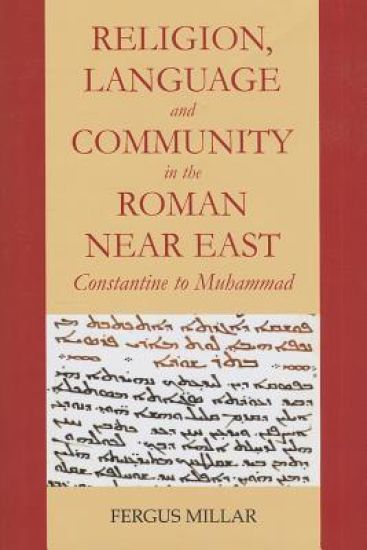
Religion, Language and Community in the Roman Near East

Religion, Language and Community in the Roman Near East

Fergus Millar

Oxford University Press
2013
sidottu
This book explores the way in which different ethnic, religious and linguistic communities co-existed and conflicted in the Roman Near East in the three centuries between the conversion of the Emperor Constantine to Christianity in 312 and the beginning of Muhammad's preaching in about 610. In the fourth century a major role was played by Greek-speaking pagans, most notably the great orator, Libanius, from Antioch in Syria. After about 400, however, the public observance of pagan rituals died away under the pressure of Christianity. But the Greek language, as used in the Church, remained dominant. Pagan Aramaic is curiously invisible in this period, but the dialect of Aramaic used by Jews in Palestine is found in very extensive use, along with Hebrew, in a mass of religious literature, including the Palestinian Talmud, Aramaic versions of books of the Bible, and in inscriptions from synagogues. Most of the synagogue inscriptions come from their often quite elaborate mosaic floors, some of which contain visual representations of scenes from the Bible. Jews used Greek also, even in the inscriptions from synagogues, and so too did Samaritans, who were a powerful force in Late Antique Palestine, mounting two major revolts against the Empire. Outside Palestine, the most notable development in the culture of the region was the emergence of Syriac (a particular dialect and script of Aramaic) as a language of Christian culture and belief. 'Syrians' however were not a distinct ethnic group. The group which was most distinct from the others was made up of the unsettled and warlike peoples on the fringes of the Empire whom almost invariably, call 'Arabs', but who in Late Antiquity were far more often referred to as 'Saracens'. By the end of the period, many of them had converted to Christianity. The major puzzle which the book poses is what is the relation between this process of conversion and the rise of Islam.
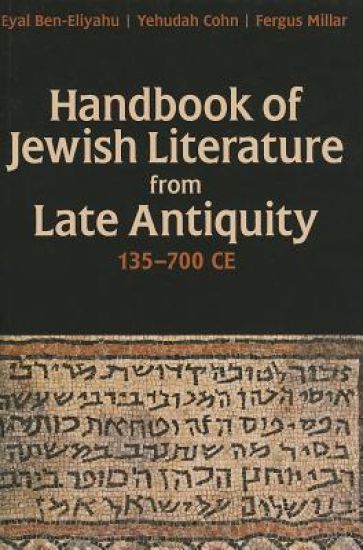
Handbook of Jewish Literature from Late Antiquity, 135-700 CE

Handbook of Jewish Literature from Late Antiquity, 135-700 CE

Fergus Millar; Eyal Ben-Eliyahu; Yehudah Cohn

Oxford University Press
2013
sidottu

Halvin toimitettuna 53,70 €

From major seminal works like the Mishnah or the Palestinian and Babylonian Talmuds, to Biblical commentaries, translations of Biblical books into Aramaic or relatively little-known mystical, liturgical or apocalyptic writings, here is a complete guide to the rich tradition of Jewish literature in the second to seventh centuries of the Common Era. Each work is described in a succinct and clearly structured entry which covers its contents, dating, language and accessibility (or otherwise) in print or online. The aim throughout is to cover all of this literature and to answer the following questions. What Jewish literature, written either in Hebrew or Aramaic, has survived? What different genres of such literature are there? What printed texts, or translations into any modern language, or commentaries (either in Hebrew or a European language) are there? And, for those who want to enquire further, what are the manuscripts on which modern editions are based? This handbook will be of value to scholars and students of Jewish Studies and historians of Late Antiquity, as well as scholars in neighbouring disciplines, such as Near Eastern history or Theology.
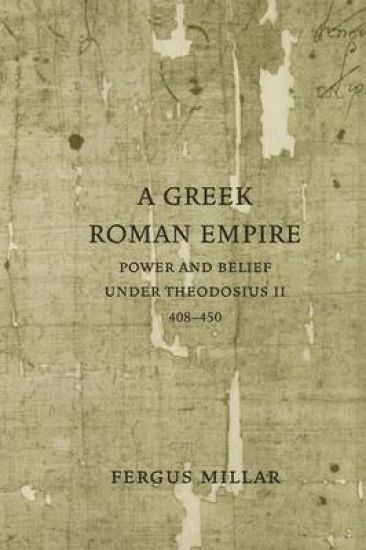
A Greek Roman Empire

A Greek Roman Empire

Fergus Millar

University of California Press
2006
pokkari
In the first half of the fifth century, the Latin-speaking part of the Roman Empire suffered vast losses of territory to barbarian invaders. But in the Greek-speaking half of the Eastern Mediterranean, with its capital at Constantinople, there was a stable and successful system, using Latin as its official language, but communicating with its subjects in Greek. This book takes an inside look at how this system worked in the long reign of the pious Christian Emperor Theodosius II (408-50), and analyzes its largely successful defense of its frontiers, its internal coherence, and its relations with its subjects, with a flow of demands and suggestions traveling up the hierarchy to the Emperor, and a long series of laws, often set out in elaborately self-justificatory detail, addressed by the Emperor, through his officials, to the people. Above all, this book focuses on the Imperial mission to promote the unity of the Church, the State's involvement in intensely-debated doctrinal questions, and the calling by the Emperor of two major Church Councils at Ephesus, in 431 and 449. Between the Law codes and the acts of the Church Councils, the material illustrating the working of government and the involvement of State and church, is incomparably richer, more detailed, and more vivid than for any previous period.
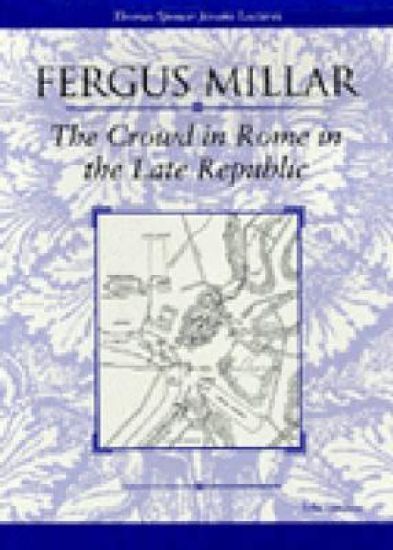
The Crowd in Rome in the Late Republic

The Crowd in Rome in the Late Republic

Fergus Millar

The University of Michigan Press
2002
nidottu
It has often been thought that Roman politics was dominated by a governing class, or even aristocracy, and it has sometimes been presumed that the Senate was a legislative body. The Crowd in Rome in the Late Republic takes a dramatically new tack, and explores the consequences of a democracy in which public office could be gained only by direct election by the people. And while the Senate could indeed debate public matters, advise other office-holders, and make some administrative decisions, it could not legislate. An office-holder who wanted to pass a law had to step out of the Senate-house and propose it to the people in the Forum--where there were few guarantees. In this important study, Fergus Millar explores the development of the Roman Republic, which, as it drew to a close in the middle decades of the first century B. C. E., had come to cover most of Italy. There were nearly a million adult male voters in the time of Cicero, but there were no constituencies, and no absentee ballots. To exercise their rights, voters had to come in person to Rome and to meet in the Forum. Millar takes the period from the dictatorship of Sulla to Caesar's crossing of the Rubicon and shows how the politics of the crowd was central to the great changes that took place year after year, and altered the Republic forever. The originality of Millar's highly accessible work lies first in its serious treatment of the importance of open-air oratory in Roman public life, and second, in its use of the narratives of events that evidence provides. Third, it refuses to interpret these narratives in the light of modern theories about the importance of the client-patron system, or the domination of the Senate. This work questions how we should understand the Roman Republic: as a network of aristocratic families dominating the people, or an erratic and volatile democracy in which power was exercised by the tiny proportion of citizens who actually came to listen to speeches and to vote. This work speaks to those interested in ancient history and its consequences in the modern world. Fergus Millar is Camden Professor of Ancient History, Brasenose College, Oxford University.
The Roman Republic in Political Thought

The Roman Republic in Political Thought

Fergus Millar

Brandeis University Press
2002
nidottu
It is a fact that the very long-lived Roman Republic has consistently played a surprisingly slight role in political theory and discussions about the nature of democracy, forms of government, and other matters, particularly when compared to the enormous attention paid to fifth-century BCE Athenian democracy. Fergus Millar re-opens the issue of how the Roman Republic was understood and used by political thinkers from the Ancient World to the present. Describing both the reality of the late Roman Republic and showing how its nature was distorted even by contemporary sources, he tracks its treatment (or absence) in political discourse from Thomas Aquinas, Machiavelli, Montesquieu, and Rousseau, and in debates surrounding the creation of the American constitution, particularly in the Federalist papers. In brief, clear prose, with quotations in English from important works, and economical use of endnotes, he reinforces his unconventional thesis about the significance of direct democracy in the late Roman Republic. In the process, he also provides an unprecedented tour through 2000 years of Western political theory from the point of view of the Roman Republic, in general, and theories of direct democracy and the balance of power, in particular.
The Crowd in Rome in the Late Republic

The Crowd in Rome in the Late Republic

Fergus Millar

The University of Michigan Press
1998
sidottu
It has often been thought that Roman politics was dominated by a governing class, or even aristocracy, and it has sometimes been presumed that the Senate was a legislative body. The Crowd in Rome in the Late Republic takes a dramatically new tack, and explores the consequences of a democracy in which public office could be gained only by direct election by the people. And while the Senate could indeed debate public matters, advise other office-holders, and make some administrative decisions, it could not legislate. An office-holder who wanted to pass a law had to step out of the Senate-house and propose it to the people in the Forum--where there were few guarantees. In this important study, Fergus Millar explores the development of the Roman Republic, which, as it drew to a close in the middle decades of the first century B. C. E., had come to cover most of Italy. There were nearly a million adult male voters in the time of Cicero, but there were no constituencies, and no absentee ballots. To exercise their rights, voters had to come in person to Rome and to meet in the Forum. Millar takes the period from the dictatorship of Sulla to Caesar's crossing of the Rubicon and shows how the politics of the crowd was central to the great changes that took place year after year, and altered the Republic forever. The originality of Millar's highly accessible work lies first in its serious treatment of the importance of open-air oratory in Roman public life, and second, in its use of the narratives of events that evidence provides. Third, it refuses to interpret these narratives in the light of modern theories about the importance of the client-patron system, or the domination of the Senate. This work questions how we should understand the Roman Republic: as a network of aristocratic families dominating the people, or an erratic and volatile democracy in which power was exercised by the tiny proportion of citizens who actually came to listen to speeches and to vote. This work speaks to those interested in ancient history and its consequences in the modern world. Fergus Millar is Camden Professor of Ancient History, Brasenose College, Oxford University.
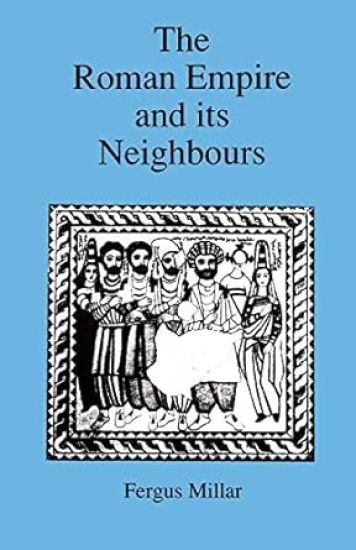
Roman Empire and Its Neighbours

Roman Empire and Its Neighbours

Fergus Millar

Bristol Classical Press
1996
nidottu
Covering the period from AD14 to 284, this comprehensive book reviews the social and economic history of the Roman Empire. Fergus Millar is the author of thirteen chapters on Rome and the provinces, arranged by topic, such as Governments and Administration, State and Subject, Italy, and Africa. These chapters for the bulk of the book and are supplemented by fours chapters by other authors (D. Berciu, Richard N. Frye, Georg Kossack and Tamara Talbot Rice) on the Parthians and Sasanid Persians, Dacians, Scytho-Sarmatians and Germans.
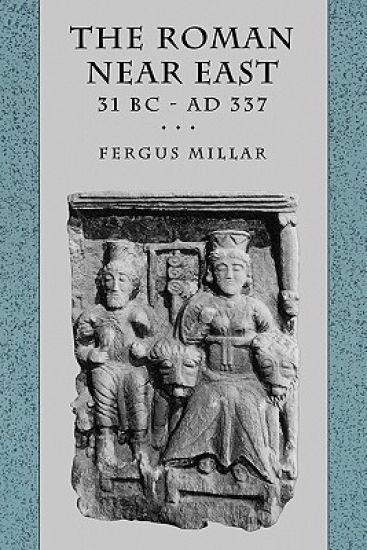
The Roman Near East

The Roman Near East

Fergus Millar

Harvard University Press
1995
nidottu
From Augustus to Constantine, the Roman Empire in the Near East expanded step by step, southward to the Red Sea and eastward across the Euphrates to the Tigris. In a remarkable work of interpretive history, Fergus Millar shows us this world as it was forged into the Roman provinces of Syria, Judaea, Arabia, and Mesopotamia. His book conveys the magnificent sweep of history as well as the rich diversity of peoples, religions, and languages that intermingle in the Roman Near East. Against this complex backdrop, Millar explores questions of cultural and religious identity and ethnicity—as aspects of daily life in the classical world and as part of the larger issues they raise. As Millar traces the advance of Roman control, he gives a lucid picture of Rome’s policies and governance over its far-flung empire. He introduces us to major regions of the area and their contrasting communities, bringing out the different strands of culture, communal identity, language, and religious belief in each. The Roman Near East makes it possible to see rabbinic Judaism, early Christianity, and eventually the origins of Islam against the matrix of societies in which they were formed. Millar’s evidence permits us to assess whether the Near East is best seen as a regional variant of Graeco-Roman culture or as in some true sense oriental. A masterful treatment of a complex period and world, distilling a vast amount of literary, documentary, artistic, and archaeological evidence—always reflecting new findings—this book is sure to become the standard source for anyone interested in the Roman Empire or the history of the Near East.
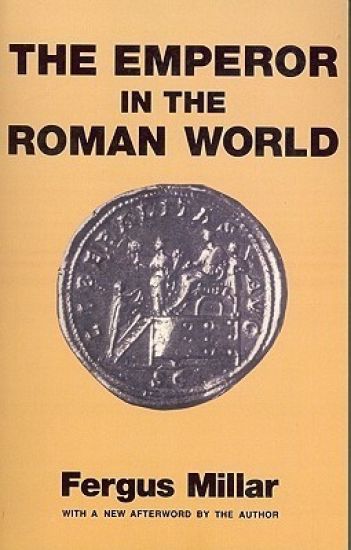
Emperor in the Roman World

Emperor in the Roman World

Fergus Millar

Bristol Classical Press
1992
pokkari
This book offers a large scale reassessment of the function of Roman emperor over three centuries (from Augustus to Constantine) and of the social realities of this exercise of power. Concentrating on the patterns of communication between the emperor and his subjects, the author shows that such communications were normally initiated by the subjects - whether grouped in cities or other associations, or individually and that the emperor fulfilled his role primarily by making responses to them or giving decisions or verdicts between them. The book casts new light on a number of detailed historical questions such as the sources of the emperor's wealth and the ways he spent it; the imperial residences and the mobility of the court; and the relatively small and simple entourage that the emperor needed to perform his functions. But above all, it emphasizes two major historical themes: the steady detachment of the emperor from the republican institutions of the city of Rome; and the way in which relations between Emperor and Church were shaped by the emperor's long-standing relations with cities, temples and associations in the pagan world. Drawing on a wide range of evidence, from literature and legal writings to inscriptions and papyri, the main text can be read without any knowledge o f Latin or Greek.