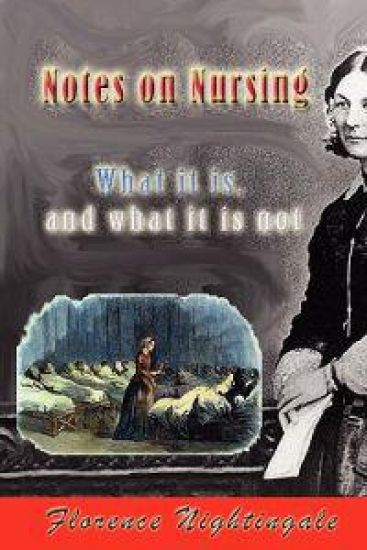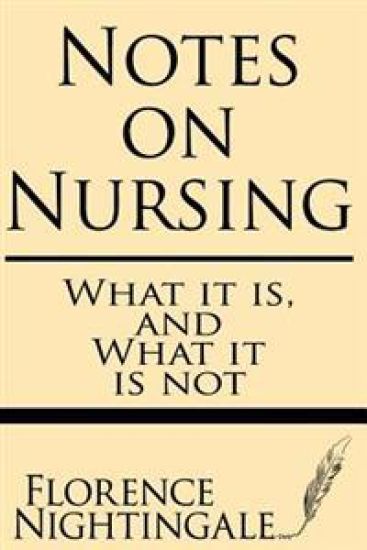
Notes on Nursing: What it is, and What it is not By Florence Nightingale Contents Ventilation and Warming Health of Houses Petty Management Noise Variety Taking Food What Food? Bed and Bedding Light Cleanliness of Rooms and Walls Personal Cleanliness Chattering Hopes and Advices Observation of the Sick Preface The following notes are by no means intended as a rule of thought by which nurses can teach themselves to nurse, still less as a manual to teach nurses to nurse. They are meant simply to give hints for thought to women who have personal charge of the health of others. Every woman, or at least almost every woman, in England has, at one time or another of her life, charge of the personal health of somebody, whether child or invalid, --in other words, every woman is a nurse. Every day sanitary knowledge, or the knowledge of nursing, or in other words, of how to put the constitution in such a state as that it will have no disease, or that it can recover from disease, takes a higher place. It is recognized as the knowledge which every one ought to have--distinct from medical knowledge, which only a profession can have. If, then, every woman must, at some time or other of her life, become a nurse, i.e., have charge of somebody's health, how immense and how valuable would be the produce of her united experience if every woman would think how to nurse. I do not pretend to teach her how, I ask her to teach herself, and for this purpose I venture to give her some hints. Excerpt Disease a reparative process. Shall we begin by taking it as a general principle--that all disease, at some period or other of its course, is more or less a reparative process, not necessarily accompanied with suffering: an effort of nature to remedy a process of poisoning or of decay, which has taken place weeks, months, sometimes years beforehand, unnoticed, the termination of the disease being then, while the antecedent process was going on, determined? If we accept this as a general principle we shall be immediately met with anecdotes and instances to prove the contrary. Just so if we were to take, as a principle-all the climates of the earth are meant to be made habitable for man, by the efforts of man-the objection would be immediately raised, -Will the top of Mont Blanc ever be made habitable? Our answer would be, it will be many thousands of years before we have reached the bottom of Mont Blanc in making the earth healthy. Wait till we have reached the bottom before we discuss the top. In watching disease, both in private houses and in public hospitals, the thing which strikes the experienced observer most... ------------------------------------------------------------------------------------------------------------------------------------------ Windham Press is committed to bringing the lost cultural heritage of ages past into the 21st century through high-quality reproductions of original, classic printed works at affordable prices. This book has been carefully crafted to utilize the original images of antique books rather than error-prone OCR text. This also preserves the work of the original typesetters of these classics, unknown craftsmen who laid out the text, often by hand, of each and every page you will read. Their subtle art involving judgment and interaction with the text is in many ways superior and more human than the mechanical methods utilized today, and gave each book a unique, hand-crafted feel in its text that connected the reader organically to the art of bindery and book-making. We think these benefits are worth the occasional imperfection resulting from the age of these books at the time of scanning, and their vintage feel provides a connection to the past that goes beyond the mere words of the text.