Kirjojen hintavertailu – 12 859 829 kirjaa ja 27 kauppaa

Kirjailija

Folashade Adeyemo

Kirjat ja teokset yhdessä paikassa: 5 kirjaa, julkaisuja vuosilta 2021–2026, suosituimpiin kuuluu Illicit Enrichment and Unexplained Wealth in Africa. Vertaile teosten hintoja ja tarkista saatavuus suomalaisista kirjakaupoista.

5 kirjaa

Kirjojen julkaisuvuodet: 2021–2026.

Illicit Enrichment and Unexplained Wealth in Africa

Illicit Enrichment and Unexplained Wealth in Africa

Folashade Adeyemo

TAYLOR FRANCIS LTD
2026
sidottu
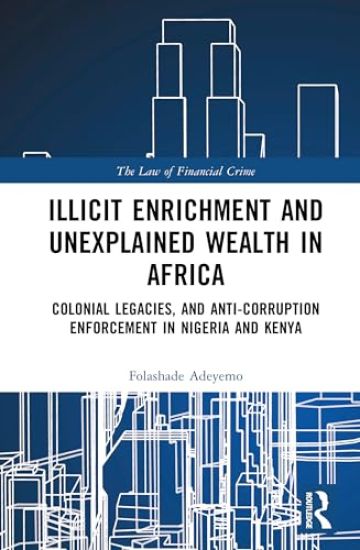
This book offers a governance-centred analysis of unexplained wealth regulation in post-colonial states. Moving beyond conventional doctrinal approaches, the book argues that unexplained wealth regimes are not merely technical legal innovations, but diagnostic instruments that expose the institutional and political conditions under which accountability is pursued. Drawing on comparative socio-legal analysis of Nigeria and Kenya, alongside high-capacity jurisdictions such as the United Kingdom, Australia, and Ireland, it demonstrates that the effectiveness of asset recovery mechanisms depends less on statutory design than on judicial credibility, institutional coordination, political insulation, and the integrity of evidentiary processes. Challenging culturalist explanations of corruption, the book situates illicit enrichment within historically produced political economies shaped by colonial administration, elite bargaining, and transnational financial networks. It advances the concept of the “informational pipeline” to explain why enforcement often fails even where legal frameworks appear robust. By integrating comparative law, political economy, and post-colonial analysis, this study reconceptualises unexplained wealth as a governance problem rather than a purely legal one, making a sustained and original contribution to global debates on anti-corruption law, legal transplants, and state power. The book will be a valuable guide for students, academics, policymakers, international banking law practitioners and those interested in economic and financial crime from a developing and emerging economies perspective.
Banking Regulation in Africa

Banking Regulation in Africa

Folashade Adeyemo

TAYLOR FRANCIS LTD
2024
nidottu
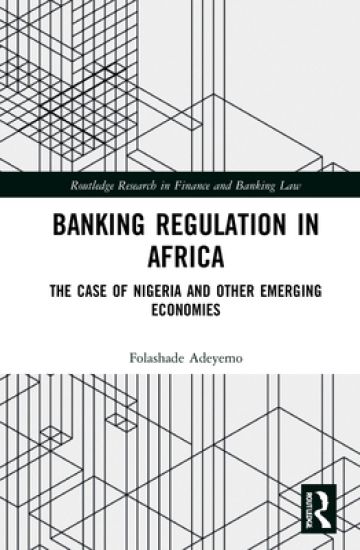
There is little literature on the development of banking regulation in Nigeria, or the scope of powers of the Central Bank of Nigeria, which is its core banking sector regulator. The critical impetus of this book is to contribute to the literature of this area, with a detailed exploration of the Nigerian regulatory architecture. In addition, the book also engages in a comparative analysis with two emerging economies in Africa: South Africa and Kenya. It also considers the UK and the US as comparator jurisdictions in light of their regulatory responses to the global financial crisis of 2008. This book contributes to the ongoing discourse in this area by exploring, in detail, the theoretical underpinnings of regulation and supervision, to determine whether there is an understanding of what constitutes effective regulation in these jurisdictions. Given that Nigeria is the core jurisdictional focus, a historical account of banking exchanges from the pre-colonial era to more recent times is provided. Offering an understanding of how political, local and economic settings, in conjunction with the theories of regulation, have impacted and influenced regulatory development in Nigeria, the book engages in an examination of Nigeria’s historical experiences with bank failures, including the banking crisis it experienced in 2008. The newly enacted Banks and Other Financial Institutions Act 2020 is also explored as part of this discourse. Through a critical analysis of the law, the book demonstrates that the Nigerian regulator has historically adopted a reactionary strategy, instead of a proactive and pragmatic approach, which is imperative for an effective regulatory regime. The outcome of this analysis is that there are lessons to be learned, and proposals are discussed in order to rethink the act of banking regulation.
Principles of Commercial Law

Principles of Commercial Law

Richard Austen-Baker; Kayode Akintola; Mukarrum Ahmed; Folashade Adeyemo

EDWARD ELGAR PUBLISHING LTD
2022
nidottu
This introductory-level textbook provides a clear and concise overview of commercial law for undergraduate law students. Covering all the key areas of law that may be included in a commercial law module, including agency, sale of goods, bailments, carriage of goods, commercial financing, and conflict of laws, it also introduces relevant elements of related fields such as banking and insolvency law and touches on emerging issues such as cryptocurrencies. Key Features:Accessible and conversational proseA tight focus on core knowledge with manageable levels of detailImportant concepts, cases and legislation are highlighted for ease of referenceStudent-friendly layout with key lessons and learning objectives clearly identifiedPrinciples of Commercial Law is perfectly suited to law students studying undergraduate commercial law modules in their second or third years. It will also be beneficial as an accessible introductory text on higher level courses for students who are newer to the topic.
Principles of Commercial Law

Principles of Commercial Law

Richard Austen-Baker; Kayode Akintola; Mukarrum Ahmed; Folashade Adeyemo

EDWARD ELGAR PUBLISHING LTD
2022
sidottu
This introductory-level textbook provides a clear and concise overview of commercial law for undergraduate law students. Covering all the key areas of law that may be included in a commercial law module, including agency, sale of goods, bailments, carriage of goods, commercial financing, and conflict of laws, it also introduces relevant elements of related fields such as banking and insolvency law and touches on emerging issues such as cryptocurrencies. Key Features:Accessible and conversational proseA tight focus on core knowledge with manageable levels of detailImportant concepts, cases and legislation are highlighted for ease of referenceStudent-friendly layout with key lessons and learning objectives clearly identifiedPrinciples of Commercial Law is perfectly suited to law students studying undergraduate commercial law modules in their second or third years. It will also be beneficial as an accessible introductory text on higher level courses for students who are newer to the topic.
Banking Regulation in Africa

Banking Regulation in Africa

Folashade Adeyemo

TAYLOR FRANCIS LTD
2021
sidottu
There is little literature on the development of banking regulation in Nigeria, or the scope of powers of the Central Bank of Nigeria, which is its core banking sector regulator. The critical impetus of this book is to contribute to the literature of this area, with a detailed exploration of the Nigerian regulatory architecture. In addition, the book also engages in a comparative analysis with two emerging economies in Africa: South Africa and Kenya. It also considers the UK and the US as comparator jurisdictions in light of their regulatory responses to the global financial crisis of 2008. This book contributes to the ongoing discourse in this area by exploring, in detail, the theoretical underpinnings of regulation and supervision, to determine whether there is an understanding of what constitutes effective regulation in these jurisdictions. Given that Nigeria is the core jurisdictional focus, a historical account of banking exchanges from the pre-colonial era to more recent times is provided. Offering an understanding of how political, local and economic settings, in conjunction with the theories of regulation, have impacted and influenced regulatory development in Nigeria, the book engages in an examination of Nigeria’s historical experiences with bank failures, including the banking crisis it experienced in 2008. The newly enacted Banks and Other Financial Institutions Act 2020 is also explored as part of this discourse. Through a critical analysis of the law, the book demonstrates that the Nigerian regulator has historically adopted a reactionary strategy, instead of a proactive and pragmatic approach, which is imperative for an effective regulatory regime. The outcome of this analysis is that there are lessons to be learned, and proposals are discussed in order to rethink the act of banking regulation.