Kirjojen hintavertailu – 12 903 732 kirjaa ja 27 kauppaa

Kirjailija

France St-Hilaire

Kirjat ja teokset yhdessä paikassa: 7 kirjaa, julkaisuja vuosilta 2001–2016, suosituimpiin kuuluu Money, Politics, and Health Care. Vertaile teosten hintoja ja tarkista saatavuus suomalaisista kirjakaupoista.

7 kirjaa

Kirjojen julkaisuvuodet: 2001–2016.

Income Inequality

Income Inequality

David A. Green; W. Craig Riddell; France St-Hilaire

The Institute for Research on Public Policy
2016
nidottu
Rising income inequality has been at the forefront of public debate in Canada in recent years, yet there is still much to learn about the economic forces driving the distribution of earnings and income in this country and how they might evolve in the future. With research showing that the tax-and-transfer system is losing the ability to counteract income disparity, the need for policy-makers to understand the factors at play is all the more urgent. Income Inequality provides a comprehensive review of Canadian inequality trends, including changing earnings and income dynamics among the middle class and top earners, wage and job polarization across provinces, and persistent poverty among vulnerable groups. The Institute for Research on Public Policy (IRPP), in collaboration with the Canadian Labour Market and Skills Researcher Network (CLSRN), presents new evidence by some of the country's leading experts on the impact of skills and education, unionization and labour relations laws, as well as the complex interplay of redistributive policies and politics over time. Amid growing anxieties about the economic prospects of the middle class, Income Inequality will serve to inform the public discourse on inequality, an issue that ultimately concerns all Canadians.

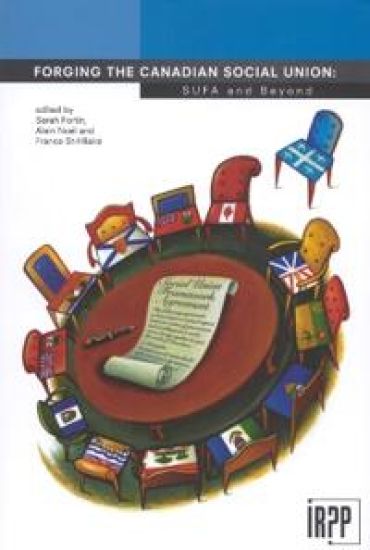
Forging the Canadian Social Union

Forging the Canadian Social Union

Sarah Fortin; Alain Noël; France St-Hilaire

The Institute for Research on Public Policy
2003
nidottu
Seven leading experts examine various aspects of the Agreement and consider whether it fulfils its expected role with respect to intergovernmental relations and social policy, whether it is a viable arrangement given the non-participation of one of its partners, and whether it should be renewed and under what conditions. Contributors include Christian Dufour (ENAP), Roger Gibbins (Canada West Foundation), Alain Noël (Université de Montréal), Susan Phillips (Carleton University), Michael Prince (University of Victoria), Bruno Théret (Université de Paris, Dauphine), and Yves Vaillancourt (UQAM).
The Review of Economic Performance and Social Progress, 2002

The Review of Economic Performance and Social Progress, 2002

Andrew Sharpe; France St-Hilaire; Keith Banting

The Institute for Research on Public Policy
2002
nidottu
The issue of productivity and the related issue of innovation continue to be high on the public policy agenda. Policymakers are particularly interested in the social aspects of productivity. In The Review of Economic Performance and Social Progress, 2002, the second issue of a new annual, authors examine the two-way linkages between productivity and various measures of social progress in Canada. Papers in the volume fall into two main themes: the effects of productivity on social progress indicators and the social determinants of productivity.
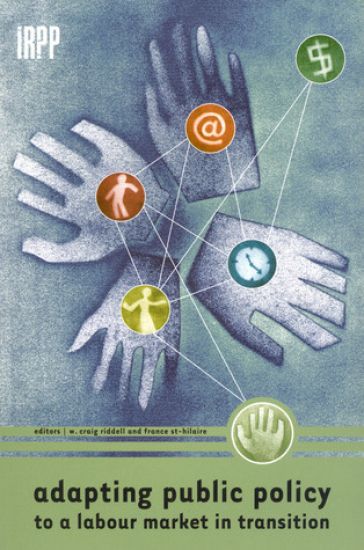
Adapting Public Policy to a Labour Market in Transition

Adapting Public Policy to a Labour Market in Transition

Craig Riddell; France St-Hilaire

The Institute for Research on Public Policy
2001
nidottu
After two decades of rapid technological and structural change and an overall record of poor economic performance, Canadians need to take stock of the ongoing transformation of the labour market and its implications for public policy. The fundamental changes to the nature of work itself suggest that labour and social policies established decades ago may no longer be adequate or appropriate. Moreover, the continuing perception of increased instability and worsening employment outcomes, and the growing concern over increased earnings inequality and labour market polarization, have raised serious questions about the role of government not only in addressing the consequences of economic adjustment but also in facilitating or, worse, hampering this process. Contributors include Michael Baker (University of Toronto & National Bureau of Economic Research, Cambridge, MA), Paul Beaudry (University of British Columbia), Dwayne Benjamin (University of Toronto), Jean-Michel Cousineau (University of Montreal), Nicole M. Fortin (University of British Columbia & University of Montreal), David A. Green (University of British Columbia), Morley Gunderson (University of Toronto), Peter Kuhn (University of California at Santa Barbara), Guy Lacroix (Laval University), Thomas Lemieux (University of British Columbia & University of Montreal), W. Craig Riddell, France St-Hilaire, Arthur Sweetman (Queen's University), and François Vaillancourt (University of Montreal & C. D. Howe Institute).