Kirjojen hintavertailu – 12 903 735 kirjaa ja 27 kauppaa

Kirjailija

Frances Henry

Kirjat ja teokset yhdessä paikassa: 8 kirjaa, julkaisuja vuosilta 1994–2017, suosituimpiin kuuluu Racial Profiling in Canada. Vertaile teosten hintoja ja tarkista saatavuus suomalaisista kirjakaupoista.

8 kirjaa

Kirjojen julkaisuvuodet: 1994–2017.

The Equity Myth

The Equity Myth

Frances Henry; Enakshi Dua; Carl E. James; Audrey Kobayashi; Peter Li; Howard Ramos; Malinda S. Smith

University of British Columbia Press
2017
pokkari
The university is often regarded as a bastion of liberal democracy where equity and diversity are promoted and racism doesn't exist. In reality, the university still excludes many people and is a site of racialization that is subtle, complex, and sophisticated. While some studies do point to the persistence of systemic barriers to equity in higher education, in-depth analyses of racism, racialization, and Indigeneity in the academy are more notable for excluding racialized and Indigenous professors. This book is the first comprehensive, data-based study of racialized and Indigenous faculty members' experiences in Canadian universities. Challenging the myth of equity in higher education, it brings together leading scholars who scrutinize what universities have done and question the effectiveness of their equity programs. They draw on a rich body of survey data, interviews, and analysis of universities' stated policies to examine the experiences of racialized faculty members across Canada who – despite diversity initiatives in their respective institutions – have yet to see meaningful changes in everyday working conditions. They also make important recommendations as to how universities can address racialization and fulfill the promise of equity in higher education.

Racial Profiling in Canada

Racial Profiling in Canada

Frances Henry; Carol Tator

University of Toronto Press
2006
sidottu
In October 2002, the Toronto Star ran a series of feature articles on racial profiling in which it was indicated that Toronto police routinely target young Black men when making traffic stops. The articles drew strong reactions from the community, and considerable protest from the media, politicians, law enforcement officials, and other public authorities. Although the articles were supported by substantial documentation and statistical evidence, the Toronto Police Association sued the Star, claiming that no such evidence existed. The lawsuit was ultimately rejected in court. As a result, however, the issue of racial profiling - a practice in which certain criminal activities are attributed to individuals or groups on the basis of race or ethno-racial background - was thrust into the national spotlight. In this comprehensive and thought-provoking work, Carol Tator and Frances Henry explore the meaning of racial profiling in Canada as it is practised not only by the police but also by many other social institutions. The authors provide a theoretical framework within which they examine racial profiling from a number of perspectives and in a variety of situations. They analyse the discourses of the media, policing officials, politicians, civil servants, judges, and other public authorities to demonstrate how those in power communicate and produce existing racialized ideologies and social relations of inequality through their common interactions. Chapter 3, by contributing author Charles Smith, provides a comparison of experiences of racial profiling and policing in Canada, the United States, and the United Kingdom. Chapter 7, by Maureen Brown, through a series of interviews, presents stories that demonstrate the realities of racial profiling in the everyday experiences of Afro-Canadians and ethno-racial minorities. Informed by a wealth of research and theoretical approaches from a wide range of disciplines, Racial Profiling in Canada makes a major contribution to the literature and debates on a topic of growing concern. Together the authors present a compelling examination of the pervasiveness of racial profiling in daily life and its impact on our society, while suggesting directions for change.
Racial Profiling in Canada

Racial Profiling in Canada

Frances Henry; Carol Tator

University of Toronto Press
2006
pokkari
In October 2002, the Toronto Star ran a series of feature articles on racial profiling in which it was indicated that Toronto police routinely target young Black men when making traffic stops. The articles drew strong reactions from the community, and considerable protest from the media, politicians, law enforcement officials, and other public authorities. Although the articles were supported by substantial documentation and statistical evidence, the Toronto Police Association sued the Star, claiming that no such evidence existed. The lawsuit was ultimately rejected in court. As a result, however, the issue of racial profiling - a practice in which certain criminal activities are attributed to individuals or groups on the basis of race or ethno-racial background - was thrust into the national spotlight. In this comprehensive and thought-provoking work, Carol Tator and Frances Henry explore the meaning of racial profiling in Canada as it is practised not only by the police but also by many other social institutions. The authors provide a theoretical framework within which they examine racial profiling from a number of perspectives and in a variety of situations. They analyse the discourses of the media, policing officials, politicians, civil servants, judges, and other public authorities to demonstrate how those in power communicate and produce existing racialized ideologies and social relations of inequality through their common interactions. Chapter 3, by contributing author Charles Smith, provides a comparison of experiences of racial profiling and policing in Canada, the United States, and the United Kingdom. Chapter 7, by Maureen Brown, through a series of interviews, presents stories that demonstrate the realities of racial profiling in the everyday experiences of Afro-Canadians and ethno-racial minorities. Informed by a wealth of research and theoretical approaches from a wide range of disciplines, Racial Profiling in Canada makes a major contribution to the literature and debates on a topic of growing concern. Together the authors present a compelling examination of the pervasiveness of racial profiling in daily life and its impact on our society, while suggesting directions for change.
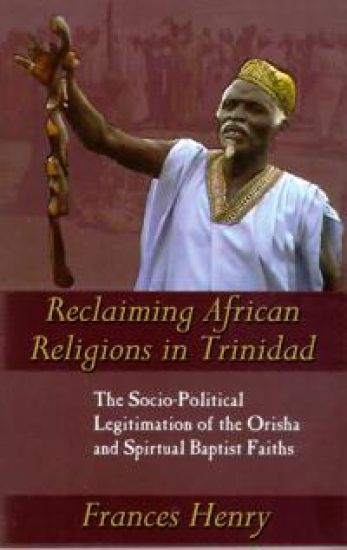
Reclaiming African Religions in Trinidad

Reclaiming African Religions in Trinidad

Frances Henry

University of the West Indies Press
2003
nidottu
Frances Henry's book explores various African religions as part of a cultural system, relevant to national identity in the island of Trinidad The book deals with the dynamic doctrinal and ideological changes that have taken place within the religions, and documents both the legislative and social acceptance of African religion today. This study is an important documentation of contemporary history and religious debate. It analyzes the process by which marginalized religions move toward the mainstream and the various internal and external tensions such movements engender. It makes a particularly strong contribution in its discussions of ritual authenticity. The work is based on a three-year period of fieldwork in Trinidad. Of interest to students and scholars interested in Caribbean Studies, especially African oriented-Studies.
Discourses of Domination

Discourses of Domination

Frances Henry; Carol Tator

University of Toronto Press
2002
pokkari
Discourses of Domination explores the issue of racial bias in the Canadian English-language press. Applying critical discourse analysis as their principal methodology, Frances Henry and Carol Tator investigate the way in which the media produce, reproduce, and disseminate racist thinking through language and discourse. The core of the text consists of a series of case studies, including several high-profile cases involving the alleged criminality of persons of colour. Using these case studies as a springboard, Henry and Tator demonstrate how the media construct people of colour, immigrants, refugees, and First Nations peoples as 'others' - those who live outside the 'imagined community' of Canada. Their analysis ultimately points to the tension between democratic liberalism as a defining characteristic of Canadian society and the collective racist ideology that is embedded in the dominant culture. Discourses of Domination thus provides a greater understanding of newer forms of racism, located within systems of cultural production and representation.
Discourses of Domination

Discourses of Domination

Frances Henry; Carol Tator

University of Toronto Press
2002
sidottu
Discourses of Domination explores the issue of racial bias in the Canadian English-language press. Applying critical discourse analysis as their principal methodology, Frances Henry and Carol Tator investigate the way in which the media produce, reproduce, and disseminate racist thinking through language and discourse. The core of the text consists of a series of case studies, including several high-profile cases involving the alleged criminality of persons of colour. Using these case studies as a springboard, Henry and Tator demonstrate how the media construct people of colour, immigrants, refugees, and First Nations peoples as 'others' - those who live outside the 'imagined community' of Canada. Their analysis ultimately points to the tension between democratic liberalism as a defining characteristic of Canadian society and the collective racist ideology that is embedded in the dominant culture. Discourses of Domination thus provides a greater understanding of newer forms of racism, located within systems of cultural production and representation.
Challenging Racism in the Arts

Challenging Racism in the Arts

Carol Tator; Frances Henry; Winston Mattis

University of Toronto Press
1998
pokkari
In this thoughtful and lucid analysis, framed by their contention that 'cultural production is one way in which society gives voice to racism,' Carol Tator, Frances Henry, and Winston Matthis examine how six controversial Canadian cultural events have given rise to a new 'radical' or 'critical' multiculturalism. Mainstream culture has increasingly become the locus for challenge by racial minorities. Beginning with the Royal Ontario Museum's Into the Heart of Africa exhibition, and following through with discussions of Show Boat, Miss Saigon, the exhibition of the Barnes Collection at the Art Gallery of Ontario, the 'Writing Thru Race' conference in Vancouver, and the ill-fated attempts to acquire a licence for a black/dance radio station in Toronto, the authors examine manifestations of racism in Canada's cultural production over the last decade. A 'radical' multiculturalism, they argue, is difference as a politicized force, and arises whenever cultural imperialism is challenged.
The Caribbean Diaspora in Toronto

The Caribbean Diaspora in Toronto

Frances Henry

University of Toronto Press
1994
pokkari
The Afro-Caribbean community of Toronto has grown dramatically over the past few decades. Increasingly active as a political and cultural force in the life of the city, the group remains unknown to many of Toronto's other communities and institutions. Frances Henry offers the first intensive ethnographic examination of the community. Based on in-depth interviews and extensive observation, her study provides a richly detailed overview of the major cultural institutions in the lives of Afro-Caribbean residents of Toronto. Henry begins with an introduction to the Caribbean region, and the cultural and historical origins of its peoples. She focuses on the cultural practices that shape the community in Toronto, and the extent to which they facilitate or impede incorporation in Canadian society. Henry looks closely at male-female relationships, forms of family organization, and patterns of religious practice, and shows that some cultural patterns have been maintained by members of the community whereas others have changed during the migration process. Two factors emerge as the key to the Afro-Caribbean experience in Toronto. One is the class differences within the community, which play a crucial role in re-creating stratification patterns similar to those in the Caribbean. The other is systemic racism against people of Afro-Caribbean origin, which impacts in all areas of the community's life in Canada.