Kirjojen hintavertailu – 12 903 724 kirjaa ja 27 kauppaa

Kirjailija

Francesco Tornabene

Kirjat ja teokset yhdessä paikassa: 9 kirjaa, julkaisuja vuosilta 2010–2025, suosituimpiin kuuluu Mechanics of Laminated Composite Doubly-Curved Shell Structures. Vertaile teosten hintoja ja tarkista saatavuus suomalaisista kirjakaupoista.

9 kirjaa

Kirjojen julkaisuvuodet: 2010–2025.

Multifield Theory of Anisotropic Doubly-Curved Shells

Multifield Theory of Anisotropic Doubly-Curved Shells

Francesco Tornabene

TAYLOR FRANCIS LTD
2025
sidottu
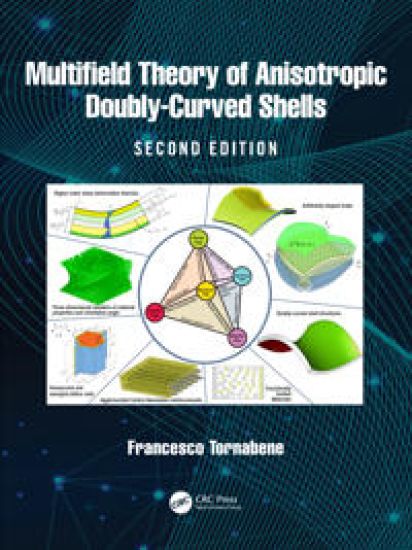
This book analyses the multifield behaviour of doubly-curved shells made of anisotropic and advanced materials. These materials include fiber reinforced composite materials, carbon nanotubes, variable angle tow composites, honeycomb cells, anisogrid, and functionally graded materials. Taking into account the three different approaches to studying the mechanical and multifield behaviour of anisotropic doubly-curved shell structures, the book comprehensively explains the mathematic steps necessary to each method based on curvilinear principal coordinates. Furthermore, an isogeometric mapping technique is illustrated to investigate arbitrarily-shaped structures. The modelling strategies presented in the book are three-dimensional elasticity theory, along with the Equivalent Single Layer and the Layer-Wise approach. The book focuses on Higher-order Shear Deformation Theories (HSDTs) with unified formulation, and it introduces also classical theories like the Kirchoff-Love theory and the First-order Shear Deformation Theory (FSDT). It also illustrates strong and weak formulations of the governing equations of motion and provides numerical results for several structural components as examples. Relevant to studies in plates and shells, advanced materials, multifield analysis, vibration and stress, the book is the ideal companion for engineers and students in the area of structural, applied and computational mechanics.
Hygro-Thermo-Magneto-Electro-Elastic Theory of Anisotropic Doubly-Curved Shells
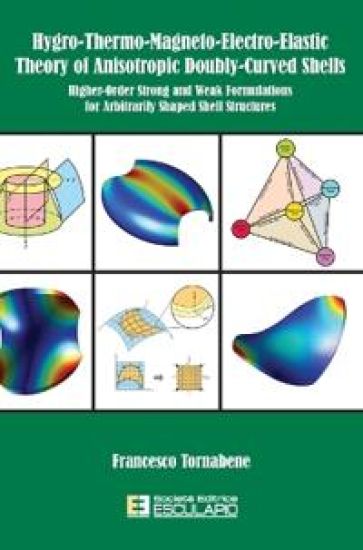
This book aims to present in depth several Higher-order Shear Deformation Theories (HSDTs) by means of a unified approach for studying the Hygro-Thermo-Magneto-Electro- Elastic Theory of Anisotropic Doubly-Curved Shells. In particular, a general coupled multifield theory regarding anisotropic shell structures is provided. The three-dimensional multifield problem is reduced in a two-dimensional one following the principles of the Equivalent Single Layer (ESL) approach and the Equivalent Layer-Wise (ELW) approach, setting a proper configuration model. According to the adopted configuration assumptions, several Higher-order Shear Deformation Theories (HSDTs) are obtained. Furthermore, the strong and weak formulations of the corresponding governing equations are discussed and illustrated. The approach presented in this volume is completely general and represents a valid tool to investigate the physical behavior of many arbitrarily shaped structures. An isogeometric mapping procedure is also illustrated to this aim. Special attention is given also to advanced and innovative constituents, such as Carbon Nanotubes (CNTs), Variable Angle Tow (VAT) composites and Functionally Graded Materials (FGMs). In addition, several numerical applications are used to support the theoretical models. Accurate, efficient and reliable numerical techniques able to approximate both derivatives and integrals are considered, which are respectively the Differential Quadrature (DQ) and Integral Quadrature (IQ) methods. The Theory of Composite Thin Shells is derived in a simple and intuitive manner from the theory of thick and moderately thick shells (First-order Shear Deformation Theory or Reissner- Mindlin Theory). In particular, the Kirchhoff-Love Theory and the Membrane Theory for composite shells are shown. Furthermore, the Theory of Composite Arches and Beams is also exposed. In particular, the equations of the Timoshenko Theory and the Euler-Bernoulli Theory are directly deducted from the equations of singly-curved shells of translation and of plates.
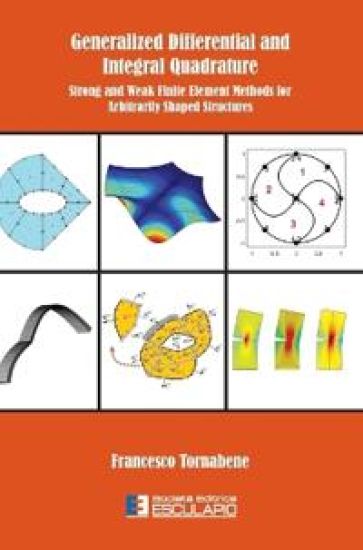
Generalized Differential and Integral Quadrature

Generalized Differential and Integral Quadrature

Francesco Tornabene

Societa Editrice Esculapio
2023
sidottu
The main aim of this book is to analyze the mathematical fundamentals and the main features of the Generalized Differential Quadrature (GDQ) and Generalized Integral Quadrature (GIQ) techniques. Furthermore, another interesting aim of the present book is to shown that from the two numerical techniques mentioned above it is possible to derive two different approaches such as the Strong and Weak Finite Element Methods (SFEM and WFEM), that will be used to solve various structural problems and arbitrarily shaped structures. A general approach to the Differential Quadrature is proposed. The weighting coefficients for different basis functions and grid distributions are determined. Furthermore, the expressions of the principal approximating polynomials and grid distributions, available in the literature, are shown. Besides the classic orthogonal polynomials, a new class of basis functions, which depend on the radial distance between the discretization points, is presented. They are known as Radial Basis Functions (or RBFs). The general expressions for the derivative evaluation can be utilized in the local form to reduce the computational cost. From this concept the Local Generalized Differential Quadrature (LGDQ) method is derived. The Generalized Integral Quadrature (GIQ) technique can be used employing several basis functions, without any restriction on the point distributions for the given definition domain. To better underline these concepts some classical numerical integration schemes are reported, such as the trapezoidal rule or the Simpson method. An alternative approach based on Taylor series is also illustrated to approximate integrals. This technique is named as Generalized Taylor-based Integral Quadrature (GTIQ) method. The major structural theories for the analysis of the mechanical behavior of various structures are presented in depth in the book. In particular, the strong and weak formulations of the corresponding governing equations are discussed and illustrated. Generally speaking, two formulations of the same system of governing equations can be developed, which are respectively the strong and weak (or variational) formulations. Once the governing equations that rule a generic structural problem are obtained, together with the corresponding boundary conditions, a differential system is written. In particular, the Strong Formulation (SF) of the governing equations is obtained. The differentiability requirement, instead, is reduced through a weighted integral statement if the corresponding Weak Formulation (WF) of the governing equations is developed. Thus, an equivalent integral formulation is derived, starting directly from the previous one. In particular, the formulation in hand is obtained by introducing a Lagrangian approximation of the degrees of freedom of the problem. The need of studying arbitrarily shaped domains or characterized by mechanical and geometrical discontinuities leads to the development of new numerical approaches that divide the structure in finite elements. Then, the strong form or the weak form of the fundamental equations are solved inside each element. The fundamental aspects of this technique, which the author defined respectively Strong Formulation Finite Element Method (SFEM) and Weak Formulation Finite Element Method (WFEM), are presented in the book.
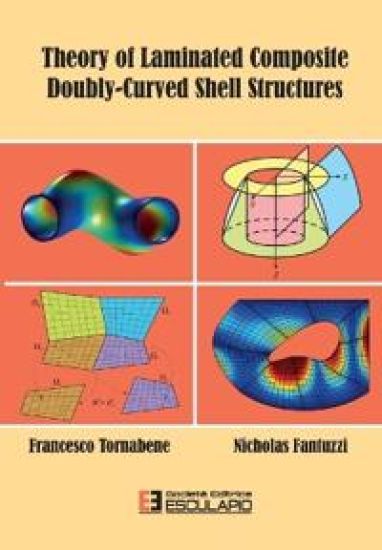
Theory of Laminated Composite Doubly-Curved Shell Structures

Theory of Laminated Composite Doubly-Curved Shell Structures

Francesco Tornabene; Nicholas Fantuzzi

Societa Editrice Esculapio
2022
pokkari
This manuscript comes from the experience gained over thirteen years of study and research on shell structures. The title, Theory of Laminated Composite Doubly-Curved Shell Structures, illustrates the theme followed in the present volume. The present study aims to analyze the static and dynamic behavior of moderately thick shells made of composite materials. A particular attention is paid, other than fibrous and lamina- ted composites, also to "Functionally graded materials" (FGMs). They are non-homogeneous materials, characterized by a continuous variation of the mechanical properties through a particular direction. In particular, the present manuscript was written as an attempt to show, in an easy way, the theoretical aspects of doubly-curved composite shell structures. Furthermore, it focuses only on the theoretical aspects related to laminated composite doubly-curved shell structures and represents a shortened version of the book entitled: Mechanics of Laminated Composite Doubly-Curved Shell Structures by the same authors, wherein also the numerical part has been presented. The present volume is aimed at Master degree and PhD students in structural and applied mechanics, as well as experts in these fields. The present volume is divided into six chapters, in which static and dynamic analyses of several structural elements are provided in detail. Furthermore, the results of the adopted numerical technique are presented for several problems such as different loading and boundary conditions.
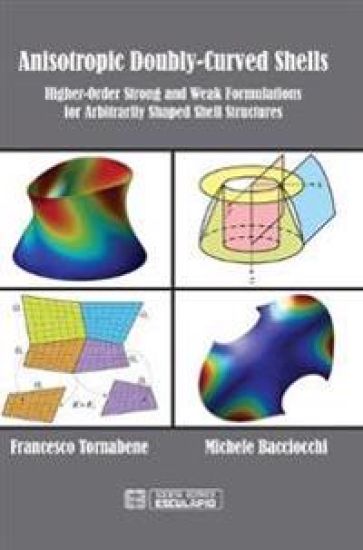
Anisotropic Doubly-Curved Shells

Anisotropic Doubly-Curved Shells

Francesco Tornabene; Michele Bacciocchi

Societa Editrice Esculapio
2018
sidottu
This book aims to present in depth several Higher-order Shear Deformation Theories (HSDTs) by means of a unified approach for the mechanical analysis of doubly-curved shell structures made of anisotropic and composite materials. In particular, the strong and weak formulations of the corresponding governing equations are discussed and illustrated. The approach presented in this volume is completely general and represents a valid tool to investigate the structural behavior of many arbitrarily shaped structures. An isogeometric mapping procedure is also illustrated to this aim. Special attention is given also to advanced and innovative constituents, such as Carbon Nanotubes (CNTs), Variable Angle Tow (VAT) composites and Functionally Graded Materials (FGMs). In addition, several numerical applications are developed to support the theoretical models. Accurate, efficient and reliable numerical techniques able to approximate both derivatives and integrals are presented, which are respectively the Differential Quadrature (DQ) and Integral Quadrature (IQ) methods. Finally, two numerical techniques, named Strong Formulation Finite Element Method (SFEM) and Weak Formulation Finite Element Method (WFEM), are developed to deal with multi-element domains characterized by arbitrary shapes and discontinuities.
Laminated Composite Doubly-Curved Shell Structures

Laminated Composite Doubly-Curved Shell Structures

Francesco Tornabene; Nicholas Fantuzzi; Erasmo Viola

Societa Editrice Esculapio
2016
sidottu
The title, "Laminated Composite Doubly-Curved Shell Structures. Differential al Geometry and Higher-order Theories" illustrates the theme treated and the prospective followed during the composition of the present work. The aim of this manuscript is to analyze the static and dynamic behavior of thick and moderately thick composite shells through the application of the Differential Quadrature (DQ) method. The book is divided into two volumes wherein the principal higher order structural theories are illustrated in detail and the mechanical behavior of doubly-curved structures are presented by several static and dynamic numerical applications. In particular, the first volume is mainly theoretical, whereas the second one is mainly related to the numerical DQ technique and its applications in the structural field. The starting point to analyze higher-order structural theories is given by the so-called Unified Formulation (UF), which allows to consider and study several kinematic models in a unified manner. Both the Equivalent Single Layer (ESL) and Layer-Wise (LW) approaches are presented. A particular attention is paid to composite materials, due to their increasing development and use in many engineering fields during the last years.
Laminated Composite Doubly-Curved Shell Structures

Laminated Composite Doubly-Curved Shell Structures

Francesco Tornabene; Nicholas Fantuzzi; Erasmo Viola

Societa Editrice Esculapio
2016
sidottu
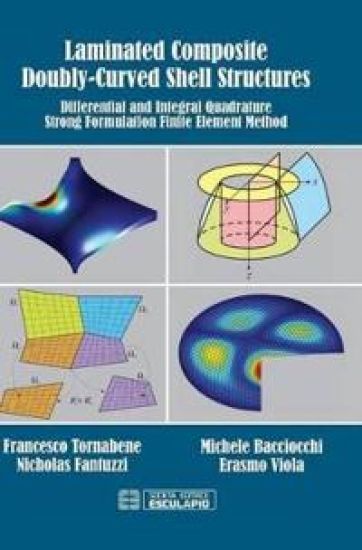
The title, "Laminated Composite Doubly-Curved Shell Structures. Differential and Integral Quadrature. Strong Form Finite Elements" illustrates the theme treated and the prospective followed during the composition of the present work. The aim of this manuscript is to analyze the static and dynamic behavior of thick and moderately thick composite shells through the application of the Differential Quadrature (DQ) method. The book is divided into two volumes wherein the principal higher order structural theories are illustrated in detail and the mechanical behavior of doubly-curved structures are presented by several static and dynamic numerical applications. In particular, the first volume is mainly theoretical, whereas the second one is mainly related to the numerical DQ technique and its applications in the structural field. The numerical results reported in the present volume are compared to the one available in the literature, but also to the ones obtained through several codes based on the Finite Element Method (FEM). Furthermore, an advanced version of the DQ method, termed Strong Formulation Finite Element Method (SFEM), is presented. The SFEM solves the differential equations inside each element in the strong form and implements the mapping technique typical of the FEM.