Kirjojen hintavertailu – 12 903 724 kirjaa ja 27 kauppaa
Kirjailija
Francis Bach
Kirjat ja teokset yhdessä paikassa: 4 kirjaa, julkaisuja vuosilta 2012–2024, suosituimpiin kuuluu Learning with Submodular Functions. Vertaile teosten hintoja ja tarkista saatavuus suomalaisista kirjakaupoista.
In recent years, a large amount of multi-disciplinary research has been conducted on sparse models and their applications. In statistics and machine learning, the sparsity principle is used to perform model selection-that is, automatically selecting a simple model among a large collection of them. In signal processing, sparse coding consists of representing data with linear combinations of a few dictionary elements. Subsequently, the corresponding tools have been widely adopted by several scientific communities such as neuroscience, bioinformatics, or computer vision. Sparse Modeling for Image and Vision Processing provides the reader with a self-contained view of sparse modeling for visual recognition and image processing. More specifically, the work focuses on applications where the dictionary is learned and adapted to data, yielding a compact representation that has been successful in various contexts. It reviews a large number of applications of dictionary learning in image processing and computer vision and presents basic sparse estimation tools. It starts with a historical tour of sparse estimation in signal processing and statistics, before moving to more recent concepts such as sparse recovery and dictionary learning. Subsequently, it shows that dictionary learning is related to matrix factorization techniques, and that it is particularly effective for modeling natural image patches. As a consequence, it has been used for tackling several image processing problems and is a key component of many state-of-the-art methods in visual recognition. Sparse Modeling for Image and Vision Processing concludes with a presentation of optimization techniques that should make dictionary learning easy to use for researchers that are not experts in the field.
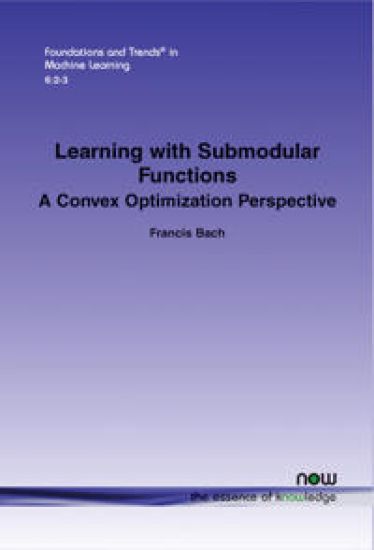
Submodular functions are relevant to machine learning for at least two reasons: (1) some problems may be expressed directly as the optimization of submodular functions, and (2) the Lovász extension of submodular functions provides a useful set of regularization functions for supervised and unsupervised learning. In Learning with Submodular Functions, the theory of submodular functions is presented in a self-contained way from a convex analysis perspective, presenting tight links between certain polyhedra, combinatorial optimization and convex optimization problems. In particular, it describes how submodular function minimization is equivalent to solving a wide variety of convex optimization problems. This allows the derivation of new efficient algorithms for approximate and exact submodular function minimization with theoretical guarantees and good practical performance. By listing many examples of submodular functions, it reviews various applications to machine learning, such as clustering, experimental design, sensor placement, graphical model structure learning or subset selection, as well as a family of structured sparsity-inducing norms that can be derived and used from submodular functions. This is an ideal reference for researchers, scientists, or engineers with an interest in applying submodular functions to machine learning problems.
Sparse estimation methods are aimed at using or obtaining parsimonious representations of data or models. They were first dedicated to linear variable selection but numerous extensions have now emerged such as structured sparsity or kernel selection. It turns out that many of the related estimation problems can be cast as convex optimization problems by regularizing the empirical risk with appropriate nonsmooth norms. Optimization with Sparsity-Inducing Penalties presents optimization tools and techniques dedicated to such sparsity-inducing penalties from a general perspective. It covers proximal methods, block-coordinate descent, reweighted ?2-penalized techniques, working-set and homotopy methods, as well as non-convex formulations and extensions, and provides an extensive set of experiments to compare various algorithms from a computational point of view. The presentation of this book is essentially based on existing literature, but the process of constructing a general framework leads naturally to new results, connections and points of view. It is an ideal reference on the topic for anyone working in machine learning and related areas.