
Kirjailija
Francis Bacon
Kirjat ja teokset yhdessä paikassa: 609 kirjaa, julkaisuja vuosilta 1810–2026, suosituimpiin kuuluu La Nueva Atlántida: Spanish Version. Vertaile teosten hintoja ja tarkista saatavuus suomalaisista kirjakaupoista.
609 kirjaa
Kirjojen julkaisuvuodet: 1810–2026.
Novum Organum; Or, True Suggestions for the Interpretation of Nature
Francis Bacon; Joseph Devey
ALPHA EDITION
2023
pokkari
Reprint of the original, first published in 1871. The publishing house Anatiposi publishes historical books as reprints. Due to their age, these books may have missing pages or inferior quality. Our aim is to preserve these books and make them available to the public so that they do not get lost.
Reprint of the original, first published in 1871. The publishing house Anatiposi publishes historical books as reprints. Due to their age, these books may have missing pages or inferior quality. Our aim is to preserve these books and make them available to the public so that they do not get lost.
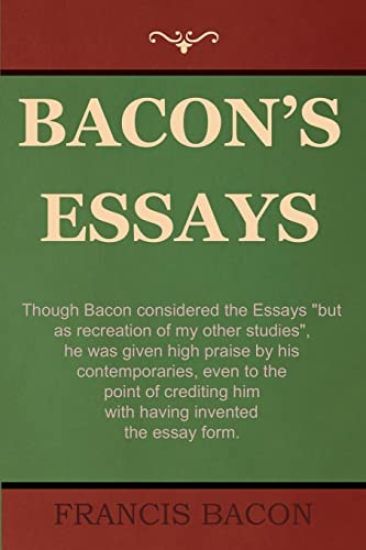
The Essays was the first published book by the philosopher, statesman and jurist Francis Bacon. The Essays are written in a wide range of styles, from the plain and unadorned to the epigrammatic. They cover topics drawn from both public and private life, and in each case the essays cover their topics systematically from a number of different angles, weighing one argument against another. Though Bacon considered the Essays "but as recreation of my other studies", he was given high praise by his contemporaries, even to the point of crediting him with having invented the essay form. The 19th century literary historian Henry Hallam wrote that "They are deeper and more discriminating than any earlier, or almost any later, work in the English language". Bacon's genius as a phrase-maker appears to great advantage in the later essays. In "Of Boldness" he wrote, "If the Hill will not come to Mahomet, Mahomet will go to the hill", which is the earliest known appearance of that proverb in print. The phrase "hostages to fortune" appears in the essay "Of Marriage and Single Life". The 1999 edition of The Oxford Dictionary of Quotations includes no less than 91 quotations from the Essays.
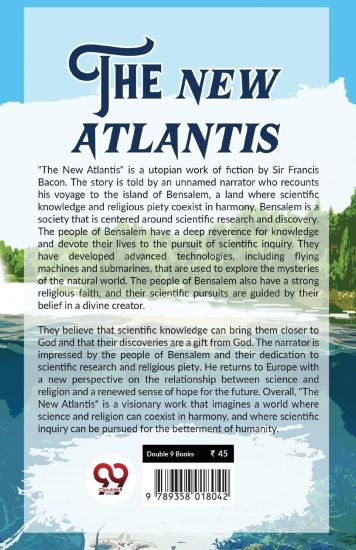
"The New Atlantis" is a utopian work of fiction by Sir Francis Bacon. The story is told by an unnamed narrator who recounts his voyage to the island of Bensalem, a land where scientific knowledge and religious piety coexist in harmony. Bensalem is a society that is centered around scientific research and discovery. The people of Bensalem have a deep reverence for knowledge and devote their lives to the pursuit of scientific inquiry. They have developed advanced technologies, including flying machines and submarines, that are used to explore the mysteries of the natural world. The people of Bensalem also have a strong religious faith, and their scientific pursuits are guided by their belief in a divine creator. They believe that scientific knowledge can bring them closer to God and that their discoveries are a gift from God. The narrator is impressed by the people of Bensalem and their dedication to scientific research and religious piety. He returns to Europe with a new perspective on the relationship between science and religion and a renewed sense of hope for the future. Overall, "The New Atlantis" is a visionary work that imagines a world where science and religion can coexist in harmony, and where scientific inquiry can be pursued for the betterment of humanity.
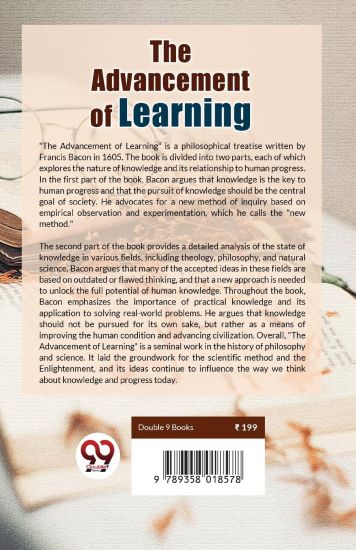
"The Advancement of Learning" is a philosophical treatise written by Francis Bacon in 1605. The book is divided into two parts, each of which explores the nature of knowledge and its relationship to human progress. In the first part of the book, Bacon argues that knowledge is the key to human progress and that the pursuit of knowledge should be the central goal of society. He advocates for a new method of inquiry based on empirical observation and experimentation, which he calls the "new method." The second part of the book provides a detailed analysis of the state of knowledge in various fields, including theology, philosophy, and natural science. Bacon argues that many of the accepted ideas in these fields are based on outdated or flawed thinking, and that a new approach is needed to unlock the full potential of human knowledge. Throughout the book, Bacon emphasizes the importance of practical knowledge and its application to solving real-world problems. He argues that knowledge should not be pursued for its own sake, but rather as a means of improving the human condition and advancing civilization. Overall, "The Advancement of Learning" is a seminal work in the history of philosophy and science. It laid the groundwork for the scientific method and the Enlightenment, and its ideas continue to influence the way we think about knowledge and progress today.

Reprint of the original, first published in 1859.

Reprint of the original, first published in 1859.

Reprint of the original, first published in 1860.

Reprint of the original, first published in 1860.

Reprint of the original, first published in 1860.
Reprint of the original, first published in 1860.
Essays moraux du très-honorable seigneur François Bacon
Francis Bacon
Hachette Livre Bnf
2022
pokkari