Kirjojen hintavertailu – 12 903 725 kirjaa ja 27 kauppaa

Kirjailija

Francis Fukuyama

Kirjat ja teokset yhdessä paikassa: 37 kirjaa, julkaisuja vuosilta 1995–2026, suosituimpiin kuuluu Der letzte Mensch. Vertaile teosten hintoja ja tarkista saatavuus suomalaisista kirjakaupoista.

37 kirjaa

Kirjojen julkaisuvuodet: 1995–2026.

Identitet

Identitet

Francis Fukuyama

Dreyers forl.
2019
sidottu
Over hele verden styres politikken i økende grad av identitetshensyn. Kategorier som nasjonalitet, religion, sekt, rase, etnisitet og kjønn har tatt over for bredere, mer inkluderende ideer om hvem vi er. Vi har bygget murer snarere enn bruer. I 2014 skrev Francis Fukuyama at amerikanske og globale institusjoner var i ferd med å forvitre etter hvert som mektige interessegrupper stadig fikk mer kontroll over staten. To år senere gikk spådommene hans i oppfyllelse da flere politiske outsidere kom til makten. Den økonomiske nasjonalismen og de autoritære tendensene deres truer nå med å destabilisere hele den internasjonale orden. Disse populistiske nasjonalistene søker en direkte karismatisk forbindelse med «folket», som de vanligvis definerer ut fra smale identitetskriterier med en uimotståelig appell til en avgrenset gruppe og som ekskluderer store deler av den samlede befolkningen. Identitet er en svært betimelig og .nødvendig bok: en skarp advarsel om at hvis vi ikke skaper en universell forståelse av menneskelig verdighet, fordømmer vi oss selv til kontinuerlig konflikt.

The End of History and the Last Man

The End of History and the Last Man

Francis Fukuyama

Audible Studios on Brilliance
2018
mp3 cd-levyllä
Ever since its first publication in 1992, The End of History and the Last Man has provoked controversy and debate. Francis Fukuyama's prescient analysis of religious fundamentalism, politics, scientific progress, ethical codes, and war is as essential for a world fighting fundamentalist terrorists as it was for the end of the Cold War. Now updated with a new afterword, The End of History and the Last Man is a modern classic.
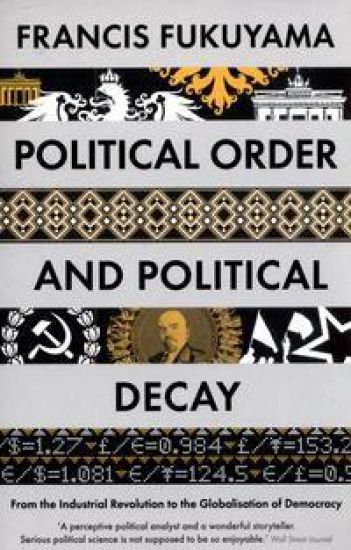
Political Order and Political Decay: From the Industrial Revolution to the Globalization of Democracy

Political Order and Political Decay: From the Industrial Revolution to the Globalization of Democracy

Francis Fukuyama

Farrar, Straus and Giroux
2015
nidottu

Halvin toimitettuna 22,00 €

The second volume of the bestselling landmark work on the history of the modern state Writing in The Wall Street Journal, David Gress called Francis Fukuyama's Origins of Political Order "magisterial in its learning and admirably immodest in its ambition." In The New York Times Book Review, Michael Lind described the book as "a major achievement by one of the leading public intellectuals of our time." And in The Washington Post, Gerard DeGrott exclaimed "this is a book that will be remembered. Bring on volume two." Volume two is finally here, completing the most important work of political thought in at least a generation. Taking up the essential question of how societies develop strong, impersonal, and accountable political institutions, Fukuyama follows the story from the French Revolution to the so-called Arab Spring and the deep dysfunctions of contemporary American politics. He examines the effects of corruption on governance, and why some societies have been successful at rooting it out. He explores the different legacies of colonialism in Latin America, Africa, and Asia, and offers a clear-eyed account of why some regions have thrived and developed more quickly than others. And he boldly reckons with the future of democracy in the face of a rising global middle class and entrenched political paralysis in the West. A sweeping, masterful account of the struggle to create a well-functioning modern state, Political Order and Political Decay is destined to be a classic.
Political Order and Political Decay

Political Order and Political Decay

Francis Fukuyama

Profile Books Ltd
2015
pokkari

Halvin toimitettuna 21,20 €

In The Origins of Political Order, Francis Fukuyama took us from the dawn of mankind to the French and American Revolutions. Here, he picks up the thread again in the second instalment of his definitive account of mankind's emergence as a political animal. This is the story of how state, law and democracy developed after these cataclysmic events, how the modern landscape - with its uneasy tension between dictatorships and liberal democracies - evolved and how in the United States and in other developed democracies, unmistakable signs of decay have emerged. If we want to understand the political systems that dominate and order our lives, we must first address their origins - in our own recent past as well as in the earliest systems of human government. Fukuyama argues that the key to successful government can be reduced to three key elements: a strong state, the rule of law and institutions of democratic accountability. This magisterial account is required reading for anyone wishing to know more about mankind's greatest achievements.
Political Order and Political Decay: From the Industrial Revolution to the Globalization of Democracy
The second volume of the bestselling landmark work on the history of the modern state Writing in The Wall Street Journal, David Gress called Francis Fukuyama's Origins of Political Order "magisterial in its learning and admirably immodest in its ambition." In The New York Times Book Review, Michael Lind described the book as "a major achievement by one of the leading public intellectuals of our time." And in The Washington Post, Gerard DeGrott exclaimed "this is a book that will be remembered. Bring on volume two." Volume two is finally here, completing the most important work of political thought in at least a generation. Taking up the essential question of how societies develop strong, impersonal, and accountable political institutions, Fukuyama follows the story from the French Revolution to the so-called Arab Spring and the deep dysfunctions of contemporary American politics. He examines the effects of corruption on governance, and why some societies have been successful at rooting it out. He explores the different legacies of colonialism in Latin America, Africa, and Asia, and offers a clear-eyed account of why some regions have thrived and developed more quickly than others. And he boldly reckons with the future of democracy in the face of a rising global middle class and entrenched political paralysis in the West. A sweeping, masterful account of the struggle to create a well-functioning modern state, Political Order and Political Decay is destined to be a classic.
The Origins of Political Order

The Origins of Political Order

Francis Fukuyama

Profile Books Ltd
2012
pokkari

Halvin toimitettuna 21,20 €

Nations are not trapped by their pasts, but events that happened hundreds or even thousands of years ago continue to exert huge influence on present-day politics. If we are to understand the politics that we now take for granted, we need to understand its origins. Francis Fukuyama examines the paths that different societies have taken to reach their current forms of political order. This book starts with the very beginning of mankind and comes right up to the eve of the French and American revolutions, spanning such diverse disciplines as economics, anthropology and geography. The Origins of Political Order is a magisterial study on the emergence of mankind as a political animal, by one of the most eminent political thinkers writing today.
The Origins of Political Order: From Prehuman Times to the French Revolution

The Origins of Political Order: From Prehuman Times to the French Revolution

Francis Fukuyama

Farrar, Straus and Giroux
2012
nidottu

Halvin toimitettuna 23,40 €

A landmark history of the origins of modern democratic societies by one of our most important political thinkers. A New York Times Notable Book for 2011 A Globe and Mail Best Books of the Year 2011 TitleA Kirkus Reviews Best Nonfiction of 2011 title Virtually all human societies were once organized tribally, yet over time most developed new political institutions which included a central state that could keep the peace and uniform laws that applied to all citizens. Some went on to create governments that were accountable to their constituents. We take these institutions for granted, but they are absent or are unable to perform in many of today's developing countries--with often disastrous consequences for the rest of the world. Francis Fukuyama, author of the bestselling The End of History and the Last Man and one of our most important political thinkers, provides a sweeping account of how today's basic political institutions developed. The first of a major two-volume work, The Origins of Political Order begins with politics among our primate ancestors and follows the story through the emergence of tribal societies, the growth of the first modern state in China, the beginning of the rule of law in India and the Middle East, and the development of political accountability in Europe up until the eve of the French Revolution. Drawing on a vast body of knowledge--history, evolutionary biology, archaeology, and economics--Fukuyama has produced a brilliant, provocative work that offers fresh insights on the origins of democratic societies and raises essential questions about the nature of politics and its discontents.
The New Invisible College

The New Invisible College

Caroline S. Wagner; Francis Fukuyama

Brookings Institution
2008
nidottu
"The twentieth century was the era of ""big science."" Driven by strategic rivalries and fierce economic competition, wealthy governments invested heavily in national science establishments. Direct funding for institutions like the National Science Foundation and high-visibility projects, such as the race to the moon, fueled innovation, growth, and national prestige. But the big science model left poorer countries out in the cold. Today the organization of science is undergoing a fundamental transformation. In T he New Invisible College, Caroline Wagner combines quantitative data and extensive interviews to map the emergence of global science networks and trace the dynamics driving their growth. She argues that the shift from big science to global networks creates unprecedented opportunities for developing countries to tap science's potential. Rather than squander resources in vain efforts to mimic the scientific establishments of the twentieth century, developing country governments can leverage networks by creating incentives for top-notch scientists to focus on research that addresses their concerns and by finding ways to tie knowledge to local problem solving. T he New Invisible College offers both a guidebook and a playbook for policymakers confronting these tasks."
Cleft Countries - Regional Political Divisions and Cultures in Post-Soviet Ukraine and Moldova

Cleft Countries - Regional Political Divisions and Cultures in Post-Soviet Ukraine and Moldova

Ivan Katchanovski; Francis Fukuyama

ibidem-Verlag, Jessica Haunschild u Christian Schon
2006
nidottu
During the "Orange Revolution" in Ukraine, the second largest country in Europe came close to a violent break-up similar to that in neighboring Moldova, which witnessed a violent secession of the Transdniestria region. Numerous elections, including the hotly contested 2004 presidential elections in Ukraine, and surveys of public opinion showed significant regional divisions in these post-Soviet countries. Western parts of Ukraine and Moldova, as well as the Muslim Crimean Tatars, were vocal supporters of independence, nationalist, and pro-Western parties and politicians. In contrast, Eastern regions, as well as the Orthodox Turkic-speaking Gagauz, consistently expressed pro-Russian and pro-Communist political orientations. Which factors-historical legacies, religion, economy, ethnicity, or political leadership-could explain these divisions? Why was Ukraine able to avoid a violent break-up, in contrast to Moldova? This is the first book to offer a systematic and comparative analysis of the regional political divisions in post-Soviet Ukraine and Moldova. The study examines voting behavior and political attitudes in two groups of regions: those which were under Russian, Ottoman, and Soviet rule; and those which were under Austro-Hungarian, Polish, Romanian, and Czechoslovak rule until World War I or World War II. This book attributes the regional political divisions to the differences in historical experience. This study helps us to better understand regional cleavages and conflicts, not only in Ukraine and Moldova, but also in other cleft countries.
The End of History and the Last Man

The End of History and the Last Man

Francis Fukuyama

FREE PRESS
2006
nidottu

Halvin toimitettuna 22,80 €

Enhanced by a new afterword dealing with the post-September 11th world, a provocative exploration of issues of human society and destiny answers such questions as, is there a direction to human history? does history have an end? and where are we now? Reprint. 25,00 first printing.
State Building

State Building

Francis Fukuyama

Profile Books Ltd
2005
pokkari

Halvin toimitettuna 16,80 €

Weak or failed states - where no government is in control - are the source of many of the world's most serious problems, from poverty, AIDS and drugs to terrorism. What can be done to help? The problem of weak states and the need for state-building has existed for many years, but it has been urgent since September 11 and Afghanistan and Iraq. The formation of proper public institutions, such as an honest police force, uncorrupted courts, functioning schools and medical services and a strong civil service, is fraught with difficulties. We know how to help with resources, people and technology across borders, but state building requires methods that are not easily transported. The ability to create healthy states from nothing has suddenly risen to the top of the world agenda. State building has become a crucial matter of global security. In this hugely important book, Francis Fukuyama explains the concept of state-building and discusses the problems and causes of state weakness and its national and international effects.
Our Posthuman Future

Our Posthuman Future

Francis Fukuyama

Profile Books Ltd
2003
pokkari

Halvin toimitettuna 19,40 €

Is a baby whose personality has been chosen from a gene supermarket still a human? If we choose what we create what happens to morality? Is this the end of human nature? The dramatic advances in DNA technology over the last few years are the stuff of science fiction. It is now not only possible to clone human beings it is happening. For the first time since the creation of the earth four billion years ago, or the emergence of mankind 10 million years ago, people will be able to choose their children's' sex, height, colour, personality traits and intelligence. It will even be possible to create 'superhumans' by mixing human genes with those of other animals for extra strength or longevity. But is this desirable? What are the moral and political consequences? Will it mean anything to talk about 'human nature' any more? Is this the end of human beings? Our Posthuman Future is a passionate analysis of the greatest political and moral problem ever to face the human race.
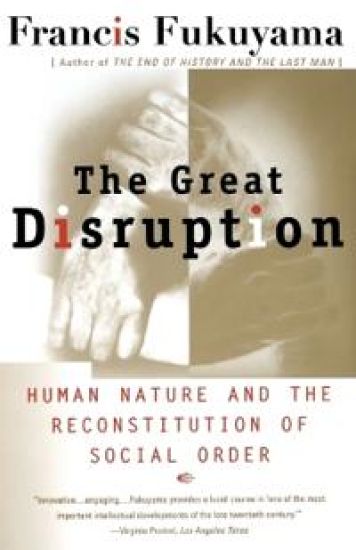
The Great Disruption: Human Nature and the Reconstitution of Social Order
In the past thirty years, the United States has undergone a profound transformation in its social structure: Crime has increased, trust has declined, families have broken down, and individualism has triumphed over community. Has the Great Disruption of recent decades rent the fabric of American society irreparably? In this brilliant and sweeping work of social, economic, and moral analysis, Francis Fukuyama shows that even as the old order has broken apart, a new social order is already taking its place. The Great Disruption forges a new model for understanding the Great Reconstruction that is under way.
Trust

Trust

Francis Fukuyama

The Free Press
1996
pokkari

Halvin toimitettuna 23,10 €

Explains the relationship between culture and economics and predicts which countries will win the ongoing battle for economic dominance.