Kirjojen hintavertailu – 12 903 724 kirjaa ja 27 kauppaa

Kirjailija

Francis M. Deng

Kirjat ja teokset yhdessä paikassa: 6 kirjaa, julkaisuja vuosilta 1992–2002, suosituimpiin kuuluu A Strategic Vision for Africa. Vertaile teosten hintoja ja tarkista saatavuus suomalaisista kirjakaupoista.

6 kirjaa

Kirjojen julkaisuvuodet: 1992–2002.

A Strategic Vision for Africa

A Strategic Vision for Africa

Francis M. Deng; I. William Zartman

Brookings Institution
2002
nidottu
"Increasingly marginalized since the end of the Cold War, the continent of Africa is struggling to identify both the root causes and possible solutions to the maladies that continue to plague it. The problems read like a laundry list of misrule in the aftermath of decolonization: rampant political corruption, internecine wars, widespread disease, underdevelopment, and economic collapse. In the early 1990s, a group of statesmen, academics, and civil leaders from all over Africa gathered to put together a comprehensive plan to make the continent become less dependent on the rest of the world and prepare it to compete in the new globalizing economy. Those who gathered to write what would come to be known as the Kampala Document envisioned an organization which would succeed where the Organization for African Unity (OAU) had failed. This new organization, the Conference on Security, Stability, Development and Cooperation in Africa (CSSDCA), will provide a forum for discussion of democratization, security issues, and sustainable development. This new book by noted scholars Francis Deng and I. William Zartman provides a ""mid-course"" appraisal of the progress of the CSSDCA, as well as charting its future in relation to other regional organizations. With a preface by President Olusegun Obasanjo, this book will undoubtedly become an important tool in understanding Africa's present and future. Francis Deng is a nonresident senior fellow in the Foreign Policy Studies program at the Brookings Institution. His books include Masses in Flight: The Global Crisis of Internal Displacement (Brookings, 1998, with Roberta Cohen), The Forsaken People: Case Studies of the Internally Displaced (Brookings, 1998, co-edited with Roberta Cohen). I. William Zartman is Jacob Blaustein Professor of International Organizations and Conflict Resolution and Director of African Studies at the Paul H. Nitze School of Advanced International Studies."
Masses in Flight

Masses in Flight

Roberta Cohen; Francis M. Deng

Brookings Institution
1998
nidottu
"Since the end of the Cold War, increasing numbers of people have been forced to leave their homes as a result of armed conflict, internal strife, and systematic violations of human rights. Whereas refugees crossing national borders benefit from an established system of international protection and assistance, those who are displaced internally suffer from an absence of legal or institutional bases for their protection and assistance from the international community. This book analyzes the causes and consequences of displacement, including its devastating impact both within and beyond the borders of affected countries. It sets forth strategies for preventing displacement, a special legal framework tailored to the needs of the displaced, more effective institutional arrangements at the national, regional, and international levels, and increased capacities to address the protection, human rights, and reintegration and development needs of the displaced."
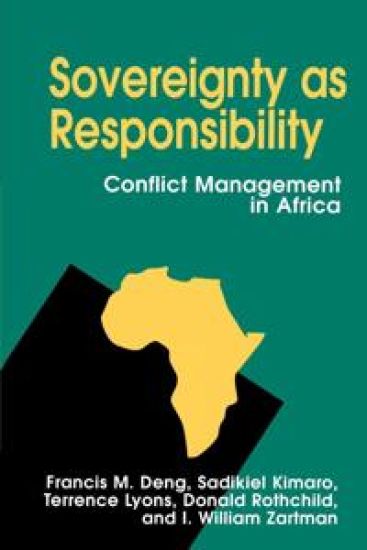
Sovereignty as Responsibility

Sovereignty as Responsibility

Francis M. Deng; Sadikiel Kimaro; Terrence Lyons

Brookings Institution
1996
nidottu
"The authors assert that sovereignty can no longer be seen as a protection against interference, but as a charge of responsibility where the state is accountable to both domestic and external constituencies. In internal conflicts in Africa, sovereign states have often failed to take responsibility for their own citizens' welfare and for the humanitarian consequences of conflict, leaving the victims with no assistance. This book shows how that responsibility can be exercised by states over their own population, and by other states in assistance to their fellow sovereigns. Sovereignty as Responsibility presents a framework that should guide both national governments and the international community in discharging their respective responsibilities. Broad principles are developed by examining identity as a potential source of conflict, governance as a matter of managing conflict, and economics as a policy field for deterring conflict. Considering conflict management, political stability, economic development, and social welfare as functions of governance, the authors develop strategies, guidelines, and roles for its responsible exercise. Some African governments, such as South Africa in the 1990s and Ghana since 1980, have demonstrated impressive gains against these standards, while others, such as Rwanda, Somalia, Liberia, Nigeria, and Sudan, have failed. Opportunities for making sovereignty more responsible and improving the management of conflicts are examined at the regional and international levels. The lessons from the mixed successes of regional conflict management actions, such as the West African intervention in Liberia, the East African mediation in Sudan, and international efforts to urge talks to end the conflict in Angola, indicate friends and neighbors outside the state in conflict have important roles to play in increasing sovereign responsibility. Approaching conflict management from the perspective of the responsibilities of sovereignty provides a framework for evaluating government accountability. It proposes standards that guide performance and sharpen tools of conflict prevention rather than simply making post-hoc judgments on success or failure. The authors demonstrate that sovereignty as responsibility is both a national obligation and a global imperative."
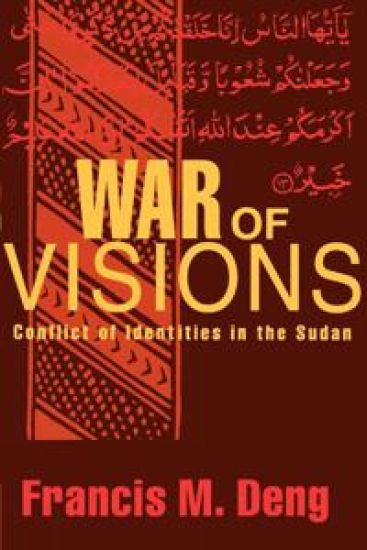
War of Visions

War of Visions

Francis M. Deng

Brookings Institution
1995
nidottu
"The civil war that has intermittently raged in the Sudan since independence in 1956 is, according to Francis Deng, a conflict of contrasting and seemingly incompatible identities in the Northern and Southern parts of the country. Identity is seen as a function of how people identify themselves and are identified in racial, ethnic, cultural, linguistic, and religious terms. The identity question related to how such concepts determine or influence participation and distribution in the political, economic, social, and cultural life of the country. War of Visions aims at shedding light on the anomalies of the identity conflict. The competing models in the Sudan are the Arab-Islamic mold of the North, representing two-thirds of the country in territory and population, and the remaining Southern third, which is indigenously African in race, ethnicity, culture, and religion, with an educated Christianized elite. But although the North is popularly defined as racially Arab, the people are a hybrid of Arab and African elements, with the African physical characteristics predominating in most tribal groups. This configuration is the result of a historical process that stratified races, cultures, and religions, and fostered a ""passing"" into the Arab-Islamic mold that discriminated against the African race and cultures. The outcome of this process is a polarization that is based more on myth than on the realities of the situation. The identity crisis has been further complicated by the fact that Northerners want to fashion the country on the basis of their Arab- Islamic identity, while the South is decidedly resistant. Francis Deng presents three alternative approaches to the identity crisis. First, he argues that by bringing to the surface the realities of the African elements of identity in the North-- thereby revealing characteristics shared by all Sudanese--a new basis for the creation of a common identity could be established that fosters equitable participation and distribution. Second, if the issues that divide prove insurmountable, Deng argues for a framework of diversified coexistence within a loose federal or confederate arrangement. Third, he concludes that partitioning the country along justified borders may be the only remaining option to end the devastating conflict."
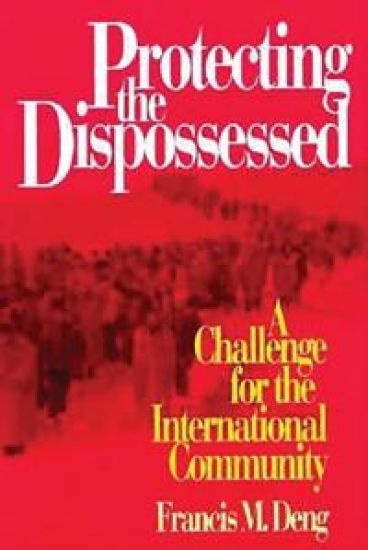
Protecting the Dispossessed

Protecting the Dispossessed

Francis M. Deng

Brookings Institution
1993
nidottu
"An estimated 25 million people worldwide are internally displaced—a significantly larger population than the 18 million refugees. Victims of civil wars, forced relocation, communal violence, natural and ecological disasters, and gross violations of human rights, they lack such human necessities as food, shelter, clothing, safety, basic health, and education. But because they remain inside their countries, they don't receive the same protection and assistance from the international community as those who cross borders and become refugees. Their plight, however, is drawing increasing international attention. In March 1992, Francis Deng was appointed Special Representative of the United Nations Secretary-General to study this harrowing situation. In this book, a substantially revised version of his report to the UN, Deng examines the causes and consequences of internal displacement, the legal standards for protection and assistance, enforcement mechanisms, the prevailing conditions in the affected countries, and the urgent need for an international response. In a compelling first-person narrative, Protecting the Dispossessed follows Deng's investigation and is based on interviews and information from governments, international organizations, individuals, and visits to several countries in Europe, Africa, and Latin America. Deng argues that sovereignty entails a responsibility to ensure the safety and welfare of the citizens and to protect fundamental human rights; the international community must uphold this standard and make violators accountable. While he acknowledges that steps are being taken in the right direction, he maintains that there is still much to be done. He presents a bold proposal, one that requires substantial changes in the international system, in the politics of major governments, and in the relations between states. He proposes a three-phase strategy aimed at monitoring conditions worldwide: to detect impending crises, alert the international community to make a timely intervention, and where preventive measures fail, to mobilize collective international action to remedy or at least alleviate the situation."
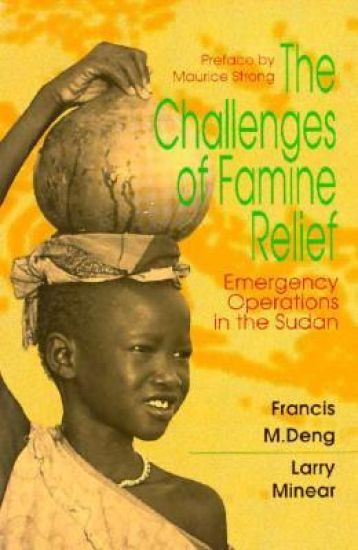
The Challenges of Famine Relief

The Challenges of Famine Relief

Francis M. Deng; Larry Minear

Brookings Institution
1992
nidottu
"For nearly a decade, international efforts to combat famine and food shortages around the globe have concentrated on the critical situations in sub-Saharan Africa. In the Sudan, the largest country in Africa, prolonged drought, complicated by civil strife and debilitating economic problems, has caused widespread human suffering. The Sudan illustrates the proverbial worst-case scenario in which urgent food needs have been denied, food has been used as a weapon, and outside assistance has been obstructed. The Challenges of Famine Relief focuses on the two famine emergencies in the Sudan in the 1980s—the great African drought-related famine of 1984-86 and the conflict-related famine that afflicted the southern Sudan in 1988-91. Francis Deng and Larry Minear analyze the historical and political setting and the response by Sudan authorities and the international community. The book outlines four problem areas exemplified in the response to each crisis: the external nature of famine relief, the relationship between relief activities and endemic problems, the coordination of such activities, and the ambivalence of the results. The authors identify the many difficulties inherent in providing emergency relief to populations caught in circumstances of life-threatening famine. They show how such famine emergencies reflect the most extreme breakdown of social order and present the most compelling imperatives for international action. Deng and Minear also discuss how the international community, alerted by the media and mobilized by the Ethiopian famine, moved to fill the moral void left by the government and how outside organizations worked together to pressure Sudan's political authorities to be more responsive to these tragedies. Looking ahead, the authors highlight the implications for future involvement in humanitarian initiatives in a new world order. As recent developments in Eastern Europe and the former Soviet Union demonstrate, such humanitarian challenges of global dimensions are no longer confined to third world countries. As the international community apportions limited resources among a growing number of such challenges, more effective responses to crises such as those described in this book are imperative."