Kirjojen hintavertailu – 12 859 819 kirjaa ja 27 kauppaa
Kirjailija
Francisco Suarez
Kirjat ja teokset yhdessä paikassa: 26 kirjaa, julkaisuja vuosilta 1976–2025, suosituimpiin kuuluu R.p. Francisci Suarez ... Metaphysicarum Disputationum ... Pars Prima. Vertaile teosten hintoja ja tarkista saatavuus suomalaisista kirjakaupoista.
Nimi esiintyy myös muodoissa: Francisco Suàrez, Francisco Suárez
De Divina Gratia, a significant theological work by Francisco Su rez, explores the intricacies of divine grace within the Catholic tradition. Presented in Italian, this edition offers readers a profound exploration of Su rez's teachings on grace, predestination, and free will. Jean-Baptiste Malou contributes to the understanding of this complex subject, making it accessible to contemporary scholars and theologians. Su rez's work remains a cornerstone of Catholic theological discourse, offering insights into the relationship between God's grace and human agency. This edition is valuable for those studying the history of theology, Catholic doctrine, and the philosophy of religion. This work has been selected by scholars as being culturally important, and is part of the knowledge base of civilization as we know it. This work was reproduced from the original artifact, and remains as true to the original work as possible. Therefore, you will see the original copyright references, library stamps (as most of these works have been housed in our most important libraries around the world), and other notations in the work. This work is in the public domain in the United States of America, and possibly other nations. Within the United States, you may freely copy and distribute this work, as no entity (individual or corporate) has a copyright on the body of the work. As a reproduction of a historical artifact, this work may contain missing or blurred pages, poor pictures, errant marks, etc. Scholars believe, and we concur, that this work is important enough to be preserved, reproduced, and made generally available to the public. We appreciate your support of the preservation process, and thank you for being an important part of keeping this knowledge alive and relevant.
Francisco Suárez (1548-1617) was one of the most important philosophers and theologians of Early Modern Scholasticism. Although Suárez spent most of his academic career as a professor of theology, he is better known today for his Metaphysical Disputations (Salamanca, 1597). The present volume contains a facing-page English translation of Metaphysical Disputations III & IV. Metaphysical Disputation III offers a general treatment of the properties of being as such, while Metaphysical Disputation IV deals with one of these properties in particular, transcendental unity. The Latin text contained in this volume introduces a significant number of corrections to the text of the Vivès edition, the one standardly used by scholars of Suárez, and thus more faithfully reproduces the text of the first edition. The volume also contains a lengthy introduction that provides a detailed survey of the disputations' principal claims and arguments.
Francisco Suárez (1548–1617) was one of the most important philosophers and theologians of early modern Aristotelian scholasticism. Although Suárez spent most of his academic career as a professor of theology, he is better known today for his Metaphysical Disputations (Salamanca, 1597). The present volume contains a facing-page English translation of Metaphysical Disputation II, which is devoted to the nature of real being, the subject of metaphysics. In it, Suárez is especially concerned, first, to argue there is a single nature of being common to all real beings, and second, to show what this nature consists in. The Latin text contained in this volume introduces a significant number of corrections to the text of the Vivès edition, the one standardly used by scholars of Suárez, and thus more faithfully reproduces the text of the first edition. The volume also contains a lengthy introduction that provides a detailed survey of the disputation's principal claims and arguments.
Francisco Suárez (1548-1617) was one of the most important philosophers and theologians of Early Modern Scholasticism. Although Suárez spent most of his academic career as a professor of theology, he is better known today for his Metaphysical Disputations (Salamanca, 1597). The present volume contains a facing-page English translation of Metaphysical Disputation I, which is introductory and devoted to the nature of metaphysics itself. In it, Suárez first specifies this science’s object and nature (Sections 1 and 2) and then discusses its unity (Section 3), its end, utility and functions (Section 4), its status as the most perfect natural science and true wisdom (Section 5), and finally the thesis that it is the science most of all desired by means of a natural appetite (Section 6). Those interested in late scholastic conceptions of metaphysics and their influence on the better known metaphysical systems of the seventeenth century – e.g., Descartes’s – will find the volume especially useful. The Latin text contained in this volume introduces a significant number of corrections to the text of the Vivès edition, the one standardly used by scholars of Suárez, and thus more faithfully reproduces the text of the first edition. The volume also contains a lengthy introduction that provides a detailed survey of the disputation’s principal claims and arguments.
In seiner Vorlesung "Uber das Willentliche und das Unwillentliche" unternimmt Suarez, der als Autor der Fruhen Neuzeit in seinem Werk wie nur wenige andere Autoren seiner Zeit die mittelalterliche Philosophie und Theologie systematisch aufnimmt und neu verarbeitet, den Versuch, die Willenstheorien der Patristik, der Hochscholastik und der fruhneuzeitlichen Aristotelesrezeption miteinander zu verknupfen. Das Werk entstammt einer Vorlesungsreihe, die Suarez zwischen 1578 und 1585 am Collegium Romanum auf Einladung von Papst Gregor XIII. abhielt. In der Diskussion der Willensfreiheit, der Rolle von Zwang oder Gewalt und den verschiedenen Arten des Willentlichen legt Suarez den Grundstein fur seine spatere Moralphilosophie.
English summary: In the second book of De legibus ac Deo legislatore (1612), the summa of his theology of law, Francisco Suarez (1548-1617) explains and develops his concept of eternal and natural law as well of international law. Suarez manages a critical revision of the theories of eternal law that have been presented by Augustine and Thomas Aquinas and thus a progressive development of medieval theology of law. Concerning the natural and international law debate that will be intensified by Hugo Grotius and Thomas Hobbes and held controversial to Christian Wolff, Suarez already formulates genuine conceptions that promote the early modern development of political theory until the 18th century. German description: Im zweiten Buch seiner rechtstheologischen Summe, De legibus ac Deo legislatore aus dem Jahre 1612, entwickelt Francisco Suarez (1548-1617) seine Konzeption des ewigen Gesetzes, des Naturrechts und des Volkerrechts. Dabei gelingt Suarez die kritische Uberarbeitung der lex aeterna-Theorien von Augustinus und Thomas von Aquin und damit eine Weiterentwicklung mittelalterlicher Rechtstheologie. Er formuliert daruber hinaus fur die im 17. Jahrhundert mit Hugo Grotius und Thomas Hobbes aufbrechenden und bis zu Christian Wolff kontrovers ausgetragenen Naturrechts- und Volkerrechtsdebatten genuin eigenstandige Konzeptionen, die die fruhneuzeitliche Entwicklung der politischen Theorie bis ins 18. Jahrhundert befordern.
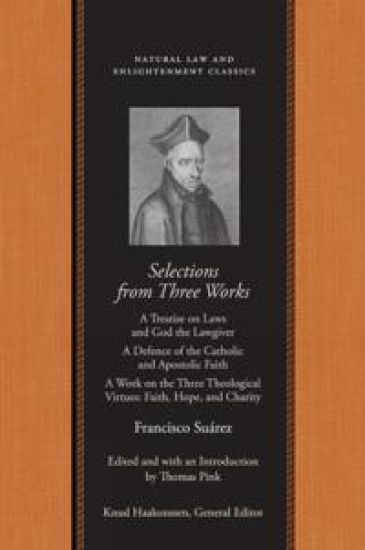
Francisco Suárez was a principal figure in the transition from scholastic to modern natural law, summing up a long and rich tradition and providing much material both for adoption and controversy in the seventeenth century and beyond. Most of the selections translated in this volume are from 'On the Laws and God the Law-Giver (De legibus ac Deo legislatore, 1612)', a work that is considered one of Suárez' greatest achievements. Working within the framework originally elaborated by Thomas Aquinas, Suárez treated humanity as the subject of four different laws, which together guide human beings toward the ends of which they are capable. Suárez achieved a double objective in his systematic account of moral activity. First, he examined and synthesized the entire scholastic heritage of thinking on this topic, identifying the key issues of debate and the key authors who had formulated the different positions most incisively. Second, he went beyond this heritage of authorities to present a new account of human moral action and its relationship to the law. Treading a fine line between those to whom moral directives are purely a matter of reason and those to whom they are purely a matter of a commanding will, Suárez attempted to show how both human reason and the command of the lawgiver dictate the moral space of human action.
Francisco Suárez was a principal figure in the transition from scholastic to modern natural law, summing up a long and rich tradition and providing much material both for adoption and controversy in the seventeenth century and beyond. Most of the selections translated in this volume are from 'On the Laws and God the Law-Giver (De legibus ac Deo legislatore, 1612)', a work that is considered one of Suárez' greatest achievements. Working within the framework originally elaborated by Thomas Aquinas, Suárez treated humanity as the subject of four different laws, which together guide human beings toward the ends of which they are capable. Suárez achieved a double objective in his systematic account of moral activity. First, he examined and synthesized the entire scholastic heritage of thinking on this topic, identifying the key issues of debate and the key authors who had formulated the different positions most incisively. Second, he went beyond this heritage of authorities to present a new account of human moral action and its relationship to the law. Treading a fine line between those to whom moral directives are purely a matter of reason and those to whom they are purely a matter of a commanding will, Suárez attempted to show how both human reason and the command of the lawgiver dictate the moral space of human action.