

Kirjailija
François Jullien
Kirjat ja teokset yhdessä paikassa: 38 kirjaa, julkaisuja vuosilta 1995–2026, suosituimpiin kuuluu Reopening Possibilities. Vertaile teosten hintoja ja tarkista saatavuus suomalaisista kirjakaupoista.
Nimi esiintyy myös muodoissa: Francois Jullien
38 kirjaa
Kirjojen julkaisuvuodet: 1995–2026.
François Jullien, the leading philosopher and specialist in Chinese thought, has always aimed at building on inter-cultural relations between China and the West. In this new book he focuses on the following questions: Do universal values exist? Is dialogue between cultures possible? To answer these questions, he retraces the history of the concept of the universal from its invention as an aspect of Roman citizenship, through its neutralization in the Christian idea of salvation, to its present day manifestations. This raises the question of whether the search for the universal is a uniquely Western preoccupation: do other cultures, like China, even have a notion of the universal, and if so, how does it differ from ours? Having considered the meaning of the concept in the East and West, Jullien argues that, if communication between cultures is to be meaningful, facile assumptions of universal values and complacent relativism need to be examined. It follows, therefore, that dialogue between cultures should not begin with issues of identity and difference, but rather by considering divergence and profusion. By no longer simply assuming universality, we allow for greater self-reflection. This wide-ranging and engaging study will be of particular interest to students and scholars of philosophy and of Chinese culture and society. It will also appeal to a wider readership interested in contemporary thought and the challenges of communication between East and West.
François Jullien, the leading philosopher and specialist in Chinese thought, has always aimed at building on inter-cultural relations between China and the West. In this new book he focuses on the following questions: Do universal values exist? Is dialogue between cultures possible? To answer these questions, he retraces the history of the concept of the universal from its invention as an aspect of Roman citizenship, through its neutralization in the Christian idea of salvation, to its present day manifestations. This raises the question of whether the search for the universal is a uniquely Western preoccupation: do other cultures, like China, even have a notion of the universal, and if so, how does it differ from ours? Having considered the meaning of the concept in the East and West, Jullien argues that, if communication between cultures is to be meaningful, facile assumptions of universal values and complacent relativism need to be examined. It follows, therefore, that dialogue between cultures should not begin with issues of identity and difference, but rather by considering divergence and profusion. By no longer simply assuming universality, we allow for greater self-reflection. This wide-ranging and engaging study will be of particular interest to students and scholars of philosophy and of Chinese culture and society. It will also appeal to a wider readership interested in contemporary thought and the challenges of communication between East and West.

The Great Image Has No Form, or On the Nonobject through Painting
François Jullien
University of Chicago Press
2012
nidottu
In premodern China, elite painters used imagery not to mirror the world around them, but to evoke unfathomable experience. Considering their art alongside the philosophical traditions that inform it, "The Great Image Has No Form" explores the "nonobject" - a notion exemplified by paintings that do not seek to represent observable surroundings. Francois Jullien argues that this nonobjectifying approach stems from the painters' deeply held belief in a continuum of existence, in which art is not distinct from reality. Contrasting this perspective with the Western notion of art as separate from the world it represents, Jullien investigates the theoretical conditions that allow us to apprehend, isolate, and abstract objects. His comparative method lays bare the assumptions of Chinese and European thought, revitalizing the questions of what painting is, where it comes from, and what it does. Provocative and intellectually vigorous, this sweeping inquiry introduces new ways of thinking about the relationship of art to the ideas in which it is rooted.
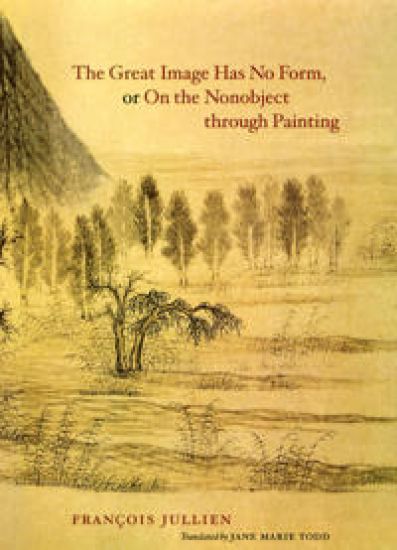
The Great Image Has No Form, or On the Nonobject through Painting
François Jullien
University of Chicago Press
2009
sidottu
In premodern China, elite painters used imagery not to mirror the world around them, but to evoke unfathomable experience. Considering their art alongside the philosophical traditions that inform it, "The Great Image Has No Form" explores the 'nonobject' - a notion exemplified by paintings that do not seek to represent observable surroundings. Francois Jullien argues that this nonobjectifying approach stems from the painters' deeply held belief in a continuum of existence, in which art is not distinct from reality. Contrasting this perspective with the Western notion of art as separate from the world it represents, Jullien investigates the theoretical conditions that allow us to apprehend, isolate, and abstract objects. His comparative method lays bare the assumptions of Chinese and European thought, revitalizing the questions of what painting is, where it comes from, and what it does. Provocative and intellectually vigorous, this sweeping inquiry introduces new ways of thinking about the relationship of art to the ideas in which it is rooted.
A philosophical inquiry into how to "feed life," or nourish it, draws from early Chinese thinker Zhuanghi to explore notions of breath, energy, and immanence. The philosophical tradition in the West has always subjected life to conceptual divisions and questions about meaning. In Vital Nourishment, Francois Jullien contends that although this process has given rise to a rich history of inquiry, it proceeds too fast. In their anxiety about meaning, Western thinkers since Plato have forgotten simply to experience life. In this installment of his continuing project of plumbing the philosophical divide between Eastern and Western thought, Jullien slows down, and, using the third and fourth century B. C. E. Chinese thinker Zhuanghi as a foil, begins to think about life from a point outside of Western inquiry. The question of how to "feed life," or nourish it, is the point of departure for the Chinese tradition that Jullien locates in Zhuanghi. Life passes through each of us, and we have a duty to become amenable to its ebbs and flows. We must cultivate a sense of being adequate to it so that we can house it. Exploring notions of breath, energy, and immanence, Jullien reopens a vibrant space of intellectual exchange between East and West. In doing so, he refuses to commit to a rigid framework of meaning, and his text unfolds as an elegant process that mirrors the very type of thought he explores. Pointing out that it seems intellectually and politically imperative today to reinvigorate Western thought with ideas from the East, Jullien seeks to create a space of mutual inquiry that maintains the integrity of both Eastern and Western thinking. Vital Nourishment is both a rich intellectual historical journey and a text very much attuned to the philosophical politics of the present.
A consideration of blandness not as the absence of defining qualities but as the harmonious union of all potential values-an infinite opening into human experience. Already translated into six languages, Francois Jullien's In Praise of Blandness has become a classic. Appearing for the first time in English, this groundbreaking work of philosophy, anthropology, aesthetics, and sinology is certain to stir readers to think and experience what may at first seem impossible: the richness of a bland sound, a bland meaning, a bland painting, a bland poem. In presenting the value of blandness through as many concrete examples and original texts as possible, Jullien allows the undifferentiated foundation of all things-blandness itself-to appear. After completing this book, readers will reevaluate those familiar Western lines of thought where blandness is associated with a lack-the undesirable absence of particular, defining qualities. Jullien traces the elusive appearance and crucial value of blandness from its beginnings in the Daoist and Confucian traditions to its integration into literary and visual aesthetics in the late-medieval period and beyond. Gradually developing into a positive quality in Chinese aesthetic and ethical traditions, the bland comprises the harmonious and unnameable union of all potential values, embodying a reality whose very essence is change and providing an infinite opening into the breadth of human expression and taste. More than just a cultural history, In Praise of Blandness invites those both familiar and unfamiliar with Chinese culture to explore the resonances of the bland in literary, philosophical, and religious texts and to witness how all currents of Chinese thought-Confucianism, Daoism, Buddhism-converge in harmonious accord.

Vortrag vor Managern über Wirksamkeit und Effizienz in China und im Westen
François Jullien
Merve Verlag GmbH
2006
nidottu
Philosophie und Sinologie, Fran?ois Jullien präsentiert hier einen Vortrag, den er vor Unternehmensführern und im Bereich des Managements gehalten hat. Einerseits ist die europäische Auffassung der Wirksamkeit mit der Erstellung von Modellen, sowie mit der Zweckbestimmung verbunden und hat die Aktion bis hin zum Heldentum zur Folge; andererseits stützt sich das chinesische Denken der indirekten und diskreten Effizienz auf das Potential der Situation und löst ?stillschweigende Wandlungen? aus, die ohne Aufsehen vonstatten gehen und nicht einmal den Status eines Ereignisses haben. Anhand dieses Unterschieds soll die Natur der Effektivität untersucht werden, beziehungsweise, wie es der menschlichen Intervention gelingt, sich an die Neigung der Dinge anzuschließen, und wie sie in diese eingeht. Dieser Ansatz bemüht sich also, die Kunst, Situationen zu beeinflussen, und die Ausübung der Philosophie so wenig wie möglich voneinander zu trennen. Daraus ergeben sich Folgerungen für die Interpretation der Geschichte des 20. Jahrhunderts und für die künftige Geopolitik - und Geoethik. Fran?ois Jullien ist Professor an der Universität Paris 7 und Leiter des Institut de la pens?e contemporaine.
An exploration of the central role of indirect modes of expression in ancient China. In what way do we benefit from speaking of things indirectly? How does such a distancing allow us better to discover-and describe-people and objects? How does distancing produce an effect? What can we gain from approaching the world obliquely? In other words, how does detour grant access? Thus begins Francois Jullien's investigation into the strategy, subtlety, and production of meaning in ancient and modern Chinese aesthetic and political texts and events. Moving between the rhetorical traditions of ancient Greece and China, Jullien does not attempt a simple comparison of the two civilizations. Instead, he uses the perspective provided by each to gain access into a culture considered by many Westerners to be strange-"It's all Chinese to me"-and whose strangeness has been eclipsed through the assumption of its familiarity. He also uses the comparison to shed light on the role of Greek thinking in Western civilization. Jullien rereads the major texts of Chinese thought-The Book of Songs, Confucius's Analects, and the work of Mencius and Lao-Tse. He addresses the question of oblique, indirect, and allusive meaning in order to explore how the techniques of detour provide access to subtler meanings than are attainable through direct approaches. Indirect speech, Jullien concludes, yields a complex mode of indication, open to multiple perspectives and variations, infinitely adaptable to particular situations and contexts. Concentrating on that which is not said, or which is spoken only through other means, Jullien traces the benefits and costs of this rhetorical strategy in which absolute truth is absent.
In this highly insightful analysis of Western and Chinese concepts of efficacy, Francois Jullien subtly delves into the metaphysical preconceptions of the two civilizations to account for diverging patterns of action in warfare, politics, and diplomacy. He shows how Western and Chinese stategies work in several domains (the battle-field, for example) and analyzes two resulting acts of war. The Chinese strategist manipulates his own troops and the enemy to win a battle without waging war and to bring about victory effortlessly. Efficacity in China is thus conceived of in terms of transformation (as opposed to action) and manipulation, making it closer to what is understood as efficacy in the West. Jullien's brilliant interpretations of an array of recondite texts are key to understanding our own conceptions of action, time, and reality in this foray into the world of Chinese thought. In its clear and penetrating characterization of two contrasting views of reality from a heretofore unexplored perspective, Treatise on Efficacy will be of central importance in the intellectual debate between East and West.
A consideration of blandness not as the absence of defining qualities but as the harmonious union of all potential values-an infinite opening into human experience. Already translated into six languages, Francois Jullien's In Praise of Blandness has become a classic. Appearing for the first time in English, this groundbreaking work of philosophy, anthropology, aesthetics, and sinology is certain to stir readers to think and experience what may at first seem impossible: the richness of a bland sound, a bland meaning, a bland painting, a bland poem. In presenting the value of blandness through as many concrete examples and original texts as possible, Jullien allows the undifferentiated foundation of all things-blandness itself-to appear. After completing this book, readers will reevaluate those familiar Western lines of thought where blandness is associated with a lack-the undesirable absence of particular, defining qualities. Jullien traces the elusive appearance and crucial value of blandness from its beginnings in the Daoist and Confucian traditions to its integration into literary and visual aesthetics in the late-medieval period and beyond. Gradually developing into a positive quality in Chinese aesthetic and ethical traditions, the bland comprises the harmonious and unnameable union of all potential values, embodying a reality whose very essence is change and providing an infinite opening into the breadth of human expression and taste. More than just a cultural history, In Praise of Blandness invites those both familiar and unfamiliar with Chinese culture to explore the resonances of the bland in literary, philosophical, and religious texts and to witness how all currents of Chinese thought-Confucianism, Daoism, Buddhism-converge in harmonious accord.


In this book, his first to appear in English, French sinologist Francois Jullien uses the Chinese concept of shi-meaning disposition or circumstance, power or potential-as a touchstone to explore Chinese culture and to uncover the intricate structure underlying Chinese modes of thinking. In this strikingly original contribution to our understanding of Chinese philosophy, Francois Julien, a French sinologist whose work has not yet appeared in English, uses the Chinese concept of shi-meaning disposition or circumstance, power or potential-as a touchstone to explore Chinese culture and to uncover the intricate and coherent structure underlying Chinese modes of thinking. A Hegelian prejudice still haunts studies of ancient Chinese civilization: Chinese thought, never able to evolve beyond a cosmological point of view, with an indifference to any notion of telos, sought to interpret reality solely on the basis of itself. In this groundbreaking study, prejudices toward the simplicity and "naivete" of Chinese thought, Hegelian and otherwise, are dismantled one by one to reveal the intricate and coherent structure underlying Chinese modes of thinking and representing reality. Jullien begins with a single Chinese term, shi, whose very ambivalence and disconcerting polysemy, on the one hand, and simple efficacy, on the other, defy the order of a concept. Yet shi insinuates itself into the ordering and conditioning of reality in all its manifold and complex representations. Because shi neither gave rise to any coherent, general analysis nor figured as one of the major concepts among Chinese thinkers, Jullien follows its appearance from one field to another: from military strategy to politics; from the aesthetics of calligraphy and painting to the theory of literature; and from reflection on history to "first philosophy." At the point where these various domains intersect, a fundamental intuition assumed self-evident for centuries emerges, namely, that reality - every kind of reality - may be perceived as a particular deployment or arrangement of things to be relied upon and worked to one's advantage. Art or wisdom, as conceived by the Chinese, lies in strategically exploiting the propensity that emanates from this particular configuration of reality.

In this book, his first to appear in English, French sinologist Francois Jullien uses the Chinese concept of shi-meaning disposition or circumstance, power or potential-as a touchstone to explore Chinese culture and to uncover the intricate structure underlying Chinese modes of thinking. In this strikingly original contribution to our understanding of Chinese philosophy, Francois Julien, a French sinologist whose work has not yet appeared in English, uses the Chinese concept of shi-meaning disposition or circumstance, power or potential-as a touchstone to explore Chinese culture and to uncover the intricate and coherent structure underlying Chinese modes of thinking. A Hegelian prejudice still haunts studies of ancient Chinese civilization: Chinese thought, never able to evolve beyond a cosmological point of view, with an indifference to any notion of telos, sought to interpret reality solely on the basis of itself. In this groundbreaking study, prejudices toward the simplicity and "naivete" of Chinese thought, Hegelian and otherwise, are dismantled one by one to reveal the intricate and coherent structure underlying Chinese modes of thinking and representing reality. Jullien begins with a single Chinese term, shi, whose very ambivalence and disconcerting polysemy, on the one hand, and simple efficacy, on the other, defy the order of a concept. Yet shi insinuates itself into the ordering and conditioning of reality in all its manifold and complex representations. Because shi neither gave rise to any coherent, general analysis nor figured as one of the major concepts among Chinese thinkers, Jullien follows its appearance from one field to another: from military strategy to politics; from the aesthetics of calligraphy and painting to the theory of literature; and from reflection on history to "first philosophy." At the point where these various domains intersect, a fundamental intuition assumed self-evident for centuries emerges, namely, that reality - every kind of reality - may be perceived as a particular deployment or arrangement of things to be relied upon and worked to one's advantage. Art or wisdom, as conceived by the Chinese, lies in strategically exploiting the propensity that emanates from this particular configuration of reality.