Kirjailija
François Rabelais
Kirjat ja teokset yhdessä paikassa: 240 kirjaa, julkaisuja vuosilta 1992–2026, suosituimpiin kuuluu Oeuvres. Éd. critique publiée par Abel Lefranc [et al.]: 6. Vertaile teosten hintoja ja tarkista saatavuus suomalaisista kirjakaupoista.
Nimi esiintyy myös muodoissa: Francois Rabelais
240 kirjaa
Kirjojen julkaisuvuodet: 1992–2026.
In the Quart livre and the Cinquieme livre, Pantagruel and Panurge, in search of the oracle of the Dive Bouteille, discover imaginary islands that give rise to a violent satire of the customs of the time. The letters at the end of the volume allow us to understand the links that connect Rabelais to contemporary humanists.
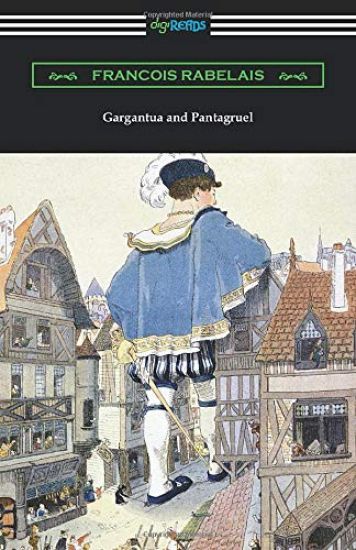
An elaborate parody written by the French Renaissance humanist, writer, Greek scholar, and physician Francois Rabelais, "Gargantua and Pantagruel" is a comic blend of energetic realism and carnival fantasy. First published in1532, "Gargantua and Pantagruel" relates the fantastical tales of its titular characters, Gargantua, a giant who becomes a sophisticated and cultured Christian knight, and his son Pantagruel, also a giant, who grows into a learned philosopher similar to Socrates. Many different types of people are satirized during their chivalric exploits, from lawyers to theologians, generals to monarchs, with humor that is often grotesque and was considered obscene when it first appeared. Intertwined with this crude comedy, however, is the wisdom of Renaissance learning, which exposes countless examples of human foolishness. Comprised of five books, the first tells the story of Gargantua and the second through fifth relate that of his son, Pantagruel. Rabelais's knowledge of Greek inspired him to invent hundreds of new words, many of which became part of the French language in this entertaining, irreverent, clever, and timeless masterpiece. This edition is printed on premium acid-free paper.

Catalogue de la Bibliothèque de l'Abbaye de Saint-Victor Au Xvie Siècle
François Rabelais
Hachette Livre - BNF
2020
pokkari
This work has been selected by scholars as being culturally important, and is part of the knowledge base of civilization as we know it. This work was reproduced from the original artifact, and remains as true to the original work as possible. Therefore, you will see the original copyright references, library stamps (as most of these works have been housed in our most important libraries around the world), and other notations in the work. This work is in the public domain in the United States of America, and possibly other nations. Within the United States, you may freely copy and distribute this work, as no entity (individual or corporate) has a copyright on the body of the work. As a reproduction of a historical artifact, this work may contain missing or blurred pages, poor pictures, errant marks, etc. Scholars believe, and we concur, that this work is important enough to be preserved, reproduced, and made generally available to the public. We appreciate your support of the preservation process, and thank you for being an important part of keeping this knowledge alive and relevant.
After the success of Pantagruel, Rabelais revisited and revised his source material, producing an improved narrative of the life and deeds of Pantagruel's father: The Very Horrific Life of Great Gargantua, Father of Pantagruel, commonly known as Gargantua. The narrative begins with Gargantua's birth and childhood. He impresses his father with his intelligence, and is entrusted to a tutor. This education renders him a great fool, and he is later sent to Paris with a new tutor. After Gargantua's reeducation, the narrator turns to some bakers from a neighbouring land who are transporting some fouaces. Some shepherds politely ask these bakers to sell them some of the said fouaces, which request escalates into war. Gargantua is summoned, while Grandgousier seeks peace. The enemy king is not interested in peace, so Grandgousier reluctantly prepares for violence. Gargantua leads a well-orchestrated assault, and defeats the enemy.
The inestimable life of the great Gargantua, father of Pantagruel
François Rabelais
Hansebooks
2019
pokkari
The Works of Rabelais
François Rabelais; Rupert Costo; Jeannette Henry Costo
Creative Media Partners, LLC
2019
sidottu
Works of Francois Rabelais / translated by Sir Thomas Urquhart and Peter Motteux
Francois Rabelais
Hansebooks
2019
pokkari
Works of Francois Rabelais / translated by Sir Thomas Urquhart and Peter Motteux - With the notes of Duchat, Ozell, and others; introd. and revision by Alfred Wallis. Book IV is an unchanged, high-quality reprint of the original edition of 1897. Hansebooks is editor of the literature on different topic areas such as research and science, travel and expeditions, cooking and nutrition, medicine, and other genres. As a publisher we focus on the preservation of historical literature. Many works of historical writers and scientists are available today as antiques only. Hansebooks newly publishes these books and contributes to the preservation of literature which has become rare and historical knowledge for the future.
With his birth itself a monumental exploit in itself, it is clear that the giant Pantagruel is destined to great things, and the novel that bears his name chronicles his the remarkable life of the exuberant youth: from his voracious reading habits to his escapades with the knave Panurge and his prowess in battle. The second work in this volume deals with the history of his father Gargantua, whose biography is equally if not more outlandish and larger than life. But these bawdy and boisterous tales, with their fixation on food and faeces, are not just entertaining yarns, as François Rabelais, one of the foremost humanists of the sixteenth century, parodies medieval learning, lambasts the established church authority and develops his own ideal visions for the ordering of society.