Kirjojen hintavertailu – 12 903 725 kirjaa ja 27 kauppaa
Kirjailija
Frank A. Thomas
Kirjat ja teokset yhdessä paikassa: 9 kirjaa, julkaisuja vuosilta 2013–2022, suosituimpiin kuuluu God of the Dangerous Sermon, The. Vertaile teosten hintoja ja tarkista saatavuus suomalaisista kirjakaupoista.
Few vocations share more in common with preaching than stand-up comedy. Each profession demands attention to the speaker's bodily and facial gestures, tone and inflection, timing, and thoughtful engagement with contemporary contexts. Furthermore, both preaching and stand-up arise out of creative tension with homiletic or comedic traditions, respectively. Every time the preacher steps into the pulpit or the comedian steps onto the stage, they must measure their words and gestures against their audience's expectations and assumptions. They participate in a kind of dance that is at once choreographed and open to improvisation. It is these and similar commonalities between preaching and stand-up comedy that this book engages. Stand-Up Preaching does not aim to help preachers tell better jokes. The focus of this book is far more expansive. Given the recent popularity of comedy specials, preachers have greater access to a broad array of emerging comics who showcase fresh comedic styles and variations on comedic traditions. Coupled with the perennial Def Comedy Jams on HBO, preachers also have ready access to the work of classic comics who have exhibited great storytelling and stage presence. This book will offer readers tools to discern what is homiletically significant in historical and contemporary stand-up routines, equipping them with fresh ways to riff off of their respective preaching traditions, and nuanced ways to engage issues of contemporary sociopolitical importance.
Every sermon has a theology, and a god of that theology behind it. Preaching is more effective, and has more integrity when preachers understand the god behind their theology. Specifically, whether the god is a universal God, like the one expressed by Christ and the Christian faith, or a tribal god, which is sometimes dressed up to resemble Christianity but is something else entirely. Frank A. Thomas culminates his exploration of the Dangerous Sermon with this book, which leads readers through the process of identifying and understanding the gods behind theology, and their connection to preaching. The reader is equipped to discern the metaphors, symbols, and rhetorical indicators which point to the god a preacher is serving and calling others to serve.
Preachers increasingly see the need to deliver sermons that are "dangerous" in a variety of ways: the way they challenge hearers' comfort levels and challenge established powers and hierarchies. Author Frank Thomas helps readers understand those dangers--especially the forces of power and hierarchy that are so intrinsic in our everyday lives and in society as a whole. He teaches how to anticipate and navigate those forces, to open opportunities for dangerous preaching, and to mitigate negative impact on congregants, the preacher, and the preacher-congregation relationships. Surviving a Dangerous Sermon is a logical follow-up to Thomas's previous book, How to Preach a Dangerous Sermon. It equips preachers to say what must be said, in a way that it is heard, so that the sermon has a chance to do its work on human hearts, without negative consequences.
The book benefits anyone who desires an approach to preaching that gets at listeners' felt needs. What we have been taught about preaching and our chosen approach to preaching may not serve us or our listeners well. Thus, the preacher's fidelity to an ineffective approach to preaching lies at the heart of the problem. This book helps preachers resolve this issue with life-situation preaching, an approach that begins with listeners' needs. Herein readers will experience the power of life-situation preaching to address the spiritual and practical problems--challenges, struggles, and unique experiences--African-Americans face daily.
Learn to use four characteristics of "preaching with moral imagination" to proclaim freedom for all. The author describes the four characteristics using examples like Robert F. Kennedy, Dr. Martin Luther King, Jr., Prathia Hall, and the Moral Monday Movement, along with musicians and other artists of today. Moral imagination helps the hearer to see what they cannot see, to hear what they cannot hear--to inhabit the lives of others, so that they can embody Christ and true freedom for those others. This book equips and empowers preachers to transcend their basic skills and techniques, so that their proclamation of the Word causes actual turnaround in the hearts and lives of their hearers, and in their communities. "Frank Thomas has written a passionate summons: amid the current destructive chaos of our society there is an urgent need for moral imagination. Such imagination is the antithesis of "diabolic" and "idolatrous" imagination that is all to the fore in our public discourse and practice. Thomas fleshes out "moral imagination" with close reflection on the practice of Robert F. Kennedy and Martin Luther King. Before he finishes Thomas shows how the urgency of "moral imagination" belongs peculiarly to the work of the preacher. This book is a welcome call for gospel-grounded courage and truth about the neighbor issued in a way that refuses the self-serving fakery that dominates our public life." --Walter Brueggemann, Columbia Theological Seminary "Timely and prophetic, How to Preach a Dangerous Sermon presents a homiletic essential for our churches today. Thomas insists that it is up to the preacher to recapture and reclaim the moral imagination of our nation so that the Gospel's message of freedom is true for all people. With attention to specific figures whose witness models the qualities and characteristics of moral imagination, Thomas inspires the preacher toward powerful proclamation that both challenges and critiques any speech that subjugates or subordinates. How to Preach a Dangerous Sermon is must read for preachers to recover and reimagine the leadership role of the church for the sake of justice for all." --Karoline M. Lewis, Associate Professor of Biblical Preaching and the Marbury E. Anderson Chair of Biblical Preaching, Luther Seminary; author of She: Five Keys to Unlock the Power of Women in Ministry. "In this lucid and compelling book, Frank Thomas plumbs the depths of American moral rhetoric for insights that will help preachers. How to Preach a Dangerous Sermon provides new and dramatic ways in which the moral imagination in a democratic society can be nurtured by visionary, empathic, wise, and artistic preachers."--John S. McClure, Charles G. Finney Professor of Preaching and Worship, Vanderbilt Divinity School "Warning: Preachers, if you are comfortable with the status quo of white privilege, patriarchy, hetero-normativity, and classism, do not read this book. If you are comfortable with sermon series that reduce the gospel to self-help acronyms, don't read this book. But if you have the courage to look honestly at our landscape and bring the moral imagination of the Christian tradition to bear on it, open these pages and your sermons may never be the same again. But then again neither will the church--or the world--be the same anymore, if enough of us follow Thomas's advice." --O. Wesley Allen, Jr., Lois Craddock Perkins Professor of Homiletics, Perkins School of Theology, Southern Methodist University
The Introduction to African American Preaching is an important, groundbreaking book. This book acknowledges African American preaching as an academic discipline, and invites all students and preachers into a scholarly, dynamic, and useful exploration of the topic. Author Frank Thomas opens with a "bus tour" study of African American preaching. He shows how African American preaching has gradually moved from an almost exclusively oral to an oral/written tradition. Readers will gain insight into the history of the study of the African American preaching tradition, and catch the author's enthusiasm for it. Next Thomas traces the relationship between homiletics and rhetoric in Western preaching, demonstrating how African American preaching is inherently theological and rhetorical. He then explores the question, "what is black preaching?" Thomas introduces the reader to methods of "close reading" and "ideological criticism." And then demonstrates how to use these methods, using a sermon by Gardner Calvin Taylor as his example. The next chapter considers the question, "what is excellence in black preaching?" The next chapter seeks to create bridges and dialogue within the field of homiletics, and in particular, the Euro-American homiletic tradition. The goal of this chapter is to clearly demonstrate connections between the African American preaching tradition and the field of homiletics. Thomas next turns to questions about the relevancy of the church to the Millennial generation. Specifically, how will the African American church remain relevant to this generation, which is so deeply concerned with social justice?
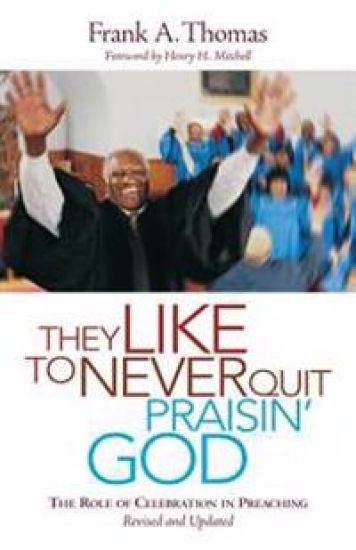
Celebration is an important component of preaching. Fifteen years, after its release, They Like to Never Quit Praising God continues to illustrate the steps that are essential to understand and experience the Gospel through celebration and praise. Through the unique lens of African American preaching, Thomas explores the theology, dynamics and guidelines for celebrative preaching.