Kirjojen hintavertailu – 12 859 818 kirjaa ja 27 kauppaa
Kirjailija
Frank Ackerman
Kirjat ja teokset yhdessä paikassa: 10 kirjaa, julkaisuja vuosilta 2004–2018, suosituimpiin kuuluu The Flawed Foundations of General Equilibrium Theory. Vertaile teosten hintoja ja tarkista saatavuus suomalaisista kirjakaupoista.
Worst-case scenarios are all too real, and all too common. The financial crisis of 2008 was not the first or the last to destroy jobs, homeownership and the savings of millions of people. Hurricanes clobber communities from New York to Bangladesh. How bad will the next catastrophe be, and how soon will it happen? Climate and financial crises are serious events, requiring vigorous responses. Yet public policy is trapped in an obsolete framework, with a simplistic focus on average or likely outcomes rather than dangerous extremes. What would it take to create better analyses of extreme events in climate and finance, and an appropriate policy framework for worst-case risks? ‘Worst-Case Economics: Extreme Events in Climate and Finance’ offers accessible and surprising answers to these crucial questions.
Worst-case scenarios are all too real, and all too common. The financial crisis of 2008 was not the first or the last to destroy jobs, homeownership and the savings of millions of people. Hurricanes clobber communities from New York to Bangladesh. How bad will the next catastrophe be, and how soon will it happen? Climate and financial crises are serious events, requiring vigorous responses. Yet public policy is trapped in an obsolete framework, with a simplistic focus on average or likely outcomes rather than dangerous extremes. What would it take to create better analyses of extreme events in climate and finance, and an appropriate policy framework for worst-case risks? ‘Worst-Case Economics: Extreme Events in Climate and Finance’ offers accessible and surprising answers to these crucial questions.
Ambitious measures to reduce carbon emissions are all too rare in reality, impeded by economic and political concerns rather than technological advances. In this timely collection of essays, Frank Ackerman and Elizabeth A. Stanton show that the impact of inaction on climate change will be far worse than the cost of ambitious climate policies.
Climate science paints a bleak picture: The continued growth of greenhouse gas emissions is increasingly likely to cause irreversible and catastrophic effects. Urgent action is needed to prepare for the initial rounds of climatic change, which are already unstoppable. While the opportunity to avert all climate damage has now passed, well-designed mitigation and adaptation policies, if adopted quickly, could still greatly reduce the likelihood of the most tragic and far-reaching impacts of climate change. Climate economics is the bridge between science and policy, translating scientific predictions about physical systems into projections about economic growth and human welfare that decision makers can most readily use but it has too often consisted of an overly technical, academic approach to the problem. Getting climate economics right is not about publishing the cleverest article of the year but rather about helping solve the dilemma of the century. The tasks ahead are daunting, and failure, unfortunately, is quite possible. Better approaches to climate economics will allow economists to be part of the solution rather than part of the problem. This book analyzes potential paths for improvement.
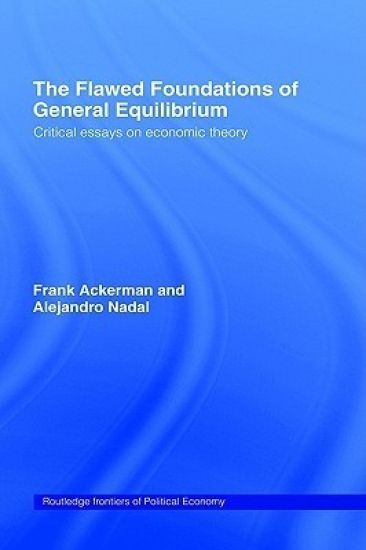
This book, as the title suggests, explains how General equilibrium, the dominant conceptual framework in mainstream economics, describes a perfectly impossible world. Even with its counterfactual assumptions taken for granted, it fails on many levels. Under the impressive editorship of Ackerman and Nadal, this book will appeal to students and researchers in economics and related social science disciplines.
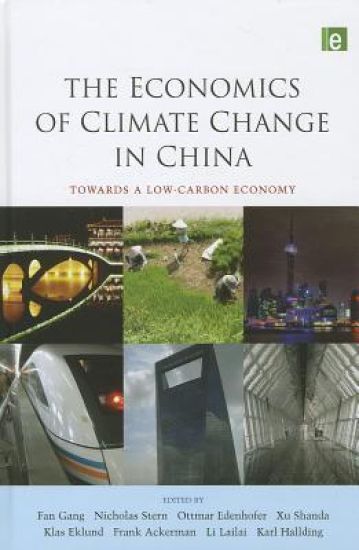
China faces many modernization challenges, but perhaps none is more pressing than that posed by climate change. China must find a new economic growth model that is simultaneously environmentally sustainable, can free it from its dependency on fossil fuels, and lift living standards for the majority of its population. But what does such a model look like? And how can China best make the transition from its present macro-economic structure to a low-carbon future? This ground-breaking economic study, led by the Stockholm Environment Institute and the Chinese Economists 50 Forum, brings together leading international thinkers in economics, climate change, and development, to tackle some of the most challenging issues relating to China's low-carbon development. This study maps out a deep carbon reduction scenario and analyzes economic policies that shift carbon use, and shows how China can take strong and decisive action to make deep reductions in carbon emission over the next forty years while maintaining high economic growth and minimizing adverse effects of a low-carbon transition. Moreover, these reductions can be achieved within the finite global carbon budget for greenhouse gas emissions, as determined by the hard constraints of climate science. The authors make the compelling case that a transition to a low-carbon economy is an essential part of China's development and modernization. Such a transformation would also present opportunities for China to improve its energy security and move its economy higher up the international value chain. They argue that even in these difficult economic times, climate change action may present more opportunities than costs. Such a transformation, for China and the rest of the world, will not be easy. But it is possible, necessary and worthwhile to pursue.
This book, as the title suggests, explains how General equilibrium, the dominant conceptual framework in mainstream economics, describes a perfectly impossible world. Even with its counterfactual assumptions taken for granted, it fails on many levels. Under the impressive editorship of Ackerman and Nadal, this book will appeal to students and researchers in economics and related social science disciplines.
Arguing that number-crunching should never replace thoughtful, democratic discussion of policy, the book also includes a particularly timely discussion of why only military expenditure is afforded the kind of moral weight the authors wish was put on other issues.