

Kirjojen hintavertailu – 12 903 725 kirjaa ja 27 kauppaa

Kirjailija

Frank Desensi

Kirjat ja teokset yhdessä paikassa: 2 kirjaa, julkaisuja vuosilta 2018–2020, suosituimpiin kuuluu Turning Around Turnaround Schools. Vertaile teosten hintoja ja tarkista saatavuus suomalaisista kirjakaupoista.

2 kirjaa

Kirjojen julkaisuvuodet: 2018–2020.

Turning Around Turnaround Schools

Turning Around Turnaround Schools

Joe Desensi; Frank Desensi

Silver Tree Publishing
2020
pokkari
In the second volume in the Turning Around Turnaround Schools series, called Embracing the Rhythm of the Learner Year, the authors explore the neuroscience of how students learn and then use those insights to recommend a powerful and proven methodology for planning the school year around student need. Teachers don't take state tests or college readiness tests -- students do. Therefore, our metric of success in K-12 education cannot be how much is taught, but rather, how much is learned. While the Rhythm of the Learner Year process is not focused on increasing test scores, it stands to reason that if we are creating independent learners who can perform at high levels and are willing to give best effort, increases on high-stakes testing should be a natural byproduct. The Learner Year teaches the reader (K-12 teachers, principals, superintendents, and other educational leaders) to consider the whole child in program design, taking into account both cognitive and noncognitive abilities and indicators. Ultimately, the authors make the case for a just-in-time approach to: -- Developing a school's culture and climate-- Unpacking standards-- Building independent learners-- Making those learners performers-- Winning hearts and minds to get best effort for assessments-- Mitigating the summer losses of content and process. The Learner Year starts with summer planning, which involves reviewing what worked this past academic year, what didn't, where the faculty were strong, and where professional development might be most useful. This all goes into the opening of school, critical to setting the culture and climate for learning. The authors write that you can't win the school year in the opening of school, but sometimes you can lose it with a bad start. In the fall, we increase a student's potential to learn and store that learning in long-term memory. In the spring, we continue the learning but equally focus on retrieving that learning and performing tasks at the level the students will ultimately be assessed. As testing rolls around, we must make sure that we have hearts and minds to get best effort, and the new school year actually starts with the last few weeks of closing the current school year. It's a continuous, thoughtful, strategic, and proven way to do exactly what the book's title suggests -- Embrace the Rhythm of the Learner Year. Like the first volume in this breakthrough book series for K-12 educators, the authors present the practice in manageable chunks and then provide checklists, tool kits, and planning protocols to help the reader put the ideas into action. This book is good for both the novice teacher or administrator looking for higher student engagement, as well as the seasoned superintendent or principal looking to redesign curricula and scheduling. This book is also a good self-study companion piece for educators attending the Ed Directions' year-long Rhythm of the Learner Year professional development series.
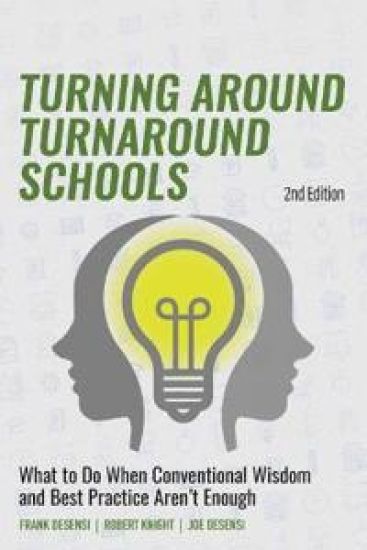
Turning Around Turnaround Schools

Turning Around Turnaround Schools

Robert Knight; Joe Desensi; Frank Desensi

Silver Tree Publishing
2018
pokkari
A Practical Guide for K-12 Schools in an Era of High-Stakes Accountability Turning Around Turnaround Schools, now in its 2nd edition, is the go-to resource for leaders working in or with turnaround schools. In a practical "what to do" format - rich with concrete examples and tools to implement at your school - this book helps schools find relevant and targeted best practices for improving student achievement in an era of high-stakes accountability. Turning Around Turnaround Schools explores the idea of "student as learner" vs. "student as performer," and helps educators to capture and use the right data. Written by a team of educators from Educational Directions, LLC, this book shares lessons learned, as well as proven strategies and processes implemented with struggling schools, both urban and rural, in several states. The book chronicles the changes in perceptions, practices, and assumptions made by these educators during their 20 years of working with "turnaround schools." The authors focus on areas that produced the greatest leverage in changing schools (e.g., identifying all the learnings and learner characteristics required by standards or developing causal data streams) and on some of the barriers that made these high leverage strategies difficult to implement (e.g., compliance cultures or entrenched programs). The book develops a new approach to the idea of intentional education, to educating the whole child, and to the process of using data to inform instruction. A major emphasis of the book is that change must be rooted in "output," not "input." Many of the early failures of conventional wisdom could be traced back to the fact that leaders were trying to change adult work, strategies, or materials without first defining the output that was expected from the students or identifying the causes of off-level performance. This 2nd edition guidebook contains assessments and toolkits that educational leaders can use - right away - to begin understanding and addressing the changes before them. The authors of Turning Around Turnaround Schools don't present their approach as a magic bullet to solve all turnaround school problems. Rather, they document how they had to address the fact that preconceived realities and assumptions limited their ability to move schools in a way that would predictably improve student performance. Their hope is that this book will stimulate a similar reevaluation in the readers so that they can come to grips with personal assumptions and deal with the barriers they will face as they come to grips and try to change practice in their schools. --- "Test scores cannot be used as the only indicator of a student's performance. Scores are a data point, and not a decision point. We must dig deeper to determine what is wrong with student work and why it breaks down. This causal analysis helps us to enable each child to maximize his or her potential." Educational Directions, LLC, (Ed Directions) is an educational consulting company providing training and leadership support for K-12 schools. Ed Directions was founded in 1998 to enable a group of retiring educators to continue working with schools struggling to improve student learning and performance. Since its establishment, the company has worked with both urban and rural schools, in several states, providing leadership development, assisting struggling schools, and collaborating with districts in developing programs and software to enhance school improvement. Learn more at www. EdDirections.com. What to Do When Conventional Wisdom and Best Practice Aren't Enough is Volume 1 in the Turning Around Turnaround Schools book series.