Kirjojen hintavertailu – 12 903 732 kirjaa ja 27 kauppaa

Kirjailija

Frank Fabozzi

Kirjat ja teokset yhdessä paikassa: 9 kirjaa, julkaisuja vuosilta 1995–2022, suosituimpiin kuuluu The Handbook of Asset/Liability Management: State-of-Art Investment Strategies, Risk Controls and Regulatory Required. Vertaile teosten hintoja ja tarkista saatavuus suomalaisista kirjakaupoista.

9 kirjaa

Kirjojen julkaisuvuodet: 1995–2022.

Fixed Income Mathematics, Fifth Edition: Analytical and Statistical Techniques

Fixed Income Mathematics, Fifth Edition: Analytical and Statistical Techniques

Frank Fabozzi; Francesco Fabozzi

McGraw-Hill Education
2022
sidottu
The standard reference for fixed income portfolio managers—fully updated with new analytical frameworks Fixed Income Mathematics is known around the world as the leading guide to understanding the concepts, valuation models for bonds with embedded option, mortgage-backed securities, asset-backed securities, and other fixed income instruments, and portfolio analytics. Fixed Income Mathematics begins with basic concepts of the mathematics of finance, then systematically builds on them to reveal state-of-the-art methodologies for evaluating them and managing fixed-income portfolios. Concepts are illustrated with numerical examples and graphs, and you need only a basic knowledge of elementary algebra to understand them. This new edition includes several entirely new chapters-Risk-Adjusted Returns, Empirical Duration, Analysis of Floating-Rate Securities, Holdings-Based Return Attribution Analysis, Returns-Based Style Attribution Analysis, Measuring Bond Liquidity, and Machine Learning-and provides substantially revised chapters on:Interest rate modelingProbability theoryOptimization models and applications to bond portfolio managementHistorical return measuresMeasuring historical return volatilityThe concepts and methodologies for managing fixed income portfolios has improved dramatically over the past 15 years. This edition explains these changes and provides the knowledge you need to value fixed-income securities and measure the various types of risks associated with individual securities and portfolios.
The Handbook of Fixed Income Securities, Ninth Edition

The Handbook of Fixed Income Securities, Ninth Edition

Frank Fabozzi; Steven Mann; Francesco Fabozzi

McGraw-Hill Education
2021
sidottu

Halvin toimitettuna 154,60 €

The definitive guide to fixed income securities-updated and revised with everything you need to succeed in today’s marketThe Handbook of Fixed Income Securities has been the most trusted resource for fixed income investing for decades, providing everything sophisticated investors need to analyze, value, and manage fixed income instruments and their derivatives. But this market has changed dramatically since the last edition was published, so the author has revised and updated his classic guide to put you ahead of the curve. With chapters written by the leading experts in their fields, The Handbook of Fixed Income Securities, Ninth Edition provides expert discussions about:Basics of Fixed Income Analytics Treasuries, Agency, Municipal, and Corporate BondsMortgage-Backed and Asset-Backed SecuritiesThe Yield Curve and the Term StructureValuation and Relative ValueCredit AnalysisPortfolio Management and StrategiesDerivative Instruments and their ApplicationsPerformance Attribution AnalysisThe Handbook of Fixed Income Securities is the most inclusive, up-to-date source available for fixed income facts and analyses. Its invaluable perspective and insights will help you enhance investment returns and avoid poor performance in the fixed income market.
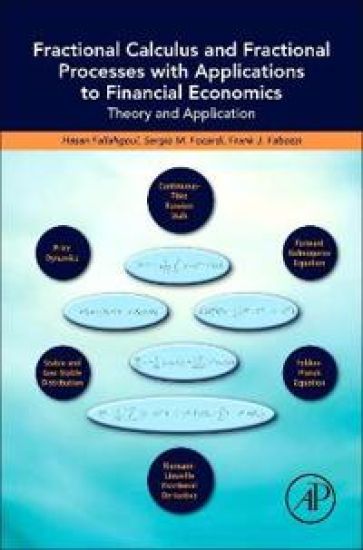
Fractional Calculus and Fractional Processes with Applications to Financial Economics

Fractional Calculus and Fractional Processes with Applications to Financial Economics

Hasan Fallahgoul; Sergio Focardi; Frank Fabozzi

Academic Press Inc
2016
sidottu
Fractional Calculus and Fractional Processes with Applications to Financial Economics presents the theory and application of fractional calculus and fractional processes to financial data. Fractional calculus dates back to 1695 when Gottfried Wilhelm Leibniz first suggested the possibility of fractional derivatives. Research on fractional calculus started in full earnest in the second half of the twentieth century. The fractional paradigm applies not only to calculus, but also to stochastic processes, used in many applications in financial economics such as modelling volatility, interest rates, and modelling high-frequency data. The key features of fractional processes that make them interesting are long-range memory, path-dependence, non-Markovian properties, self-similarity, fractal paths, and anomalous diffusion behaviour. In this book, the authors discuss how fractional calculus and fractional processes are used in financial modelling and finance economic theory. It provides a practical guide that can be useful for students, researchers, and quantitative asset and risk managers interested in applying fractional calculus and fractional processes to asset pricing, financial time-series analysis, stochastic volatility modelling, and portfolio optimization.
The Methods of Distances in the Theory of Probability and Statistics

The Methods of Distances in the Theory of Probability and Statistics

Svetlozar T. Rachev; Lev Klebanov; Stoyan V. Stoyanov; Frank Fabozzi

Springer-Verlag New York Inc.
2015
nidottu
This book covers the method of metric distances and its application in probability theory and other fields. The method is fundamental in the study of limit theorems and generally in assessing the quality of approximations to a given probabilistic model. The method of metric distances is developed to study stability problems and reduces to the selection of an ideal or the most appropriate metric for the problem under consideration and a comparison of probability metrics. After describing the basic structure of probability metrics and providing an analysis of the topologies in the space of probability measures generated by different types of probability metrics, the authors study stability problems by providing a characterization of the ideal metrics for a given problem and investigating the main relationships between different types of probability metrics. The presentation is provided in a general form, although specific cases are considered as they arise in the process of finding supplementary bounds or in applications to important special cases. Svetlozar T. Rachev is the Frey Family Foundation Chair of Quantitative Finance, Department of Applied Mathematics and Statistics, SUNY-Stony Brook and Chief Scientist of Finanlytica, USA. Lev B. Klebanov is a Professor in the Department of Probability and Mathematical Statistics, Charles University, Prague, Czech Republic. Stoyan V. Stoyanov is a Professor at EDHEC Business School and Head of Research, EDHEC-Risk Institute—Asia (Singapore). Frank J. Fabozzi is a Professor at EDHEC Business School. (USA)
The Methods of Distances in the Theory of Probability and Statistics

The Methods of Distances in the Theory of Probability and Statistics

Svetlozar T. Rachev; Lev Klebanov; Stoyan V. Stoyanov; Frank Fabozzi

Springer-Verlag New York Inc.
2013
sidottu
This book covers the method of metric distances and its application in probability theory and other fields. The method is fundamental in the study of limit theorems and generally in assessing the quality of approximations to a given probabilistic model. The method of metric distances is developed to study stability problems and reduces to the selection of an ideal or the most appropriate metric for the problem under consideration and a comparison of probability metrics. After describing the basic structure of probability metrics and providing an analysis of the topologies in the space of probability measures generated by different types of probability metrics, the authors study stability problems by providing a characterization of the ideal metrics for a given problem and investigating the main relationships between different types of probability metrics. The presentation is provided in a general form, although specific cases are considered as they arise in the process of finding supplementary bounds or in applications to important special cases. Svetlozar T. Rachev is the Frey Family Foundation Chair of Quantitative Finance, Department of Applied Mathematics and Statistics, SUNY-Stony Brook and Chief Scientist of Finanlytica, USA. Lev B. Klebanov is a Professor in the Department of Probability and Mathematical Statistics, Charles University, Prague, Czech Republic. Stoyan V. Stoyanov is a Professor at EDHEC Business School and Head of Research, EDHEC-Risk Institute—Asia (Singapore). Frank J. Fabozzi is a Professor at EDHEC Business School. (USA)
The Handbook of Fixed Income Securities, Eighth Edition

The Handbook of Fixed Income Securities, Eighth Edition

Frank Fabozzi; Mann Steven

McGraw-Hill Professional
2012
sidottu
The Definitive Guide to Fixed Income Securities—Revised and Updated for the New Era of InvestingFor decades, The Handbook of Fixed Income Securities has been the most trusted resource in the world for fixed income investing. Since the publication of the last edition, however, the financial markets have experienced major upheavals, introducing dramatic new opportunities and risks. This completely revised and expanded eighth edition contains 31 new chapters that bring you up to date on the latest products, analytical tools, methodologies, and strategies for identifying and capitalizing on the potential of the fixed income securities market in order to enhance returns. Among the world’s leading authorities on the subject, Frank J. Fabozzi, along with Steven V. Mann, has gathered a powerful global team of leading experts to provide you with the newest and best techniques for taking advantage of this market. New topics include:Electronic tradingMacro-economic dynamics and the corporate bond marketLeveraged loansStructured and credit-linked notesExchange-traded fundsCovered bondsCollateralized loan obligationsRisk analysis from multifactor fixed income modelsHigh-yield bond portfolio managementDistressed structured credit securitiesHedge fund fixed income strategiesCredit derivatives valuation and riskTail risk hedgingPrinciples of performance attributionInvaluable for its theoretical insights, unsurpassed in its hands-on guidance, and unequaled in the expertise and authority of its contributors, this all-new edition of The Handbook of Fixed Income Securities delivers the information and knowledge you need to stay on top of the market and ahead of the curve.
The Handbook of Mortgage-Backed Securities

The Handbook of Mortgage-Backed Securities

Frank Fabozzi

McGraw-Hill Professional
2006
sidottu
The definitive MBS guide, with fully updated material on the latest mortgage-backed products, methods, models, and portfolio strategies By providing hands-on information vital to market participants, previous editions of The Handbook of Mortgage-Backed Securities were instrumental in fueling the growth of the mortgage-backed securities market. The sixth edition contains all the elements that made previous editions so successful and influential, and provides you with more than 25 new chapters on topics including collateralized mortgage obligations, prepayment derivatives, loan level determinants of repayments, new approaches to MBS valuation, and a survey of non-U. S. mortgage rates.
The Handbook of Asset/Liability Management: State-of-Art Investment Strategies, Risk Controls and Regulatory Required
This edition assembles an all new team of investment experts to provide state-of-the-art strategies, which confront the new investment opportunities, risk controls and regulatory requirements in the ever-evolving financial markets. A definitive tool to keep the balance sheet in line and market risk under control. Financial managers, investors and bankers will find expert strategies on: balancing interest rate volatility, profitability and capital requirements; measuring and managing market and credit risk; developing and implementing liability and funding strategies; using interest rate control tools (futures, options, swaps, caps and floors); building a customized asset/liability model.