Kirjojen hintavertailu – 12 903 724 kirjaa ja 27 kauppaa

Kirjailija

Frank Fischer

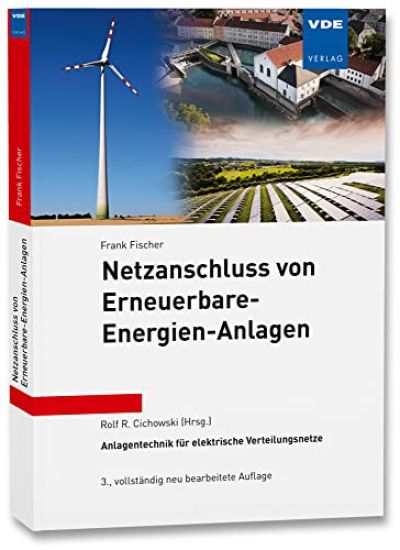
Kirjat ja teokset yhdessä paikassa: 23 kirjaa, julkaisuja vuosilta 1993–2025, suosituimpiin kuuluu Netzanschluss von Erneuerbare-Energien-Anlagen. Vertaile teosten hintoja ja tarkista saatavuus suomalaisista kirjakaupoista.

23 kirjaa

Kirjojen julkaisuvuodet: 1993–2025.

Critical Policy Inquiry

Critical Policy Inquiry

Frank Fischer

EDWARD ELGAR PUBLISHING LTD
2025
nidottu
Presenting a critical approach to the study of public policy and policy analysis, this book offers a postpositivist foundation that challenges empiricist and technocratic approaches to policy studies. Critical Policy Inquiry draws on Jürgen Habermas’s work on communicative action and deliberation, Michel Foucault’s writings on discourse, and the epistemics of social constructivism. Frank Fischer advances deliberative policy argumentation and the logic of practical reason, exploring how this can be used as a framework for interpreting the interaction of normative and empirical arguments in policy politics. He applies this approach to a diverse range of topics, including technocracy, policy expertise, deliberative democratic politics, interpretive policy analysis, post-truth, climate and Covid denialism, participatory governance, local and tacit knowledge, and the role of emotion in policy controversies. The book concludes with a look to transformative policy learning and the future of the field. Connecting social and political theory with empirical research, this book is essential for students and scholars of public policy, politics, governance, public administration, and regulatory policy. Its practical, real-world applications will also be of value to policymakers worldwide.

Critical Policy Inquiry

Critical Policy Inquiry

Frank Fischer

EDWARD ELGAR PUBLISHING LTD
2024
sidottu
Presenting a critical approach to the study of public policy and policy analysis, this book offers a postpositivist foundation that challenges empiricist and technocratic approaches to policy studies. Critical Policy Inquiry draws on Jürgen Habermas’s work on communicative action and deliberation, Michel Foucault’s writings on discourse, and the epistemics of social constructivism. Frank Fischer advances deliberative policy argumentation and the logic of practical reason, exploring how this can be used as a framework for interpreting the interaction of normative and empirical arguments in policy politics. He applies this approach to a diverse range of topics, including technocracy, policy expertise, deliberative democratic politics, interpretive policy analysis, post-truth, climate and Covid denialism, participatory governance, local and tacit knowledge, and the role of emotion in policy controversies. The book concludes with a look to transformative policy learning and the future of the field. Connecting social and political theory with empirical research, this book is essential for students and scholars of public policy, politics, governance, public administration, and regulatory policy. Its practical, real-world applications will also be of value to policymakers worldwide.
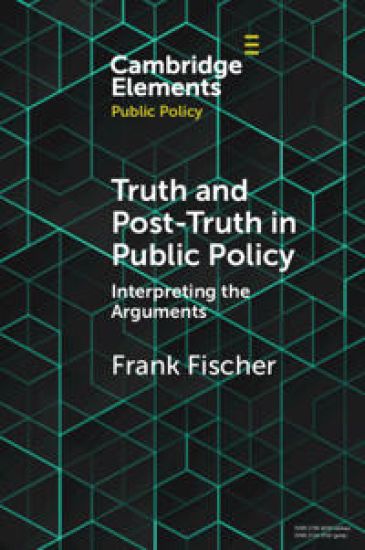
Truth and Post-Truth in Public Policy

Truth and Post-Truth in Public Policy

Frank Fischer

Cambridge University Press
2021
pokkari
The phenomenon of post-truth poses a problem for the public policy-oriented sciences, including policy analysis. Along with “fake news,” the post-truth denial of facts constitutes a major concern for numerous policy fields. Whereas a standard response is to call for more and better factual information, this Element shows that the effort to understand this phenomenon has to go beyond the emphasis on facts to include an understanding of the social meanings that get attached to facts in the political world of public policy. The challenge is thus seen to be as much about a politics of meaning as it is about epistemology. The analysis here supplements the examination of facts with an interpretive policy-analytic approach to gain a fuller understanding of post-truth. The importance of the interpretive perspective is illustrated by examining the policy arguments that have shaped policy controversies related to climate change and coronavirus denial.
Politics, Values, And Public Policy
Addressed to the growing concerns about norms and values in policy assessment, this study develops a methodology for the political evaluation of public policy. It is designed to move policy evaluation beyond its current emphasis on efficient achievement of goals, focusing instead on the assessment of the acceptability of the goals themselves, emplo
Politics, Values, And Public Policy
Addressed to the growing concerns about norms and values in policy assessment, this study develops a methodology for the political evaluation of public policy. It is designed to move policy evaluation beyond its current emphasis on efficient achievement of goals, focusing instead on the assessment of the acceptability of the goals themselves.
Climate Crisis and the Democratic Prospect

Climate Crisis and the Democratic Prospect

Frank Fischer

Oxford University Press
2017
nidottu
Can contemporary democratic governments tackle climate crisis? Some argue that democracy has to be a central part of a strategy to deal with climate change. Others argue that experience shows it not to be up to the challenge in the time frame available-that it will require a stronger hand, even a form of eco-authoritarianism. A question that does not lend itself to an easy assessment, this volume seeks to out and assess the competing answers. While the book supports the case for environmental democracy, it argues that establishing and sustaining democratic practices will be difficult during the global climate turmoil ahead, especially in the face of state of emergencies. This inquiry undertakes a search for an appropriate political-ecological strategy for preserving a measure of democratic governance during hard times. Without ignoring the global dimensions of the crisis, the analysis finds an alternative path in the theory and practices participatory environmental governance embodied in a growing relocalization movement, and global eco-localism generally. Although such movements largely operate under the radar of the social sciences, the media and the political realm generally, these vibrant socio-ecological movements not only speak to the crisis ahead, but are already well established and thriving on the ground, including ecovillages, eco-communes, eco-neighborhoods, and local transition initiatives. With the help of these ideas and projects, the task is to influence the discourse of environmental political theory in ways that can be of assistance to those who will face climate crisis in its full magnitude.
Climate Crisis and the Democratic Prospect

Climate Crisis and the Democratic Prospect

Frank Fischer

Oxford University Press
2017
sidottu
Can contemporary democratic governments tackle climate crisis? Some argue that democracy has to be a central part of a strategy to deal with climate change. Others argue that experience shows it not to be up to the challenge in the time frame available-that it will require a stronger hand, even a form of eco-authoritarianism. A question that does not lend itself to an easy assessment, this volume seeks to out and assess the competing answers. While the book supports the case for environmental democracy, it argues that establishing and sustaining democratic practices will be difficult during the global climate turmoil ahead, especially in the face of state of emergencies. This inquiry undertakes a search for an appropriate political-ecological strategy for preserving a measure of democratic governance during hard times. Without ignoring the global dimensions of the crisis, the analysis finds an alternative path in the theory and practices participatory environmental governance embodied in a growing relocalization movement, and global eco-localism generally. Although such movements largely operate under the radar of the social sciences, the media and the political realm generally, these vibrant socio-ecological movements not only speak to the crisis ahead, but are already well established and thriving on the ground, including ecovillages, eco-communes, eco-neighborhoods, and local transition initiatives. With the help of these ideas and projects, the task is to influence the discourse of environmental political theory in ways that can be of assistance to those who will face climate crisis in its full magnitude.
Grand Challenges in Technology Enhanced Learning

Grand Challenges in Technology Enhanced Learning

Frank Fischer; Fridolin Wild; Rosamund Sutherland; Lena Zirn

Springer International Publishing AG
2013
nidottu
This book presents a key piece of the vision and strategy developed in STELLAR. It sets out a new mid-term agenda by defining Grand Challenges for research and development in technology-enhanced learning. Other than mere technology prizes, STELLAR Grand Challenges deal with problems at the interface of social and technical sciences. They pose problems that can be solved only in interdisciplinary collaboration. The descriptions of the Grand Challenge Problems were sent out to a number of stakeholders from industry, academia, and policy-making who responded with insightful, creative and critical comments bringing in their specific perspectives. This book will inspire everyone interested in TEL and its neighboring disciplines in their future projects. All of the listed problems, first hints with respect to the approach, measurable success indicators and funding sources are outlined. The challenges focus on what noted experts regard as important upcoming, pending, and innovative fields of research, the solution of which is within reach in a timeframe of a mere 2 to 15 years of work.
Democracy and Expertise

Democracy and Expertise

Frank Fischer

Oxford University Press
2009
sidottu
This book examines the role of policy expertise in a democratic society. From the perspectives of both political theory and policy studies, the chapters explore the implications of deliberative democratic governance for professional expertise and extends them to specific policy practices. Following the lead of John Dewey, the discussion focuses in particular on the ways professional practices might be reoriented to assist citizens in understanding and discussing the complex policy issues of an advanced technological society. In doing so, it also explores how public deliberation can be improved through more cooperative forms of policy inquiry. Adopting a deliberative-analytic approach , policy inquiry is grounded in a postempiricist, constructivist understanding of inquiry and knowledge and the participatory practices that support it. Toward this end, the chapters draw on thriving theoretical and practical work dedicated to revitalizing the citizen's role in both civil society and newer practices of democratic governance, in particular deliberative democracy in political theory, practical work with deliberative experiments, the theory and practices of democratic governance, and participatory research. Deliberative practices are promoted here as a new component part of policy-related disciplines required for participatory governance. Calling for a specialization of "policy epistemics" to advance such practices, the second half of the book takes up issues related to deliberative empowerment, including the relation of technical and social knowledge, the interpretive dimensions of social meaning and multiple realities, the role of narrative knowledge and storylines policy inquiry, social learning, tacit knowledge, the design of discursive spaces, and the place of emotional expression in public deliberation.
Democracy and Expertise

Democracy and Expertise

Frank Fischer

Oxford University Press
2009
nidottu
This book explores the role of policy expertise in a democratic society. From the perspectives of political science and policy theory, the chapters examine the implications of deliberative democratic governance for professional expertise and extends them to specific policy practices. Following the earlier lead of John Dewey, the discussion focuses in particular on the ways professional practices might be reoriented to assist citizens in understanding and discussing the complex policy issues of an advanced technological society. In doing so, it also explores how public deliberation can be improved through more cooperative forms of policy inquiry. Adopting a deliberative-analytic approach to policy inquiry, grounded in a postempiricist, constructivist understanding of inquiry and knowledge and the participatory practices that support such an approach, the chapters draw on thriving theoretical and practical work dedicated to revitalizing the citizen's role in both civil society and newer practices of democratic governance-in particular deliberative democracy, practical work with deliberative experiments, the theory and practices of democratic governance, and participatory research. Deliberative practices are promoted here as a new component part of policy-related disciplines required for participatory governance. Calling for a specialization of "policy epistemics" to advance such practices, the second half of the book takes up issues related to deliberative empowerment, including the relation of technical and social knowledge, the interpretive dimensions of social meaning and multiple realities, the role of narrative knowledge and storylines, policy inquiry, social learning, tacit knowledge, the design of discursive spaces, and the place of emotional expression in public deliberation.
MARIE. Roman.

MARIE. Roman.

Frank Fischer

Books on Demand Gmbh
2007
nidottu
Marie flüchtet Hals über Kopf aus einer katastrophalen Beziehung. In einer süddeutschen Studentenstadt verliebt sie sich und alles dreht wieder von vorne: die Zeit im Zürcher Hotel, die Jahre an der Goldküste und der Ausbruch ins Tessin. Die Geschichte einer befreienden Begegnung aus einem verstrickten Leben.
Reframing Public Policy

Reframing Public Policy

Frank Fischer

Oxford University Press
2003
sidottu
New approaches to public policy, drawing on discursive analysis and participatory deliberative practices, have come to challenge the dominant technocratic, empiricist models in policy analysis. In his major new book Frank Fischer examines approaches.
Reframing Public Policy

Reframing Public Policy

Frank Fischer

Oxford University Press
2003
nidottu
In recent years a set of radical new approaches to public policy has been developing. Frank Fischer brings together this new work and critically examines it. He describes the theoretical, methodological and political requirements and implications of this "post-empiricist" approach to public policy.
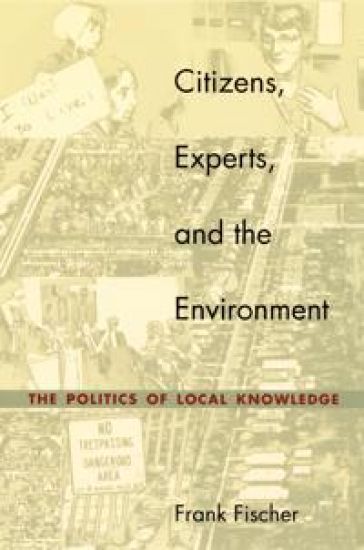
Citizens, Experts, and the Environment

Citizens, Experts, and the Environment

Frank Fischer

Duke University Press
2000
pokkari
The tension between professional expertise and democratic governance has become increasingly significant in Western politics. Environmental politics in particular is a hotbed for citizens who actively challenge the imposition of expert theories that ignore forms of local knowledge that can help to relate technical facts to social values. Where information ideologues see the modern increase in information as capable of making everyone smarter, others see the emergence of a society divided between those with and those without knowledge. Suggesting realistic strategies to bridge this divide, Fischer calls for meaningful nonexpert involvement in policymaking and shows how the deliberations of ordinary citizens can help solve complex social and environmental problems by contributing local contextual knowledge to the professionals’ expertise. While incorporating theoretical critiques of positivism and methodology, he also offers hard evidence to demonstrate that the ordinary citizen is capable of a great deal more participation than is generally recognized. Popular epidemiology in the United States, the Danish consensus conference, and participatory resource mapping in India serve as examples of the type of inquiry he proposes, showing how the local knowledge of citizens is invaluable to policy formation. In his conclusion Fischer examines the implications of the approach for participatory democracy and the democratization of contemporary deliberative structures. This study will interest political scientists, public policy practitioners, sociologists, scientists, environmentalists, political activists, urban planners, and public administrators along with those interested in understanding the relationship between democracy and science in a modern technological society.
Citizens, Experts, and the Environment

Citizens, Experts, and the Environment

Frank Fischer

Duke University Press
2000
sidottu
The tension between professional expertise and democratic governance has become increasingly significant in Western politics. Environmental politics in particular is a hotbed for citizens who actively challenge the imposition of expert theories that ignore forms of local knowledge that can help to relate technical facts to social values. Where information ideologues see the modern increase in information as capable of making everyone smarter, others see the emergence of a society divided between those with and those without knowledge. Suggesting realistic strategies to bridge this divide, Fischer calls for meaningful nonexpert involvement in policymaking and shows how the deliberations of ordinary citizens can help solve complex social and environmental problems by contributing local contextual knowledge to the professionals’ expertise. While incorporating theoretical critiques of positivism and methodology, he also offers hard evidence to demonstrate that the ordinary citizen is capable of a great deal more participation than is generally recognized. Popular epidemiology in the United States, the Danish consensus conference, and participatory resource mapping in India serve as examples of the type of inquiry he proposes, showing how the local knowledge of citizens is invaluable to policy formation. In his conclusion Fischer examines the implications of the approach for participatory democracy and the democratization of contemporary deliberative structures. This study will interest political scientists, public policy practitioners, sociologists, scientists, environmentalists, political activists, urban planners, and public administrators along with those interested in understanding the relationship between democracy and science in a modern technological society.