
Kirjojen hintavertailu – 12 903 725 kirjaa ja 27 kauppaa

Kirjailija

Frank Greenaway

Kirjat ja teokset yhdessä paikassa: 2 kirjaa, julkaisuja vuosilta 1986–2006, suosituimpiin kuuluu Science in the Early Roman Empire. Vertaile teosten hintoja ja tarkista saatavuus suomalaisista kirjakaupoista.

2 kirjaa

Kirjojen julkaisuvuodet: 1986–2006.

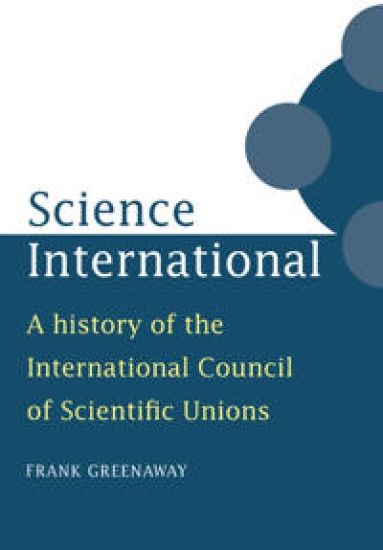
Science International

Science International

Frank Greenaway

Cambridge University Press
2006
pokkari
Science International is the history of a worldwide organization of scientists, now involving thousands of participants, which was started a century ago when a few visionaries founded the International Association of Academies (1899–1919). This was succeeded by an International Research Council, which, in 1932, became the International Council of Scientific Unions (ICSU). The initiative to have an international arena for scientists survived two global wars, as well as immense economic and social change in the twentieth century. This history describes how national academies and international unions of scientists from specific disciplines learned to work together, and shows how from these alliances sprang great co-operative projects such as the International Geophysical Year and the International Biological Programme, as well as the creation of a global scientific organization directed to the study of the entire planet and prospects for the human race.

Science in the Early Roman Empire

Science in the Early Roman Empire

Roger French; Frank Greenaway

Barnes Noble Books-Imports, Div of Rowman Littlefield Pubs., Inc
1986
sidottu
The studies collected in this book represent the newest research being done on this important and difficult figure. If Rome is not always regarded as the most natural home for the scientific spiritóthat seeming rather to characterize Greeceóparticular problems are raised by the effort Pliny had to make to transfer his Greek sources into a Roman form and context. The papers seek to locate Pliny in his social and intellectual milieu, to survey his approach to particular sciences such as astronomy, mineralogy, botany and pharmacopoeia. Two papers consider the response to his work in the Renaissance.